We’ve all felt it — that strange pull towards a time we never knew. Perhaps you’ve found yourself teary-eyed over photographs of a family you never met, or felt an inexplicable longing when listening to music from decades before you were born. But why does this happen? Why do we grieve for losses we never experienced?
The Psychology Behind Anemoia
At its core, anemoia stems from our deeply human need for narrative continuity. From the moment we’re born, we begin constructing our life story — but that story feels incomplete. We instinctively want to belong to something larger than our own brief existence. When we encounter the remnants of past eras — their aesthetics, their music, their vibe — something fascinating happens in our brains. We imagine ourselves into those times. We fill in the gaps with our own romantic visions, creating idealised versions of the past that feel both familiar and impossibly distant.
The Mystery Factor
One reason anemoia feels so powerful is the mystery. We can’t actually experience the times we long for, so our minds fill the void with imagination. Without the mundane realities of daily life in those eras — the hardships, the tedium, the limitations — we free to envision them as somehow purer, simpler, more authentic.
This idealisation isn’t necessarily false — it’s simply how our brains process the unreachable. The past becomes a blank canvas onto which we project our deepest longings for connection, simplicity, and meaning.
Shared Human Experience
Interestingly, anemoia is becoming increasingly common in the digital age. Social media exposes us constantly to aesthetics and moments from every era. We can easily access music, films, and photographs from any decade. This constant immersion in the visual and cultural remnants of past times creates more opportunities than ever to feel this nostalgic pull. There’s also a community aspect now. Finding others who share these feelings — who understand the ache for a time they never knew — can be deeply validating. Online spaces like Tumblr, Reddit, and various Discord communities have formed around anemoia, creating belonging around this shared experience.
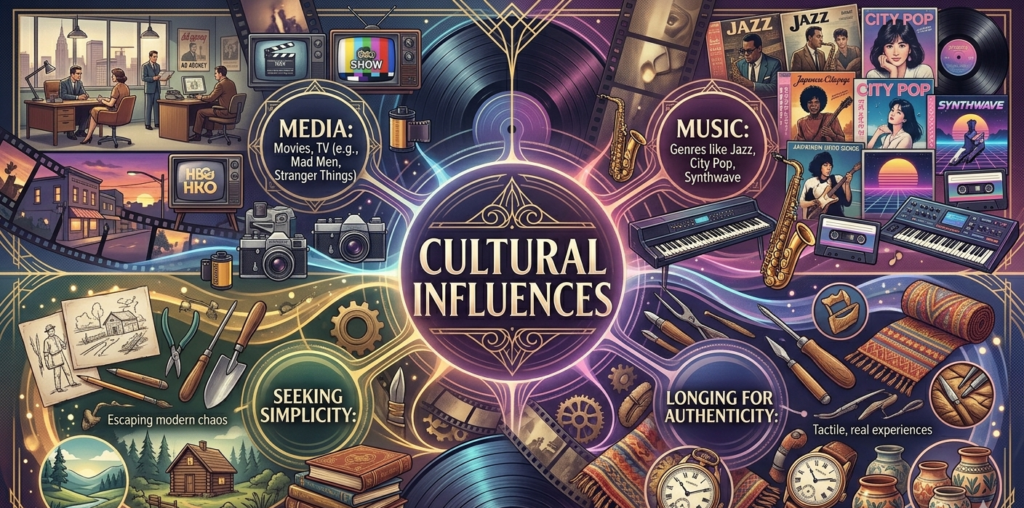
Cultural Touchstones
Several modern phenomena tap directly into anemoia:
Lo-fi music — The crackle, the warm production, the sense of calm nostalgia for study sessions we imagine from decades past
Vintage aesthetics — Cottagecore, vintage clothing, film photography — all seeking simpler times
Ambient YouTube — Videos featuring rainy windows, old bookstores, snowy streets — visual anemoia
Classic films — Movies that capture a “feeling” rather than just telling a story
Finding Peace With It
Rather than fighting anemoia, consider these approaches:
Channel it creatively — Moodboards, playlists, writing, photography — let the feeling inspire rather than burden
Connect with others — Find communities who understand. You’re not alone in this
Appreciate the present — While we long for the past, this moment too will become someone’s nostalgic memory
Embrace the mystery — There’s something beautiful in longing for the unknowable. It shows our capacity for deep feeling
The past calls to us in whispers. Maybe the point isn’t to reach it — but to let it enrich the time we’re living right now.
What eras do you find yourself longing for? Share your thoughts below.
Leave a Reply