There’s a reason certain songs make us ache for decades we never inhabited. Music has an unmatched power to transport us across time — not just to memories we hold, but to moments we’ve never lived. For those experiencing anemoia, certain sounds become portals to the unreachable past.
Sound as Time Machine
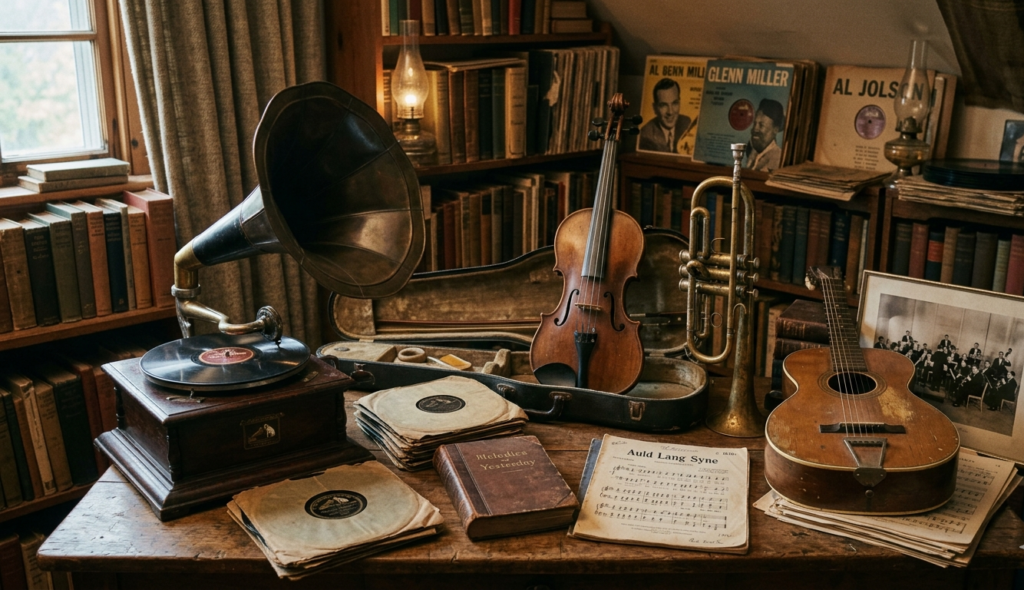
Music operates differently than visual media when it comes to anemoia. A photograph shows us what something looked like; a song lets us feel what it might have been like to exist in another time. The crackle of an old record, the warm hum of analog recording, the particular timbre of instruments from past eras — these elements create an almost physical sensation of temporal displacement.
When we hear music from before our time, something fascinating happens. We imagine ourselves into those moments: Sunday drives with the windows down, dances in grand ballrooms, late nights in smoky jazz clubs. We can’t have these experiences, but we can feel them through sound.
The Aesthetics of Nostalgic Sound
Several recording qualities immediately evoke anemoia:
Analog warmth — The slight hiss, the limited frequency range, the organic compression of vinyl and tape recordings creates a sonic texture that feels human, lived-in.
Ensemble richness — Big band orchestrations, orchestral arrangements, the fullness of pre-electronic production
Specific instrument timbres — The sound of Hammond organs, tape delays, brass sections recorded with ribbon microphones
Production quirks — The unique characteristics of different eras’ recording technology
Genres That Carry Anemoia
Some musical styles particularly lend themselves to anemoia:
Jazz — Especially 1950s cool jazz and early swing era sounds
Soul and R&B — Motown, Stax, the rich productions of the 1960s
Folk — The introspective simplicity of 1960s and 1970s folk
Bossanova — That warm Brazilian breeze, timeless and transportive
Old Hollywood scores — The grand orchestral film music of mid-century
Modern Music That Evokes the Past
Interestingly, many contemporary artists deliberately craft music to evoke anemoia:
Mac DeMarco — His lo-fi production and warm arrangements feel like forgotten 1970s recordings
Beach House — Dream pop with a nostalgic sonic palette
Khruangbin — Global influences filtered through vintage production Tame Impala — Retro sounds reimagined for modern ears
Cordell — Lo-fi rock that feels like unearthed 1960s recordings
Building an Anemoia Playlist
Creating a playlist that evokes longing for times untouchable requires thought:
Start with era-specific tracks — Begin with authentic music from your target decade
Add modern artists with vintage sensibilities — Bridge the gap with contemporary artists capturing old sounds
Consider flow — Build emotional arcs, moving between moods
Embrace repetition — The same songs become tied to the feeling over time
The Lo-Fi Connection
Perhaps no modern phenomenon better captures anemoia in music than the lo-fi movement. Those crackling samples, gentle guitar melodies, and warm production values aren’t accidents — they’re deliberate invitations into nostalgic feeling.
Lo-fi study music, in particular, creates a fantasy of past study sessions: rainy windows, old libraries, typewriter keys clicking. We’re not just listening to music; we’re imagining ourselves into a past we’re constructing in our minds.
Finding Your Sound
Everyone’s anemoia triggers differ. Some find it in 1940s swing, others in 1980s synthesizer music. The key is paying attention to which songs make you feel that particular ache — that longing for a time you can almost touch but never will.
Explore freely. Let your ears guide you backward.
What songs make you long for a time you’ve never known? Share your anemoia playlist in the comments below.
Leave a Reply