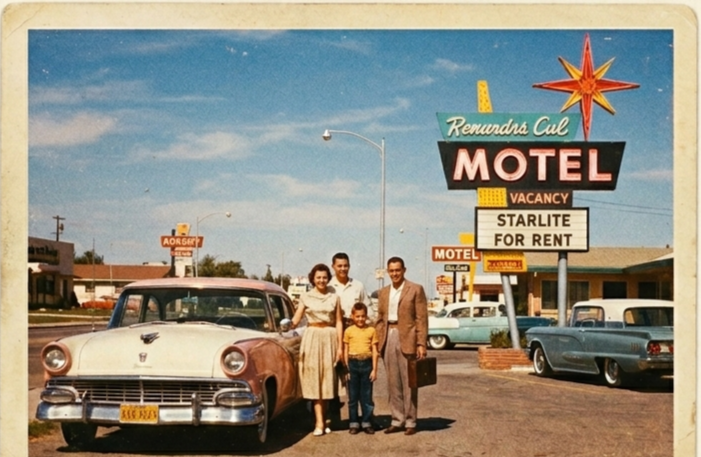
There’s a particular magic in mid-century American photography — that visual language of optimistic normalcy, sun-drenched suburbs, and the quiet dignity of everyday life. For those experiencing anemoia, these images offer a window into an era that holds an almost mythical status in our collective imagination. Let’s explore why this era captures so many hearts — and how you might capture similar feelings in your own work.
Understanding the Mid-Century Aesthetic
The mid-century period (roughly 1940s through 1960s) produced a distinctive visual style that continues to influence photography today. Several elements define this aesthetic:
Natural, golden light — Post-war America seemed perpetually bathed in warm afternoon sun, photographers favouring soft, natural illumination over artificial setups.
Composed simplicity — Every day scenes were treated with compositional care. Diner windows, parked cars, suburban streets — nothing was too mundane to deserve attention.
Optimistic colour palettes — The saturated yet warm colours of Kodachrome and similar films created images that feel hopeful, forward-looking.
The importance of the everyday — Unlike wartime photography’s drama, mid-century American photography found beauty in the ordinary: families at dinner, kids playing in the street, the local five-and-dime.
Why It Speaks to Anemoia
For those of us who never lived through these decades, these photographs offer something powerful: a glimpse of normalcy from a time we can only imagine. They show what daily life looked like, what people wore, how they spent ordinary afternoons.
We look at these images with a particular kind of wonder — not quite remembering, but deeply feeling. The familiarity of everyday moments combined with their alien distance creates that characteristic anemoia ache.
Key Photographers to Know
Dorothea Lange — Though known for Depression-era work, her post-war photography captured quiet American moments with profound humanity.
Saul Leiter — His colour photography of 1950s New York feels like looking through misted windows at a world both familiar and unreachable.
Dennis Hopper — Surprisingly, his photography captures the edge of the era, the transition into the more turbulent 1960s.
William Eggleston — His ordinary Southern landscapes created a new language of colour photography that feels deeply nostalgic.
Capturing Anemoia in Your Own Photography
You don’t need to live in the past to capture its feeling. Here’s how to bring anemoia into your work:
Choose your subjects thoughtfully — Look for the quiet moments. A parked car, an empty street, a sun-lit room. The mundane, elevated by attention.
Work with natural light — Seek out soft, warm light. Early morning and late afternoon provide that distinctive golden glow. Overcast days create similar softness.
Consider film — The grain and colour rendition of film — especially slide film and black-and-white — adds an instant sense of time. Even smartphone filters can approximate this.
Edit with restraint — Avoid over-saturation or heavy processing. The beauty of nostalgic photography lies in its subtlety.
Find the old within the new — Modern equivalents of mid-century subjects still exist: classic car shows, preserved historical neighbourhoods, vintage diners.
Building Your Own Collection
If you’re drawn to this era, start collecting:
- Photobooks from the period
- Postcards and vintage prints
- Films set in these decades
- Music from the era
The past speaks through the lens — if we learn to listen.
What draws you to mid-century photography? Share your favourite images and photographers below.
Leave a Reply