

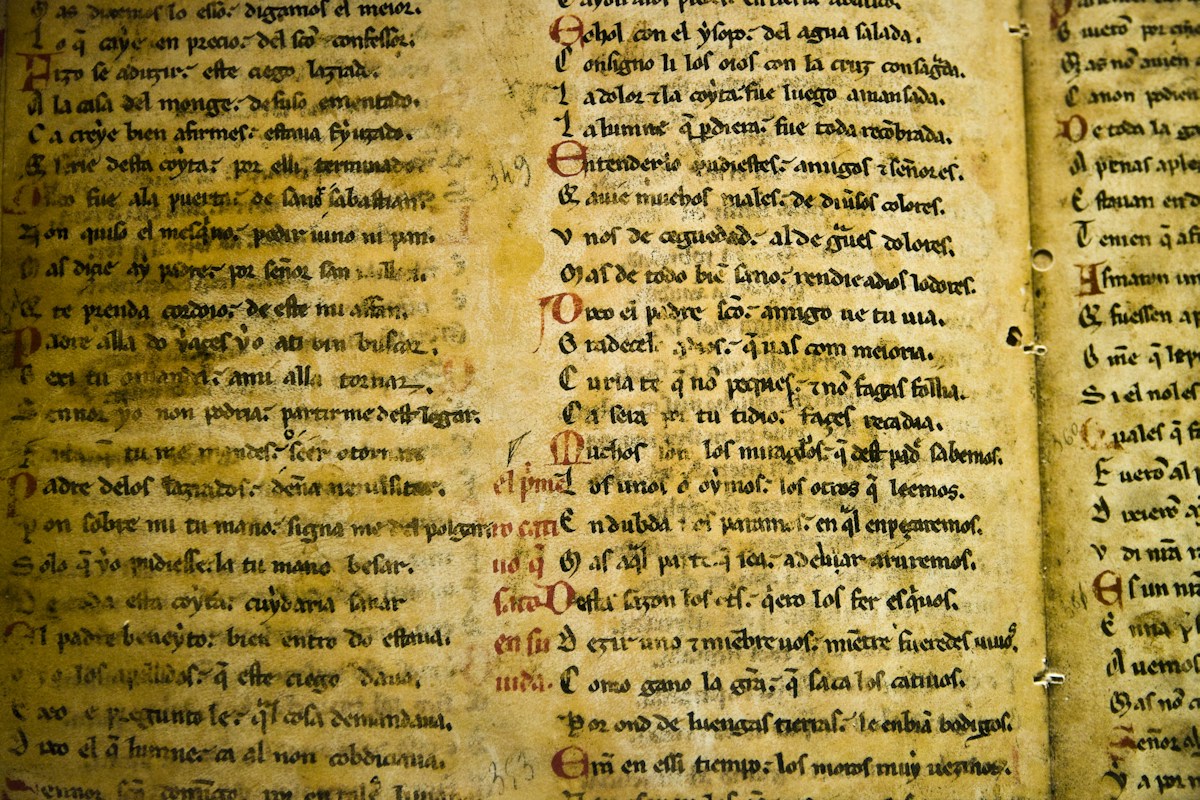
Step inside the shadowed cloisters of an eighth-century Benedictine abbey perched above the mist-shrouded valleys of Northumbria or the rugged cliffs of Burgundy, and you enter a world of absolute, reverent silence broken only by the faint scraping of steel knives against scraped calfskin and the rhythmic rasp of goose quills dipped in iron gall ink. Here, within the unheated, high-vaulted stone confines of the monastic scriptorium, a handful of devoted scribes, rubricators, and master illuminators waged a silent, generational campaign against the slow erasure of human civilization. In an era marked by geopolitical fragmentation, Viking coastal raids, and the catastrophic collapse of Roman administrative literacy, the medieval scriptorium served as the sacred fortress of Western cultural memory.
Every single illuminated codex produced within these monastery walls was an astonishing convergence of animal husbandry, metallurgical alchemy, mineral geology, complex page geometry, and transcendent artistic devotion. A single Bible or liturgical Gospel book might consume the skins of hundreds of calves, require pigments ground from lapis lazuli mined in the Hindu Kush mountains of Afghanistan, utilize real gold leaf beaten down to fractions of a micron, and demand years of eye-straining, backbreaking physical labor from an artisan working by northern daylight. To write a manuscript was not merely to record words; it was an act of liturgical prayer, spiritual penance, and physical endurance.
In this authoritative historical, codicological, and material science treatise, we explore the extraordinary world of the medieval monastic scriptorium. We trace the transformation of raw animal hides into luminous uterine vellum, examine the chemistry of iron gall inks and rare mineral pigments, dissect the geometric layout systems governing Carolingian minuscule and gothic textura, investigate the monastic preservation of classical pagan philosophy, analyze masterpieces like the Book of Kells and Lindisfarne Gospels, and evaluate modern spectral imaging technologies that are resurrecting erased palimpsests from the medieval shadows.
1. The Rule of Saint Benedict and the Holy Duty of the Quill
The philosophical foundation of the medieval monastic scriptorium was established in the sixth century by Saint Benedict of Nursia through his foundational monastic rule, the Regula Benedicti. Prior to Benedict, ascetic Christian monks had retreated into Egyptian deserts as solitary hermits, often viewing worldly intellectual pursuit with deep theological suspicion.
Benedict introduced a revolutionary communal balance captured in the Latin motto Ora et labora (pray and work). Within Chapter 48 of the Rule, Benedict mandated specific daily hours for manual labor and communal reading, known as lectio divina (divine reading). Because communal spiritual contemplation required physical liturgical books-bibles, psalters, patristic commentaries, and hymnals-the physical production of books was elevated from secular commercial craft to a sacred monastic duty. To copy a sacred text was understood as an act of profound spiritual warfare; as the sixth-century statesman and monk Cassiodorus declared in his monastery at Vivarium: “Every word written by the scribe is a wound inflicted upon the body of Satan.”
Under this monastic mandate, writing was integrated into the monastic vow of stability. Scribes spent decades seated at inclined wooden desks, laboring in freezing cloisters where ink froze in horn inkpots during winter months. They were forbidden from speaking; all communication was conducted through elaborate systems of hand gestures to preserve monastic silence. Scribes frequently added exhausted personal colophons at the end of manuscripts: “As the sailor longs for port, so the scribe longs for the last line,” or “Writing is excessive drudgery; it carves your back, dims your sight, twists your stomach, and racks your entire frame.”
2. Parchment and Vellum Manufacture: From Raw Hides to Smooth Membranes
Long before paper was introduced from China through Islamic Spain in the late Middle Ages, every medieval book was crafted entirely from animal skins: primarily calves, sheep, and goats. The resulting writing material is known as parchment (from sheep or goats) and vellum (from fine calfskin, derived from the Old French velin).
Transforming a coarse, bloody animal hide into a smooth, supple, ivory-white writing surface was an arduous, months-long chemical and mechanical process carried out by the monastic parchment-maker (the pergamener):
- Liming and Dehairing: Fresh hides were washed in cold running streams and immersed for several weeks in large wooden vats filled with a caustic solution of water and slaked lime (calcium hydroxide). The caustic lime loosened hair follicles, dissolved subcutaneous animal fats, and broke down protein bonds.
- Fleshing: Workers draped the slippery hide over a curved wooden beam and vigorously scraped both sides with a dull, two-handled crescent-shaped iron knife (the scudding knife) to shear off rotting hair on the outer grain side and scrape away flesh, veins, and adipose tissue on the inner flesh side.
- Tensioned Drying on the Herse: The wet skin was laced with cords and wooden toggles onto a rigid circular or rectangular wooden frame called a herse. As the skin dried under high mechanical tension, workers tightened the pegs. This tension forced the disordered collagen fibers inside the animal skin to realign horizontally into tight, parallel planes, transforming what would have become leather into a rigid, translucent, and glass-smooth writing membrane.
- Pumicing and Chalking: While still stretched on the frame, the scribe shaved the skin with a semicircular moon-knife (the lunellum) to uniform thickness, then burnished the surface with abrasive volcanic pumice stone and rubbed it with finely ground chalk or bone ash to absorb residual grease and create a velvety tooth receptive to water-based ink.
3. The Quill and the Reed: Feather Selection, Tempering, and Nib Shaping Geometry
While the ancient Mediterranean world wrote on papyrus using stiff Egyptian marsh reeds (calamus), the introduction of animal vellum necessitated a more flexible, responsive writing tool that could glide across animal collagen without tearing the delicate surface: the bird feather quill (penna).
The finest quills were harvested from the primary flight feathers of large birds: specifically the swan, goose, and turkey. The flight feathers of the left wing were preferred by right-handed scribes, as the natural physical curvature of the feather curved away from the writer’s eyes and fingers, providing an unobstructed line of sight down to the point of contact. To transform a raw, flexible feather into a durable writing instrument, the scribe had to temper the shaft through heat curing. The quill was plunged into a pot of heated dry sand (around 140 degrees Celsius), which dried out the internal oily marrow, hardened the outer keratin barrel, and rendered the quill shaft crystal clear and brittle.
The shaping of the writing tip was a delicate surgical operation executed with a razor-sharp small penknife (the scalprum). The scribe made a long sloping cut along the underside of the barrel, sliced off the tip, made a tiny longitudinal slit down the center to serve as a capillary ink reservoir, and trimmed the nib with a square or chisel-angled edge. The width and angle of this cut nib dictated the entire aesthetic of the script: a broad, square-cut nib produced the dramatic contrast of razor-thin horizontals and bold vertical strokes characteristic of high-gothic lettering, while a narrower, flexible point produced the rounded flowing curves of insular minuscule.
4. Medieval Ink Chemistry: Oak Galls, Vitriol, and Iron Gall Ink
Ancient inks were primarily carbon black suspensions: soot scraped from burning oil lamps mixed with water and gum arabic. While carbon ink was chemically stable, it did not chemically bond with animal vellum; it sat passively on the surface and could be easily scraped off or dissolved by water. In the early Middle Ages, monastic alchemists perfected a revolutionary chemical compound that permanently etched itself into the animal skin: iron gall ink.
Iron gall ink is a dynamic organometallic chemical synthesis produced from four core ingredients:
- Oak Galls: Spherical woody swellings formed on oak trees when the gall wasp (Cynips quercusfolii) deposits its eggs into oak buds. Oak galls are exceptionally rich in gallotannic acid, containing up to sixty percent pure tannins. Monks crushed the galls and boiled or fermented them in rainwater, stale wine, or vinegar to hydrolyze the complex tannins into gallic acid.
- Iron Vitriol (Green Vitriol): Ferrous sulfate heptahydrate ( \cdot 7H_2O$), a greenish crystalline mineral salt mined from copperas mines or prepared by dissolving scrap iron in sulfuric acid.
- Gum Arabic: Hardened sap harvested from Acacia trees, imported through Mediterranean trade routes. Gum arabic served as a viscous suspension agent to keep mineral particles floating evenly and provided surface adhesion to the vellum.
- Solvent: Pure spring water, wine, or vinegar, which provided the acidic medium to prevent premature oxidation inside the inkwell.
When the dissolved ferrous sulfate was stirred into the pale brown gallic acid solution, a chemical reaction occurred: ferrous ions bonded with gallic acid to form soluble ferrous gallate, yielding a pale purplish-gray liquid. The miracle of iron gall ink occurred upon writing: as the scribe stroked the ink onto the alkaline vellum, contact with ambient atmospheric oxygen oxidized the ferrous ions (^{2+}$) into ferric ions (^{3+}$), precipitating insoluble ferric pyrogallate. Within minutes, the pale ink darkened into a deep, permanent, indelible purplish-black that chemically bonded with the collagen matrix of the vellum.
5. The Pigment Palette: Lapis Lazuli, Minium, Vermilion, and Verdigris
The dazzling visual glory of an illuminated manuscript derives from its mineral, chemical, and organic pigments. To illuminate a sacred text, monastic illuminators operated sophisticated chemical workshops, utilizing recipes recorded in medieval craft treatises such as Theophilus Presbyter’s twelfth-century Schedula Diversarum Artium.
The medieval monastic pigment palette spanned a spectrum of precious and hazardous substances:
- Ultramarine (Deep Blue): The most precious pigment in the medieval world, worth more than its weight in pure gold. Sourced exclusively from the remote mountain mines of Badakhshan in modern northeastern Afghanistan, lapis lazuli was transported thousands of miles along the Silk Road to Venice. Scribes crushed the semi-precious stone and kneaded it with beeswax, pine resin, and lye in a laborious purification process called the pastiglia method to isolate pure ultramarine crystals. Because of its staggering cost, ultramarine was reserved strictly for the robes of Christ and the Virgin Mary.
- Minium (Red Lead): Sourced from heating lead white carbonate in kiln air to produce trilead tetroxide ($), yielding a brilliant orange-scarlet pigment. The Latin term for minium gave birth to the word miniature: originally referring not to a small painting, but to any initial or illustration painted with minium red ink.
- Vermilion (Cinabrese): A saturated scarlet red composed of mercuric sulfide ($). It was synthesized by heating elemental mercury and sulfur in sealed clay crucibles until they sublimated into crystalline vermilion, which was then ground fine on marble slabs.
- Verdigris (Copper Green): Basic copper acetate, manufactured by suspending copper plates over clay bowls filled with hot, sour vinegar or fermenting wine must inside sealed wooden boxes. The acidic fumes corroded the copper into brilliant blue-green crusts.
- Orpiment and Realgar: Toxic arsenic sulfide minerals mined from volcanic vents, producing fiery golden yellows and oranges, but notorious for off-gassing sulfur fumes that blackened nearby lead-based white pigments.
6. Gold Leaf Application and Burnishing: Gesso Grounds and Dog-Tooth Polishers
The word illumination derives from the Latin illuminare, meaning “to light up” or “to brighten.” A manuscript was not technically considered illuminated merely because it contained colored paintings; it earned the title only when it incorporated beaten gold or silver that physically reflected ambient candlelight, causing the sacred pages to shimmer with heavenly radiance.
Gold was applied in two primary forms: powdered shell gold (gold dust suspended in gum water and painted with a fine brush) and, more dramatically, raised gold leaf. To create three-dimensional, mirrored gold initials that rose proud of the vellum page, the illuminator prepared a raised foundation cushion known as gesso sottile. This specialized ground consisted of slaked plaster of Paris, white lead, Armenian bole (a fine, oily reddish clay that lent warm undertones to the gold), and fish glue or hide size.
The illuminator painted the thick gesso onto the vellum letterforms, building up a convex, rounded droplet that dried into a rock-hard dome. Once cured, the scribe breathed heavily onto the gesso: the moisture in human breath softened the animal glues within the ground just enough to create tackiness. Using a badger-hair brush, the scribe gently lifted a leaf of beaten gold-hammered between animal intestines down to less than one ten-thousandth of a millimeter in thickness-and laid it over the moist gesso. Once dry, the artist took a burnisher made from a highly polished agate stone or a smooth carnivore tooth (traditionally a wolf or dog tooth) mounted in a wooden handle and rubbed the gold with firm, rhythmic pressure. The friction compacted the microscopic gold atoms, transforming the dull metallic leaf into a mirror-bright, three-dimensional solid gold sculpture that gleamed like molten sunlight.
7. The Scriptorium Physical Space: Architecture, Natural Light, and Strict Winter Silence
Contrary to modern romantic depictions of cozy monastic libraries with crackling fireplaces, the authentic medieval scriptorium was a rigorous, physically taxing environment designed around the strict limitations of light and fire safety.
Monasteries strictly prohibited artificial open flames-candles, torches, and oil lamps-inside the scriptorium or anywhere near the book collections. A single knocked-over tallow candle could instantly incinerate a monastic library containing centuries of irrecoverable manuscripts. Consequently, the scriptorium was positioned on the upper floor of the eastern or northern cloister, fitted with large, unglazed or translucent oiled-linen lancet windows designed to maximize natural daylight from dawn until dusk. When the sun set, all work ceased immediately.
Because open fireplaces generated soot that would ruin pristine vellum and delicate gold leaf, scriptoriums were completely unheated. In winter across northern Europe, ambient temperatures inside the stone masonry cloisters hovered near freezing. Scribes worked with blue, swollen fingers, wrapping their feet in sheepskin rags and resting their writing arms on wooden blocks to prevent body heat from being sucked away by stone desks. Many surviving medieval margins contain scribal complaints written in shorthand: “The ink is frozen in my horn,” “My fingers are so stiff that the quill slips away,” and “Oh, that a warm cup of wine were waiting for my trembling hands.”
8. Scribes, Rubricators, and Miniaturists: The Division of Artistic Labor
The creation of a monumental codex was rarely the solitary work of a single craftsman; it operated as a highly disciplined, multi-stage monastic assembly line where distinct artisans performed specialized roles according to their skill and seniority.
The production cycle followed an unyielding operational sequence:
- The Armarius (Librarian/Director): The monastic supervisor who assigned texts, oversaw vellum inventory, distributed quills, and checked completed quires for orthographic accuracy against verified master exemplars.
- The Scribe (Scriptor): The copyist who sat at the inclined desk with quill in his right hand and penknife in his left (used both to hold down bouncy vellum and scrape away freshly made ink mistakes). The scribe copied the main body text in black ink, leaving precisely measured blank spaces for capital initials, running headers, and full-page illustrations. In the margins, the scribe wrote microscopic guide letters (lettres d’attente) to inform the next artist which letter belonged in the void.
- The Rubricator (Rubricator): From the Latin ruber (red), this specialist took the quires and inked chapter titles, section markers, verse indicators, and marginal notes in bright red minium ink, establishing visual hierarchy and navigational landmarks for the reader.
- The Miniaturist and Master Illuminator: The most senior artistic masters, who received the rubricated sheets to execute intricate pen-flourished border foliage, apply raised gold leaf, and paint complex narrative miniatures depicting biblical scenes, saints, and complex theological allegories.
9. Script Evolution: From Roman Uncial and Carolingian Minuscule to Textura Quadrata
The history of the scriptorium is inextricably intertwined with the paleographical evolution of Western handwriting. When the Western Roman Empire collapsed, classical writing systems-such as Roman Square Capitals and Rustic Capitals-were slow, bulky, and consumed unsustainable amounts of expensive parchment.
In the fourth to eighth centuries, Christian monasteries developed Uncial and Half-Uncial: rounded, majuscule letterforms that could be written with continuous pen strokes. However, regional isolation produced splintered, barely legible local scripts: Visigothic in Spain, Beneventan in southern Italy, Merovingian in Gaul, and Insular majuscule in Ireland and Britain.
The great paleographical turning point occurred around 780 AD during the Carolingian Renaissance. Emperor Charlemagne, distressed by theological corruption arising from illiterate scribes copying garbled Latin Bibles, commissioned English scholar Alcuin of York at the Abbey of Saint Martin in Tours to standardize European handwriting. Alcuin and his monastic scribes engineered Carolingian Minuscule: an exceptionally clear, elegant, balanced lowercase script featuring generous letter spacing, distinct ascenders and descenders, and standardized word separation.
Carolingian minuscule was so legible that eight centuries later, Renaissance Italian humanists mistook Carolingian manuscripts for original ancient Roman documents, adapting Carolingian letterforms directly into the earliest printed roman typefaces that still govern typography today. By the late twelfth century, as commercial urban demand for books skyrocketed and parchment prices soared, Carolingian rounded forms compressed into Gothic Textura Quadrata (Blackletter): dense, angular, laterally compressed vertical strokes that maximized words per page at the expense of legibility, resembling a woven textile across the page.
10. Pricking, Ruling, and Page Geometry: The Golden Canon of Medieval Layout
Before a scribe dipped a quill in ink, the blank parchment sheet had to be converted into a perfectly proportioned geometric grid. Medieval scribes possessed an instinctive, sophisticated grasp of spatial harmonics, designing margins according to what modern typographers call the Golden Canon of Page Construction (formalized in the twentieth century by Jan Tschichold).
To establish parallel lines without marking visible graphite lines across the precious membrane, the scribe employed pricking and ruling:
- Pricking: The scribe folded multiple sheets together into a booklet (a quire or gathering). Using a sharp compass, an awl, or a spiked wheel called a roulette, the scribe punched tiny, uniform holes through the outer margins of all the stacked sheets simultaneously.
- Ruling: Laying the pricked sheets flat, the scribe aligned a straightedge wooden ruler with the pinprick guide holes. In the early Middle Ages, lines were scored via blind ruling (drypoint): pressing a hard bone or metal stylus into the vellum to create a raised furrow on one side and an indented channel on the reverse without leaving any color. By the twelfth century, scribes transitioned to plummet (soft lead or silver rods) and faint colored inks to rule horizontal text baselines and vertical margin boundaries.
The resulting page proportions were strictly harmonious: the inner gutter margin was the narrowest; the top head margin was wider; the outer fore-edge margin was wider still; and the bottom tail margin was the most expansive (often double the width of the inner gutter). This deliberate spatial hierarchy ensured that the reader’s oily thumbs held the codex without obscuring the sacred text, while providing expansive white space for marginal scholarly glosses and liturgical corrections.
11. Classical Transmission: How Monks Preserved Aristotle, Cicero, and Virgil
A pervasive historical misconception paints the medieval monastery as a purely religious institution that suppressed classical pagan intellect. In reality, modern human knowledge of classical Greco-Roman literature, philosophy, natural science, and medicine exists almost entirely because medieval Christian monks meticulously copied and preserved pagan classical texts across half a millennium of European turmoil.
Monastic founders recognized that to understand the Latin Bible and patristic theology, monks required rigorous training in classical Latin grammar, rhetoric, logic, and metric poetics. To teach young novices how to write pure classical Latin, abbeys utilized the literary masterpieces of pagan Rome: the speeches of Cicero, the poetry of Virgil and Horace, the natural history of Pliny the Elder, and the historical annals of Tacitus, Suetonius, and Livy.
At monumental intellectual centers such as the Abbey of Monte Cassino in Italy, the Abbey of Saint Gall in Switzerland, the Abbey of Corbie in France, and the Cathedral of Canterbury in England, scriptorium directors maintained dedicated secular scriptoria alongside liturgical workshops. In the early ninth century, Carolingian monasteries launched an empire-wide campaign to locate, purchase, and copy deteriorating fourth-century Roman papyrus scrolls before they rotted away into dust. When Renaissance humanists like Poggio Bracciolini ventured into Swiss and German monastic attics in the fifteenth century to “discover” classical literature, every ancient Latin text they found was a Carolingian monastic codex copied by diligent medieval scribes.
12. The Binding Craft: Oak Boards, Leather Thongs, Pigskin, and Brass Furniture
A finished set of illuminated parchment sheets was not rolled into an ancient scroll; it was bound into the revolutionary structural format pioneered in Late Antiquity: the codex. Unlike fragile papyrus scrolls that required two hands to unroll and made searching for specific passages cumbersome, the codex opened flat, allowed text on both sides of a page, and offered immense durability.
However, binding parchment presented unique structural challenges. Because animal vellum is hygroscopic, it expands in humid weather and curls violently in dry heat. To keep parchment leaves perfectly flat under tension, medieval bookbinders encased the quires inside monumental, armored wooden bindings:
- Sewing on Raised Thongs: Quires were gathered in sequential order and stitched together along their folded spines onto thick strips of alum-tawed pigskin or braided hemp cords mounted on a wooden sewing frame.
- Beveled Oak Boards: The structural covers were carved from heavy, seasoned quarter-sawn oak, beech, or walnut planks, often half an inch thick. Binders chiseled deep channels into the edges of the wooden boards, threaded the heavy sewing thongs through the wood, and wedged them tight with wooden pegs.
- Leather Encasing: The wooden boards were wrapped in durable vegetable-tanned calfskin, pigskin, or deerskin, blind-tooled with heated bronze stamps displaying geometric interlace, crosses, and stylized flora.
- Clasps and Bosses: Because the heavy parchment leaves constantly fought to spring open and curl, binders installed heavy cast-bronze or brass clasps and leather straps that mechanically locked the wooden boards together under high compressive tension. Protective brass corner pieces and raised central bosses (studs) were affixed to the leather covers to prevent the binding from scraping against wooden library shelves or stone reading desks.
13. Case Study: The Book of Kells and Insular Celtic Knotwork Complexity
The absolute zenith of Western manuscript illumination is universally acknowledged to be the Book of Kells (Dublin, Trinity College Library, MS 58), created circa 800 AD by Celtic monks either on the remote Hebridean island monastery of Iona or at the Abbey of Kells in County Meath, Ireland.
Containing the four Latin Gospels, the Book of Kells represents the pinnacle of the Insular illumination style: a dazzling, hyper-complex fusion of indigenous Celtic spiral metalwork, Anglo-Saxon animal interlace, and Late Antique Christian iconography. The complexity of its decoration strains human comprehension; on the famous Chi-Rho page (Folio 34r), which announces the incarnation of Christ, a single square inch of vellum contains dozens of microscopic, interwoven golden spirals, knotwork ribbons, and intertwined serpent beasts that reveal no compass marks or drafting errors even under thirty-power optical magnification.
Written on thick, creamy calf vellum using an extraordinary palette of lapis lazuli, malachite, orpiment, kermes red, and imported Mediterranean woad, the manuscript exhibits a playful, subversive genius. Hidden within the dense geometric interlace are humorous genre vignettes: two cats watching mice fight over a communion wafer, an otter catching a salmon, and tiny bearded human figures twisting their limbs around decorative initials. The twelfth-century chronicler Giraldus Cambrensis gazed upon the Book of Kells and remarked that it seemed the work “not of human hands, but of angelic craftsmanship.”
14. Case Study: The Lindisfarne Gospels and Anglo-Saxon Interlace Synthesis
Equally monumental in the history of the medieval book is the Lindisfarne Gospels (London, British Library, Cotton MS Nero D.IV), produced circa 700-715 AD on the Holy Island of Lindisfarne off the coast of Northumberland.
Unlike the Book of Kells, which was the collaborative effort of several scribes and painters, historical records and colophons confirm that the Lindisfarne Gospels was the monumental, solitary achievement of a single master artist-scribe: Eadfrith, Bishop of Lindisfarne. Working alone in his coastal scriptorium overlooking the wild North Sea, Eadfrith dedicated over a decade of his life to designing, writing, and illuminating the entire 259-leaf manuscript as a personal tribute to the island’s patron saint, Saint Cuthbert.
Eadfrith’s masterwork features five magnificent carpet pages: full-page geometric labyrinths of dizzying complexity featuring cross motifs embedded within dense, ribbon-like animal interlace. Utilizing an ingenious drafting system based on compass pricking, ruler grids, and lead plummet guidelines visible on the reverse of the vellum under transmitted light, Eadfrith calculated the placement of thousands of intertwined avian and serpentine creatures with mathematical perfection. In the tenth century, a Lindisfarne priest named Aldred added a word-for-word continuous interlinear gloss in Old English between the lines of Latin text, creating the oldest surviving translation of the Gospels into the English language.
15. The Rise of Commercial University Workshops: Secularization Before Gutenberg
For more than six centuries, the monastic scriptorium held an absolute monopoly over book production in Western Europe. However, by the beginning of the thirteenth century, a profound cultural and intellectual shift dismantled this monastic hegemony: the rise of medieval universities in Bologna, Paris, Oxford, Cambridge, and Montpellier.
The newly emerging student bodies-thousands of young scholars studying law, medicine, theology, and the liberal arts-could not wait years for a country monastery to produce an ornate, luxury vellum bible. They required cheap, portable, standardized textbooks with rapid turnarounds. In response to this commercial pressure, book production migrated out of the quiet country cloisters and into bustling secular urban centers surrounding university campuses.
Secular guilds of professional stationers, parchment dealers, freelance scribes, and independent illuminators established commercial workshops along dedicated streets (such as the Rue Neuve Notre-Dame in Paris). To accelerate book replication, university stationers invented the pecia system: official university-approved exemplars were disassembled into unbound four-leaf booklets (peciae). A student or professional copyist rented one pecia at a time for a modest fee, copied it onto parchment or early paper, returned it, and rented the next quire. This decentralized commercial leasing system multiplied book output tenfold, secularized the book trade, and paved the economic and educational foundation for Johannes Gutenberg’s movable type printing press in 1450.
16. Modern Conservation and Spectral Imaging: Resurrecting Erased Palimpsests
Today, the surviving corpus of medieval manuscripts faces the inevitable ravages of time: humidity fluctuations, insect degradation, mold outbreaks, and iron gall ink corrosion (where acidic vitriol slowly eats holes through the vellum). At the same time, twenty-first-century cutting-edge scientific technology is revolutionizing manuscript conservation.
The most dramatic breakthrough in modern codicology is multispectral imaging (MSI). Because animal parchment was extraordinarily expensive in antiquity, medieval monks frequently recycled old, out-of-date, or damaged manuscripts. Scribes washed the old text away using milk, orange juice, or abrasive pumice, and wrote a new liturgical text perpendicular across the scraped membrane: a recycled document known as a palimpsest (from the Greek for “scraped again”).
While the erased under-text is completely invisible to the naked eye, residual traces of iron gall ink and microscopic chemical alteration remain embedded deep within the collagen fibers of the vellum. By illuminating palimpsest leaves with narrow-band light emitting diodes across sixteen distinct optical wavelengths-ranging from ultraviolet through the visible spectrum into near-infrared-and processing the reflected fluorescence through advanced statistical algorithms, scientists can digitally erase the upper medieval text and reveal the hidden underlying writing. Multispectral imaging projects, such as the Archimedes Palimpsest and Sinai Palimpsests Project, have resurrected lost treatises of Archimedes, lost plays of Euripides, and ancient biblical translations that had been buried in monastic erasure for over a thousand years.
Comparative Codicological Analysis: Masterpiece Codices of the Early Medieval Era
To fully appreciate the diversity of techniques, materials, and paleographical aesthetics across the golden age of illumination, one must analyze the defining codices produced across distinct monastic traditions. While every scriptorium shared the foundational tools of quill, ink, and vellum, their regional execution reflected radically different artistic influences, local geopolitical patronages, and economic resources.
The following comparative analytical matrix deconstructs six of the most influential illuminated manuscripts in human history. It compares their geographical origins, dates of manufacture, underlying vellum requirements, primary script styles, and surviving physical preservation states, illustrating how different monastic traditions approached the sacred art of textual transmission.
| Manuscript Title | Origin & Date | Script Style | Vellum Requirements | Primary Decorative Hallmark | Current Preservation Vault |
|---|---|---|---|---|---|
| Book of Kells | Iona / Kells (c. 800 AD) | Insular Majuscule | Est. 185 calf hides (340 leaves) | Dazzling Chi-Rho page; micro-knotwork and zoomorphic spirals. | Trinity College Library, Dublin |
| Lindisfarne Gospels | Northumbria (c. 715 AD) | Insular Majuscule | Est. 130 calf hides (259 leaves) | Five intricate carpet pages; single-artist masterwork by Eadfrith. | British Library, London |
| Codex Amiatinus | Wearmouth-Jarrow (c. 716 AD) | Italianate Uncial | Over 500 calf hides (1,030 leaves) | Colossal 75-pound complete Vulgate Bible; portrait of Ezra the Scribe. | Biblioteca Medicea Laurenziana, Florence |
| Vienna Dioscurides | Constantinople (c. 512 AD) | Byzantine Greek Uncial | Est. 250 sheep/goat skins (491 leaves) | 383 naturalistic pharmacological botanical and zoological paintings. | Austrian National Library, Vienna |
| Gero Codex | Reichenau Abbey (c. 969 AD) | Carolingian Minuscule | Est. 90 fine vellum skins (176 leaves) | Ottonian imperial style; monumental evangelist portraits and gold leaf. | Darmstadt University Library |
| Tres Riches Heures | Chantilly, France (c. 1416 AD) | Gothic Bastarda | Est. 110 uterine vellum skins (206 leaves) | Limbourg brothers calendar miniatures; astronomical dials and pure lapis lazuli. | Musee Conde, Chantilly |
Frequently Asked Questions About Medieval Monastic Scriptoriums and Manuscripts
What is the physical difference between parchment and vellum?
In traditional codicological terminology, parchment refers generally to animal skin prepared from sheep or goats, which tends to be slightly greyer or yellower and shows prominent hair follicles on the grain side. Vellum refers specifically to fine skins made from calves (derived from the Old French velin, meaning calf). Uterine vellum was the finest grade of all, sourced from stillborn calves, producing a pure white, extraordinarily thin, nearly translucent membrane with virtually zero visible follicle grain.
How did medieval scribes correct errors when writing in permanent iron gall ink?
Scribes held a small, curved crescent penknife (scalprum) in their non-dominant hand at all times. If a fresh ink blunder occurred, they could immediately blot it with fresh breadcrumbs. If the ink had already dried, the scribe used the razor-sharp edge of the penknife to gently shave away the micro-thin surface layer of parchment collagen, physically excising the black ink. The roughened patch was then polished smooth using abrasive pumice stone and rubbed with bone dust before re-writing the correct letter.
How long did it take a monastic scribe to copy an entire medieval Bible?
Copying a complete Latin Bible (containing over seventy books and hundreds of thousands of words) was an epic undertaking requiring between one and three years of continuous, full-time daily labor for a single experienced scribe. If the Bible included elaborate full-page miniatures, gilded carpet pages, and rubricated initials, the entire illumination and binding cycle could easily extend across five to ten years, involving multiple scribes, rubricators, illuminators, and master bookbinders.
Why did medieval manuscripts feature humorous or bizarre creatures in their margins?
These whimsical marginal drawings-known to art historians as marginalia, drolleries, or babewyns-depicted snails fighting armored knights, rabbits hunting men, human-animal hybrids, and bawdy musical jesters. They served several vital purposes: they provided lighthearted psychological relief for scribes and readers during grueling hours of theological study, symbolized the inverted, topsy-turvy fallen world outside the sacred divine order of the text, and functioned as memorable visual mnemonics to help readers locate specific passages.
Why are medieval monastic library books often shown chained to desks?
Medieval manuscripts were extraordinarily valuable assets, each codex worth the equivalent of a farm, a herd of cattle, or a stone manor house. To prevent theft by visiting scholars, rogue students, or mercenary soldiers, monasteries installed heavy iron rods along communal library lecterns. Long iron chains were forged onto the brass clasps or oak boards of each book and looped around the iron rod, allowing patrons to read the text freely on the desk while preventing the manuscript from leaving the library chamber.
Did scribes ever write complaints or personal notes directly into the manuscripts?
Yes. Scribes regularly wrote personal marginal notes, curses against book thieves, and complaints about physical suffering in the margins or final colophons. Famous examples include: “Now I have written the whole thing; for Christ’s sake give me a drink,” “O, my hand,” “The parchment is hairy and thin,” and “Whoever steals this book, may he die an evil death, may he be fried in a pan, and may the falling sickness tear him to pieces.”
Why did medieval manuscripts use red ink for titles and headings?
The practice of writing titles and structural headings in red ink is known as rubrication (from the Latin rubrica, referring to red ochre or minium). Red ink created immediate chromatic contrast against the dense blocks of black text, allowing readers chanting liturgical prayers or performing communal readings in dim cathedral candlelight to spot section shifts, feast days, and instructional cues without breaking rhythm.
How did the invention of the printing press affect monastic scriptoriums?
Johannes Gutenberg’s development of movable metal type around 1450 revolutionized European book production. While early monastic traditionalists initially resisted printed books as cold, soulless mechanical products lacking spiritual devotion, the overwhelming economic reality-a printing press could produce thousands of pages in days at a fraction of the cost of a hand-copied vellum codex-caused monastic scriptoriums to close or transition exclusively into binding, archival preservation, or boutique luxury liturgical production within a few decades.
Conclusion: The Sacred Sanctuary of Western Intellectual Memory
In an age dominated by instantaneous digital text, cloud servers, and disposable electronic media, the medieval monastic scriptorium stands as an awe-inspiring testament to the enduring power of human craftsmanship and intellectual reverence. Within those freezing, unlit cloisters, generations of nameless scribes sacrificed their eyesight, their physical comfort, and their entire working lives to ensure that the poetry, science, philosophy, and spiritual devotion of the ancient world would not perish from the earth.
Every stroke of the goose quill, every drop of oak gall ink, every micro-thin sheet of hammered gold leaf, and every oak-board binding was an act of profound defiance against historical darkness and cultural oblivion. When we stand before a preserved manuscript in a modern research library and gaze upon the crisp, luminous Latin letterforms, we are not merely looking at ink on animal skin; we are looking across a thousand years into the living heart of human civilization, preserved through the sacred devotion of the medieval quill.
Scholarly Citations and Authoritative Manuscript Archives
- British Library Medieval Manuscripts Vault: The Lindisfarne Gospels and Anglo-Saxon Codicological Studies (bl.uk)
- Trinity College Dublin Digital Collections: The Book of Kells Complete High-Resolution Digitized Manuscript Repository (tcd.ie)
- J. Paul Getty Museum Department of Manuscripts: Understanding Illuminated Manuscripts: A Guide to Technical Terms and Pigment Chemistry (getty.edu)
- Bodleian Library, University of Oxford: Western Medieval and Renaissance Manuscripts Special Collections (bodleian.ox.ac.uk)
- The Metropolitan Museum of Art: The Art of the Book in the Middle Ages: Scribes, Illuminators, and Materials (metmuseum.org)
- Internal Archive: Anemoia History & Places, Ancient Civilizations, and Monumental Architecture Vault

