


In our modern era of quartz oscillators, telecommunication satellite synchronization, and silent smartphone lock screens, human perception of time has become disembodied and abstract. Time is displayed as changing numerical digits on illuminated glass panels, divorced from physical friction, mechanical weight, or kinetic movement. Yet when an individual lifts an antique mechanical pocket watch: a Victorian English lever or an American railroad chronometer, and holds it close to the ear, an entirely different temporal universe opens. Within its polished silver or solid gold hunter case, hundreds of microscopic gears, hand-finished steel pinions, and a poised balance wheel oscillate back and forth five times every second, producing a crisp, rhythmic heartbeat that has ticked faithfully across two centuries. This physical encounter triggers an acute, bittersweet wave of anemoia: a profound longing for an era when timekeeping was a monumental physical art of metal craftsmanship, kinetic beauty, and existential dignity.
The antique pocket watch represents one of the highest summits of human micro-mechanical engineering. Long before computer-aided design or automated robotics, nineteenth-century horologists crafted microscopic mechanisms of astonishing precision using treadle foot lathes, hand-held gravers, and eye loupes. Archival horological treatises preserved through the British Library document the intense scientific quest for isochronism: the physical principle that an oscillating balance wheel should complete each swing in precisely the same time regardless of the amplitude of its arc. Master watchmakers like Thomas Mudge, John Arnold, and Abraham-Louis Breguet battled temperature fluctuations, gravity, friction, and metal fatigue, solving complex physics dilemmas through pure mechanical elegance.
In environmental psychology and sensory phenomenology, holding an antique mechanical timepiece engages what researchers term temporal grounding. The pocket watch possesses physical mass, filling the palm with the reassuring density of noble metals and thick mineral crystals. When wound manually with a vintage winding key or knurled crown, the coiled mainspring stores physical potential energy imparted directly by human fingers, which is then metered out second by second through the hypnotic dance of the escapement. Unlike modern electronic devices engineered for rapid obsolescence and battery death, a mechanical watch is potentially immortal: as long as its steel pivots are oiled and its jewels kept clean, it will tick for five hundred years without ever requiring a battery or microchip.
To understand why antique pocket watches evoke such profound historical nostalgia, one must examine their mechanical anatomy: the mainspring barrel, gear train pinions, detached lever and chronometer escapements, temperature-compensating bimetallic balances, and hand-finished decorative damaskeening. This comprehensive horological investigation explores the physics, metallurgy, and philosophy of mechanical timekeeping, demonstrating how these miniature mechanical marvels transformed the philosophical mystery of passing time into an intimate, pocket-sized work of living art.
The Potential Energy Reservoir: Mainspring Barrel and Geneva Stopwork
Every mechanical timepiece begins with the storage of kinetic energy, housed within the mainspring barrel. In an antique pocket watch, the power source is not a chemical battery or solar cell, but a long, coiled ribbon of high-carbon spring steel, often measuring up to two feet in length when uncoiled, heat-treated to an exquisite spring temper. This steel ribbon is coiled tightly inside a cylindrical brass drum known as the barrel, surrounding a central steel arbor.
When the owner winds the watch using a pocket key or the winding crown, the arbor turns, coiling the mainspring tighter around its center. As the spring seeks to uncoil, it exerts rotational force upon the teeth cut into the outer perimeter of the barrel drum. However, a major physical challenge in early horology was that a standard coiled spring does not deliver constant torque; it delivers maximum torque when fully wound and gradually loses power as it unwinds, causing early watches to run significantly faster in the morning and slower in the evening.
To solve this physical dilemma, Renaissance and eighteenth-century master watchmakers invented the fusee: an ingenious cone-shaped pulley with a spiral groove connected to the mainspring barrel via a miniature bicycle-style chain crafted from hundreds of microscopic steel links. As the spring unwound and lost power, the chain pulled against the wider base of the fusee cone, utilizing leverage to equalize torque across thirty hours of operation.
In nineteenth-century watches, advances in metallurgy allowed the development of the going barrel, where longer, thinner springs delivered remarkably uniform power without requiring a bulky fusee. To eliminate the extreme ends of spring tension, watchmakers fitted the barrel with Geneva stopwork: a Maltese-cross mechanical gear system that locked the winding mechanism before the spring reached its tightest coil and stopped the watch before it reached its slackest state. This mechanical discipline ensured that only the middle, perfectly linear torque band of the spring was transmitted to the gear train, establishing the baseline prerequisite for chronometric accuracy.
The Kinetic Cascade: Going Train, Wheel Pinions, and Velocity Multiplication
From the slowly rotating mainspring barrel, energy is transferred through the going train: a sequential series of toothed brass wheels and hardened steel pinions engineered to multiply rotational velocity while stepping down mechanical torque. The physics of the going train is a triumph of mathematical gear ratios.
The barrel teeth drive the center wheel pinion, which rotates exactly once every sixty minutes, making it the natural mechanical anchor for the minute hand. The center wheel in turn drives the third wheel, which transfers power to the fourth wheel. In watches equipped with a subsidiary seconds hand at the six o’clock position, the fourth wheel arbor extends directly through the dial, rotating exactly once every sixty seconds to carry the delicate blued-steel seconds hand.
The teeth of these wheels and pinions were not cut arbitrarily; they were shaped according to advanced cycloidal and epicycloidal curves calculated to ensure that as gear teeth engage and disengage, they roll smoothly against each other with zero sliding friction. Watchmakers polished every individual pinion leaf to a mirror-like black polish using boxwood laps and diamantine paste under magnifying loupes. Even the slightest microscopic burr or surface roughness on a pinion would cause energy loss, disrupting the delicate flow of power to the escapement.
Finally, the fourth wheel drives the escape wheel: the final, most energetic wheel in the gear train. By the time energy reaches the escape wheel, rotational velocity has been multiplied thousands of times. The escape wheel stands poised, vibrating with stored kinetic energy, waiting for the escapement to release its power one tooth at a time. The going train represents a continuous, flowing river of kinetic energy, transformed by human craftsmanship from the heavy, slow pull of the mainspring into the rapid, agile dance of seconds.
The manufacturing tolerances required for these microscopic gears were astonishingly demanding. Because a pocket watch was intended to operate continuously for decades without lubrication failure, gear teeth were cut with microscopic clearances that allowed microscopic oil films to cushion metal-on-metal contact. The brass alloy utilized for the wheels was cold-rolled to high temper, while the steel pinions were hardened in furnace coals and quenched in whale oil, creating an optimal metallurgical pairing where hardened steel rotated against low-friction brass with near-zero friction.
The Heartbeat: Detached Lever, Cylinder, and Chronometer Escapements
The escapement is the true intellectual soul of the mechanical watch, the master mechanism that arrests and releases the gear train in precise, microscopic increments while imparting tiny pulses of energy to maintain the balance wheel’s oscillation. Without the escapement, the mainspring would unleash its stored energy in an uncontrolled, five-second blur of spinning gears.
Early pocket watches utilized the verge or cylinder escapements, which suffered from continuous frictional rest: the balance wheel was in constant rubbing contact with the escape wheel throughout its swing, causing severe friction, rapid wear, and poor timekeeping. The great breakthrough came in 1754 when English watchmaker Thomas Mudge invented the detached lever escapement: an invention that remains the universal standard for mechanical wristwatches and pocket watches to this day.
In the detached lever escapement, an anchor-shaped lever carrying two synthetic ruby or sapphire pallets rocks back and forth between two banking pins. As the escape wheel teeth press against the angled impulse faces of the ruby pallets, the lever flips, delivering a tiny mechanical impulse to a ruby jewel pin mounted on the balance wheel roller. Crucially, once this impulse is delivered, the lever unlocks, allowing the balance wheel to swing completely free and detached throughout the remainder of its arc, unobstructed by mechanical friction.
For high-precision marine timepieces and luxury pocket watches, horologists developed the detent or chronometer escapement, pioneered by John Arnold and Thomas Earnshaw. The detent escapement delivered impulse to the balance wheel only in one direction of its swing, offering even less friction than the lever escapement. When an antique pocket watch ticks, the sound you hear is the physical collision of ruby pallets locking and unlocking against hardened steel escape teeth: an acoustic rhythm of five beats per second (eighteen thousand vibrations per hour) that measures the steady, relentless march of human time.
The Harmonic Oscillator: Bimetallic Balance Wheels and Overcoil Hairsprings
While the escapement meters out energy, the actual timekeeping accuracy of a watch is determined solely by the harmonic oscillator: the balance wheel and hairspring assembly. The balance wheel acts as a rotary pendulum, oscillating back and forth under the restoring force of an ultra-fine, coiled metal hairspring.
The physical principle governing this oscillation was discovered by Robert Hooke in 1675: Hooke’s Law (Ut tensio, sic vis), which dictates that the restoring force of a coiled spring is directly proportional to its displacement. However, watchmakers faced an immense physical enemy: thermal expansion. As ambient temperature rose, ordinary steel hairsprings expanded, became softer, and lost elasticity, causing watches to lose several minutes per day in summer and gain time in winter.
To overcome this fatal flaw, eighteenth-century horologists invented the bimetallic temperature-compensating balance wheel. The rim of the balance wheel was cut into two open semi-circles, each constructed from two layers of metal fused together: an outer layer of brass and an inner layer of steel. Because brass expands more than steel when heated, the open arms of the rim bent inward toward the center as temperature rose, reducing the wheel’s moment of inertia and speeding it up, precisely counterbalancing the softening of the hairspring.
Historical research preserved by the Internet Archive Antiquarian Horology Society collections documents Abraham-Louis Breguet’s revolutionary contribution: the Breguet overcoil hairspring. Breguet bent the outermost coil of the hairspring upward and curved it inward across the top of the spring, securing it near the center. This three-dimensional geometry allowed the hairspring to breathe concentrically in all directions as it expanded and contracted, eliminating lateral friction on the balance staff pivots and achieving near-perfect isochronism regardless of the watch’s physical orientation.
Jeweled Bearings: Synthetic Rubies, Endstones, and Friction Elimination
At the microscopic scale of watch pivots, where steel shafts measured down to four-hundredths of a millimeter in diameter spin at thousands of rotations per day, physical friction and wear are devastating enemies. If steel pivots rested inside brass holes, microscopic abrasive dust would quickly grind the holes into ovals, causing the gears to misalign and seize.
In 1704, Swiss mathematician Nicolas Fatio de Duillier and French watchmakers Peter and Jacob Debaufre patented the revolutionary art of piercing natural jewels: rubies, sapphires, and diamonds, to serve as low-friction bearings for watch pivots. Natural corundum (ruby and sapphire) possesses a hardness rating of 9 on the Mohs scale, surpassed only by diamond. When polished with diamond dust, jewel bearings provide an ultra-hard, mirror-smooth surface with extraordinarily low coefficients of friction against polished steel.
High-grade nineteenth-century pocket watches were fitted with fifteen, seventeen, nineteen, or twenty-one jewel bearings. A fully jeweled train included hole jewels for the balance staff, escape wheel, fourth wheel, third wheel, and pallet arbor, along with two ruby pallet jewels and one ruby roller jewel. Most critically, the balance staff pivots were fitted with cap jewels (endstones): flat, polished ruby or diamond discs mounted over the hole jewels, so that the microscopic conical tips of the balance staff rested on point contacts, minimizing friction to near-zero levels.
In luxury American railroad pocket watches manufactured by Waltham, Elgin, and Hamilton, these jewels were held in place by screw-set gold chatons: solid gold settings secured by two or three blued steel screws. These shimmering red rubies, glistening against frosted brass plates and blued steel screws, transformed the interior of the pocket watch into a jeweled mechanical galaxy, demonstrating that functional mechanical engineering could simultaneously achieve the status of magnificent fine jewelry.
The Art of Finishing: Damaskeening, Anglage, and Flame-Blued Screws
What elevates an antique mechanical pocket watch from a functional tool into a transcendent work of art is the culture of haute horlogerie finishing: the painstaking manual decoration applied to every metal component, even those hidden deep inside the case that would only ever be seen by a professional watchmaker during servicing.
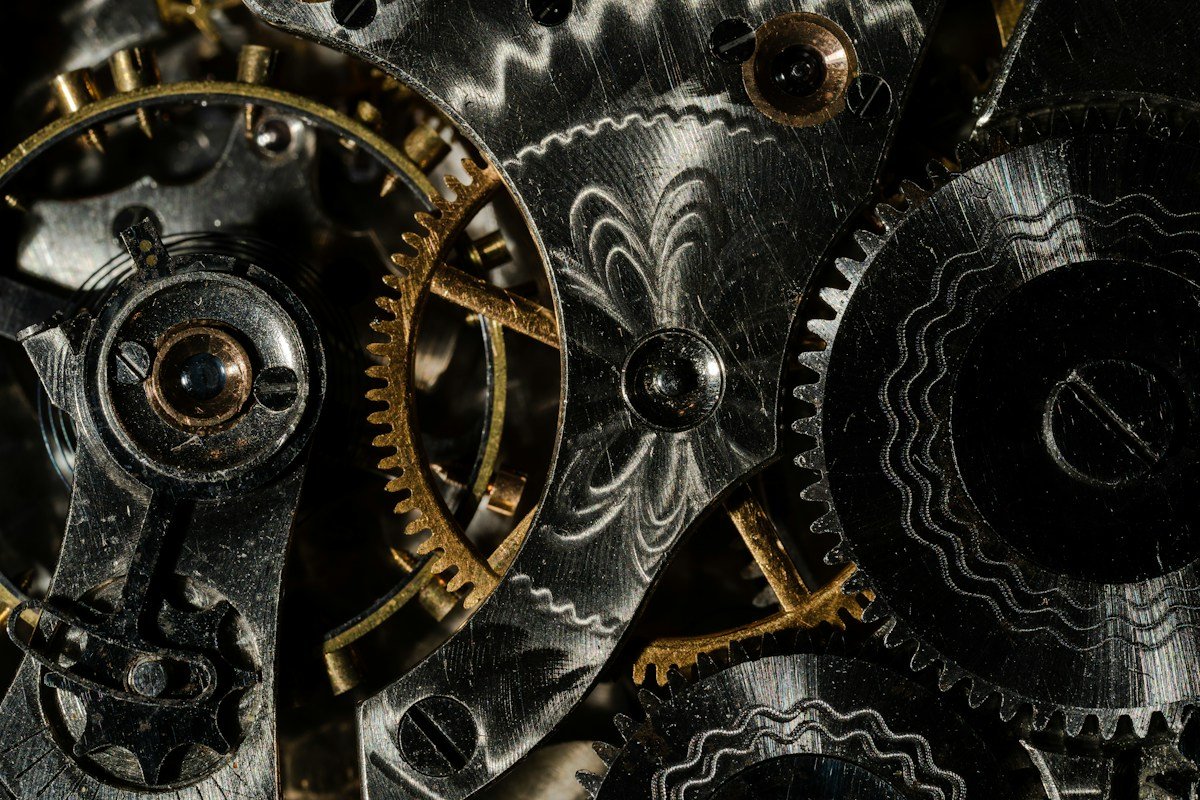
The most visually dazzling decorative technique was damaskeening, known in Switzerland as Côtes de Genève. Watchmakers used rotating boxwood pegs charged with fine abrasive pastes mounted on mechanical dividing engines to mill intricate geometric patterns onto the nickel or brass movement plates. Wave patterns, circular snailings, and radiating sunbursts were carved with microscopic precision across the bridges, catching the light in shimmering three-dimensional holograms that seemed to dance across the metal as the watch moved.
Equally demanding was the art of anglage or chamfering. Master finishers used hand-held boxwood files and diamond pastes to bevel the sharp ninety-degree edges of steel and brass bridges to a consistent forty-five-degree angle, polishing the chamfer to a mirror-like black polish. This manual beveling served both an aesthetic and practical purpose: it eliminated sharp edges that could shed microscopic metal burrs into the delicate train, while creating brilliant borders of light that defined the architectural contours of the movement.
Finally, every steel screw head, regulator pointer, and click spring was mirror-polished and heat-treated through the sacred art of flame bluing. The watchmaker placed the polished steel parts upon a brass pan filled with fine brass shavings and heated it gently over an alcohol flame. As the temperature reached precisely five hundred and ninety degrees Fahrenheit (three hundred and ten degrees Celsius), the microscopic oxide layer on the steel surface transformed through yellow, brown, and purple into a deep, luminous peacock blue. This bluing was not paint or dye; it was an optical interference layer of iron oxide that protected the steel from corrosion while adding breathtaking jewel-like color to the mechanical landscape.
The visual harmony created by this multi-stage finishing process transformed the movement into a microscopic mechanical palace. When sunlight strikes an open pocket watch movement, the alternating textures of circular damaskeened waves, mirror-polished chamfers, glowing ruby chatons, and flame-blued screws produce an optical spectacle of breathtaking complexity. This decorative labor was a silent testament to the maker’s pride, a declaration that human work should be executed with perfection even where only the eye of a fellow craftsman would ever behold it.
Railroad Precision: The Webb C. Ball Standards and Industrial Safety
The development of ultra-precise American pocket watches was forged through tragedy. On April 19, 1891, a catastrophic head-on train collision occurred in Kipton, Ohio, between the Lake Shore and Michigan Southern Railway fast mail train and a passenger train, resulting in the deaths of both engineers and nine postal clerks. The official accident investigation revealed that the disaster was caused by an engineer’s pocket watch that had stopped for four minutes before resuming operation, leading him to believe the track was clear.
Following the disaster, the railway authorities appointed Cleveland jeweler and horologist Webb C. Ball as General Time Inspector to establish rigorous, standardized railroad chronometer standards. Ball formulated strict mechanical criteria that every railroad pocket watch was legally mandated to meet: the watch must be open-faced; size 18 or 16; have at least 17 jeweled bearings; feature a bold, legible dial with Arabic numerals and thick spade hands; be lever-set (meaning the bezel had to be unscrewed and a mechanical lever pulled out before the hands could be moved, preventing accidental time changes in pockets); and be adjusted to temperature, isochronism, and five physical positions (dial up, dial down, pendant up, pendant left, pendant right).
Most critically, railroad watches were required to maintain an accuracy within thirty seconds per week (an astonishing margin of error under four seconds per day) across extreme temperature swings and mechanical vibrations. American watch companies like Waltham, Hamilton, Elgin, and Illinois rose to this industrial challenge, manufacturing legendary railroad grades like the Hamilton 992B and the Waltham Vanguard.
These railroad pocket watches represented the democratization of scientific chronometry. A train conductor or locomotive engineer carried in his vest pocket a timepiece whose accuracy rivaled the astronomical observatories of Greenwich and Paris. The pocket watch ceased to be an aristocratic toy; it became an indispensable guardian of human life, an instrument of absolute precision that synchronized the expanding industrial infrastructure of an entire continent.
The Enamel Dial: Crushed Glass, Kiln Fire, and Eternal Typography
When an observer gazes upon the face of an antique pocket watch, they are looking at a material surface that is fundamentally immune to the passage of time: the fired vitreous enamel dial. In modern watches, dials are typically manufactured from painted brass or printed aluminum that oxidizes, fades, and deteriorates over decades. An antique enamel dial, by contrast, looks as pristine, glossy, and brilliant today as it did when it emerged from the kiln two hundred years ago.
The manufacture of a grand feu (great fire) enamel dial was an extraordinary, high-risk artisan craft. The base was a thin disc of pure copper, carefully counter-enameled on the reverse to prevent warping. The artisan sifted an ultra-fine powder of crushed silica glass, potassium carbonate, and metallic oxides onto the copper surface, and fired it in an oven heated to over one thousand four hundred degrees Fahrenheit (eight hundred degrees Celsius). In the furnace, the glass powder melted, fused, and flowed into a glass-smooth, milk-white porcelain-like enamel layer.
Once cooled and polished flat with pumice stone, master calligraphers painted the hour numerals, minute railway tracks, and subsidiary seconds dials by hand using fine sable hair brushes dipped in black iron oxide enamel paste. The dial was then returned to the kiln for a final, perilous firing to permanently fuse the typography into the glass surface. Even the slightest error in temperature or timing would cause the enamel to crack, blister, or discolor, instantly ruining days of skilled labor.
The resulting enamel dial possesses an ethereal, deep milky translucence that modern printing can never match. The black Roman or Arabic numerals appear suspended within the glass, while the fired dial surface remains chemically inert, completely impervious to moisture, sunlight, and air pollution. Paired with hand-forged blued steel spade, Breguet, or cathedral hands, the enamel dial presents a face of timeless, aristocratic elegance that will never fade as long as its glass surface remains unbroken.
The Tactile Ritual: The Winding Key, the Crown, and Hunter Cases
To experience an antique pocket watch is to participate in an intimate physical ritual of human-machine interaction that has vanished from our touchscreen world. The physical architecture of the watch case was designed to protect the delicate movement while providing tactile pleasure to the owner’s hands.
Pocket watch cases were manufactured in three primary configurations: open-face, where the dial is protected only by a thick mineral glass crystal; hunter case (savonnette), where spring-loaded front and back metal covers enclose the watch entirely, opening with a satisfying mechanical click when the winding crown button is depressed; and half-hunter, featuring a small central glass window in the front cover surrounded by blue enamel hour numerals, allowing the owner to check the time without opening the case.
The case itself was a masterpiece of metalsmithing, crafted from solid eighteen-karat gold, sterling silver, or durable coin silver, adorned with hand-chased engine turnings, engraved family crests, or botanical scrollwork. The heavy gold cover snapped shut with an airtight, solid acoustic click that communicated fortress-like security. Inside the pocket, the watch absorbed the warmth of the owner’s body, transforming the cold metal into a living, personal talisman.
The daily ritual of winding was a sacred moment of contemplation. In early watches, the owner inserted an engraved gold or steel winding key into square arbors cut into the inner dust cuvette, feeling the physical resistance of the spring coiled click by click. In later stem-wind models, the thumb and forefinger turned the knurled crown, feeling the firm, tactile resistance of the ratchet click spring. Winding the watch was a conscious covenant: the human gave physical energy to the machine, and the machine in return gave the human twenty-four hours of faithful, ordered time.
The Horological Anemoia: Why We Yearn for Mechanical Heartbeats
In our contemporary world of planned obsolescence, digital surveillance, and disposable synthetic gadgets, the emotional pull of an antique mechanical pocket watch is more powerful than ever before. Why do modern human beings feel such deep anemoic reverence for these Victorian and Edwardian timepieces?
The answer lies in the profound contrast between mechanical honesty and digital abstraction. A smartphone is an opaque black box: a miraculous piece of technology, but one that possesses no mechanical soul, no visible cause and effect, and no material permanence. When a smartphone breaks, it is discarded into electronic waste; its components cannot be repaired or comprehended by human hands.
An antique pocket watch, by contrast, is completely honest and comprehensible. Through the open back of a pocket watch, every mechanical action is visible to the naked eye. We see the mainspring deliver power to the center wheel; we watch the gear train multiply speed; we see the ruby pallets catch and release the escape wheel; and we watch the balance wheel swing back and forth with hypnotic, living grace. It is a miniature universe operating according to pure Newtonian physics, a physical manifestation of human reason, order, and beauty.
Furthermore, holding an antique pocket watch connects us directly to the long chain of human generations. That ticking movement was held in the pocket of a nineteenth-century railway conductor, an Edwardian physician, or a soldier in the trenches of the First World War. It recorded their heartbeats, witnessed their joys and sorrows, and survived them all. The watch reminds us of our own mortality, whispering that our time on this earth is brief and precious, while inspiring us with the knowledge that human craftsmanship, honor, and beauty can endure long after our physical lives have returned to dust.
The Restoration Ethos: Horological Stewardship and the Preservation of Craft
In the twenty-first century, the preservation and restoration of antique pocket watches have become an urgent act of cultural stewardship, championed by a passionate global community of professional horologists, conservators, and collectors. As the old master watchmakers who spent their lives at traditional wooden benches pass away, the specialized knowledge required to repair, adjust, and preserve these mechanical treasures is at risk of vanishing.
Authentic horological restoration is a discipline of profound ethics and historical humility. Unlike commercial repair shops that replace original components with modern generic parts, master conservators operate under the strict principle of reversible, historical fidelity. Every original component: every hand-cut screw, fire-blued regulator spring, and original enamel dial, is treated as an irreplaceable historical document. When a broken balance staff pivot must be repaired, the conservator turns a new pivot by hand on an antique watchmaker’s lathe to within two microns of the original specification, polishing it with boxwood laps to ensure another century of frictionless operation.
Dedicated horological schools in Switzerland, England, Germany, and the United States are currently training a new generation of young craftspeople in these ancient techniques. Students learn to cut cycloidal gear teeth on hand-cranked wheel-cutting engines, to forge hairspring overcoils with microscopic tweezers, and to master the chemical arts of flame bluing and gold chaton setting. These young conservators are not looking backward with passive nostalgia; they are actively preserving the physical DNA of human mechanical genius.
This restoration ethos proves that the antique pocket watch is not a dead historical relic, but an eternal, living tradition. In every antique watch movement carefully disassembled, cleaned, oiled, and set ticking once again, the flame of human craftsmanship is kept alive. The steady, quiet tick of the pocket watch continues to echo across the centuries, a timeless mechanical heartbeat that honors our past, steadies our present, and inspires our future with enduring grace.
Comparative Diagnostic Matrix of Horological Escapement Mechanisms and Mechanical Accuracy
A rigorous horological, mechanical, and historical analysis of timekeeping requires systematic comparison across different escapement architectures, frictional characteristics, positional stability, and chronometric accuracy. The physical method by which stored potential energy is metered out to the oscillating balance wheel directly dictates a timepiece’s accuracy, durability, and historical significance.
The comparative diagnostic matrix below illustrates the definitive mechanical principles, friction classifications, daily rate deviations, and historical applications that distinguish early verge and cylinder escapements from the classic detached lever and high-precision marine chronometer escapements. This matrix synthesizes horological engineering manuals, historical rate records, and micro-mechanical physics.
| Escapement Architecture | Detached Lever Escapement (Thomas Mudge, 1754) | Spring Detent Chronometer Escapement (Earnshaw, 1783) |
| Kinetic Principle | Anchor-shaped lever with synthetic ruby pallets locks and unlocks escape teeth; impulse delivered via ruby roller pin. | Spring detent locks escape wheel directly; balance wheel unlocks tooth via passing spring; direct impulse on single swing. |
| Frictional Profile | Detached oscillation; balance wheel swings completely free between impulses; low sliding friction on pallet faces. | Ultimate low-friction architecture; impulse delivered directly to roller without intermediate lever; zero oil required on teeth. |
| Vulnerability to Shock | Highly shock-resistant; safety action of guard pin and roller table prevents accidental unlocking during violent motion. | Vulnerable to sudden lateral shocks; risk of tripping or over-banking; optimized for stationary gimballed marine boxes. |
| Chronometric Precision | Adjusted accuracy within 2 to 5 seconds per day; meets rigorous American Railroad standards (Ball criteria). | Observatory chronometer precision within 0.5 to 1 second per day; enabled global naval longitude calculation. |
| Historical Legacy | Universal standard for 20th-century pocket watches and mechanical wristwatches; mass-produced high precision. | Sacred instrument of Admiralty navigation and astronomical observatories; bespoke handcrafted summit. |
As demonstrated across these micro-mechanical parameters, the antique pocket watch represents an extraordinary synthesis of mathematical physics, metallurgical science, and artisanal beauty. By transforming physical friction, gravity, and stored spring potential into an accurate, audible measure of human time, historical horology created an enduring monument of human intellectual triumph that continues to enchant and inspire our modern world.
Frequently Asked Questions Regarding Antique Pocket Watches
What was the purpose of synthetic ruby jewel bearings in antique pocket watches?
Synthetic ruby and sapphire jewels (corundum) possess extreme hardness (9 on the Mohs scale). When pierced and polished, they provide ultra-hard, mirror-smooth bearings for delicate steel pivots, virtually eliminating friction, preventing pivot hole wear, and ensuring long-term timekeeping accuracy.
How did the detached lever escapement revolutionize mechanical timekeeping?
Invented by Thomas Mudge in 1754, the detached lever escapement allowed the balance wheel to swing completely free of the gear train throughout most of its oscillation, receiving only a brief impulse at each beat. This detached state eliminated continuous friction, dramatically improving accuracy.
Why were bimetallic balance wheels constructed from brass and steel?
Temperature changes altered the elasticity of steel hairsprings, causing watches to run slow in heat. Bimetallic balance wheels had open rims made of brass laminated to steel. Because brass expands faster than steel, the arms bent inward when heated, reducing the balance wheel’s diameter and perfectly offsetting the spring’s loss of elasticity.
What triggered the creation of strict American Railroad watch standards?
The Great Kipton Train Wreck of 1891, which killed eleven people, was caused by an engineer’s pocket watch that had stopped for four minutes. Horologist Webb C. Ball was appointed to establish strict standards, mandating lever-set mechanisms, 17+ jewels, bold dials, and weekly accuracy within 30 seconds.
What is the Breguet overcoil hairspring, and why is it superior?
Abraham-Louis Breguet bent the outer coil of the hairspring upward and curved it inward toward the center. This three-dimensional overcoil allowed the spring to expand and contract concentrically in all directions, eliminating lateral pivot friction and achieving near-perfect isochronism in all positions.
How were antique grand feu enamel dials manufactured?
Enamel dials were created by sifting powdered glass onto a copper disc and firing it in an oven at over 1,400 degrees Fahrenheit. The molten glass fused into a smooth, porcelain-white layer. Numerals were painted with metal oxide paste and fired a second time, creating permanent dials that never fade.
What is damaskeening, and what function did it serve on watch plates?
Damaskeening was the decorative milling of geometric wavy or circular patterns onto watch plates using abrasive wood laps on precision dividing engines. While visually breathtaking, it also served a practical purpose by capturing microscopic dust particles and preventing them from migrating into the gear train.
What does it mean when a pocket watch is lever-set?
A lever-set watch requires the owner to unscrew the front bezel and pull out a small steel lever before turning the winding crown to set the hands. This safety mechanism was mandated on railroads to prevent the hands from accidentally being shifted when pulling the watch from a pocket.
Why do mechanical watch collectors revere flame-blued screws?
Flame bluing is the traditional art of heating polished steel to precisely 590 degrees Fahrenheit, creating an optical interference layer of iron oxide that shines with a rich, peacock-blue luster. It provides natural rust resistance while serving as a hallmark of master handcrafted finishing.
Conclusion: The Timeless Measure of the Human Journey
The journey through the intricate mechanics of antique pocket watches reveals that time is far more than an abstract measurement or digital convenience. In the sacred dance of gears, escapements, and jeweled bearings, human ingenuity succeeded in transforming the invisible, irreversible flow of time into a physical object of living beauty and moral dignity. Every ticking pocket watch carried in a vest pocket was a testament to the belief that human life, labor, and history possess profound purpose, order, and value.
As we hold an antique pocket watch in our hands today, feeling its heavy case and listening to its steady, faithful tick, we are reminded of the timeless fellowship of human craftsmanship that spans across generations. In an ephemeral digital world that encourages us to forget, the mechanical watch ticks on with serene, unhurried defiance. It reminds us to treasure each passing second, to honor the enduring achievements of the past, and to live our lives with the precision, dignity, and beauty that our ancestors poured into these timeless masterworks of horological art.
