

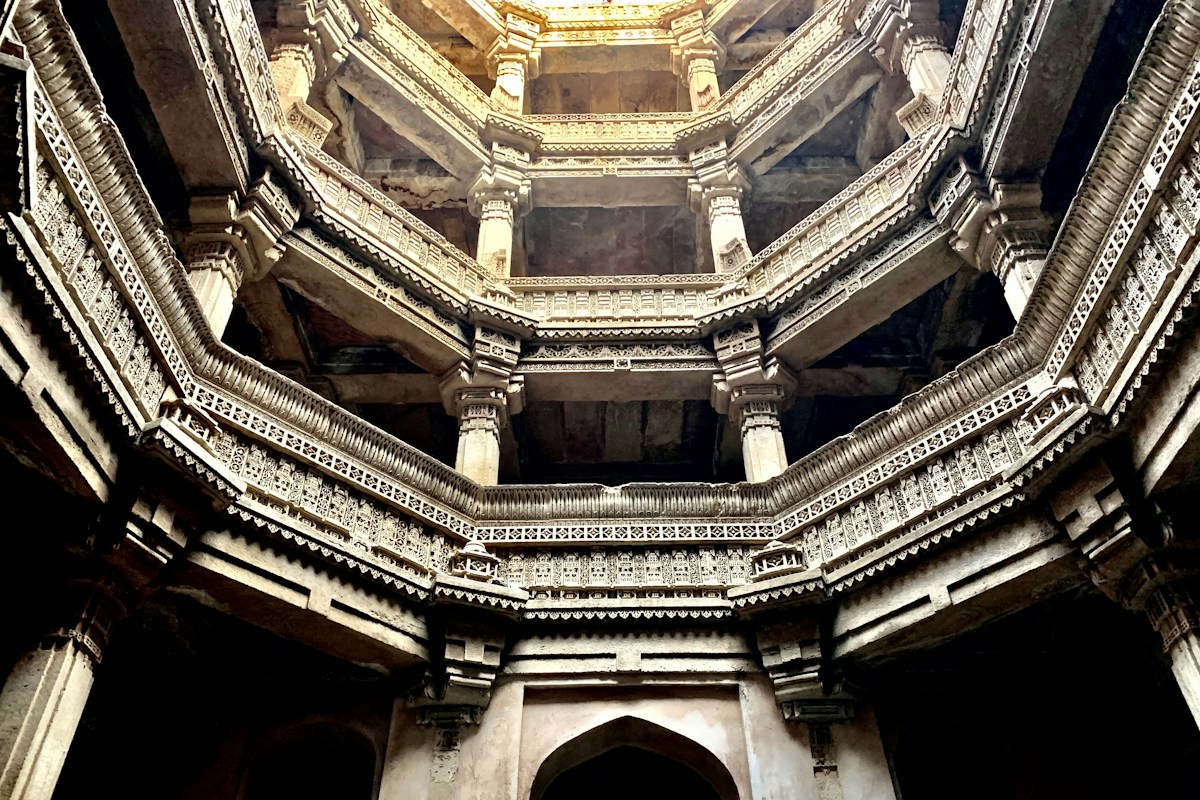
Step off the sun-scorched, dusty plains of northern Gujarat or eastern Rajasthan during the blistering heat of May, where ambient desert temperatures regularly climb past forty-five degrees Celsius, and approach what appears to be a modest, low stone wall rising out of the baked earth. Peer over the carved sandstone parapet, and the flat earth suddenly plunges downward into a breathtaking, five-story subterranean canyon of carved architectural wonder. Descending through successive tiers of open-air pillared pavilions, ornate corbelled balconies, and thousands of masterfully chiseled stone sculptures of deities, celestial dancers, and coiled serpents, the searing desert wind abruptly vanishes. With every downward step, ambient light softens into cool golden shade, the air grows delightfully humid, and the temperature drops by ten to fifteen degrees until you reach a tranquil, subterranean pool of living groundwater shimmering at the earth’s deep core.
This inverted cathedral carved into the earth is the traditional Indian stepwell, known regionally as a vav in Gujarat and a baoli, baori, or kund across Rajasthan, Delhi, and Madhya Pradesh. Built between the fifth and nineteenth centuries, stepwells represent one of the most astonishing syntheses of hydro-geological engineering, monumental sculpture, sacred Hindu-Jain cosmology, and feminine communal life in human history. While Western civilizations conquered water by building elevated aqueducts that soared into the sky, master builders across western India dug deep into the living womb of the earth, creating monumental subterranean temples where water was not merely consumed as a physical utility, but revered as a sacred divine presence.
In this authoritative architectural, hydrological, and historical monograph, we deconstruct the design and cultural significance of India’s ancient stepwells. We examine the hydro-geology of the Thar Desert and monsoon recharge cycles, analyze the Maru-Gurjara structural principles that prevent deep subterranean soil walls from collapsing inward under earth pressure, explore the architectural masterpieces of Rani ki Vav, Adalaj, and Chand Baori, unpack the role of stepwells as female social sanctuaries and trade caravan halts, examine their tragic decline under British colonial sanitary campaigns, and evaluate modern groundwater revival efforts resurrecting these ancient subterranean treasures.
1. The Inverted Temple: Subterranean Sanctity and Desert Hydro-Geology
In classical Indian architectural theory (Vastu Shastra), temples were traditionally conceived as cosmic mountains (Meru) rising proudly toward the heavens, crowned with soaring spires (shikharas) that drew the human soul upward toward transcendence. Stepwells, however, represent a profound conceptual inversion: they are inverted temples (patala-loka) carved deep into the underworld.
This inverted geometry was born from the harsh geological realities of western India. Bordering the vast Thar Desert, the states of Gujarat and Rajasthan receive erratic, torrential monsoon rainfall concentrated into just two or three months between July and September, followed by nine to ten months of unrelenting drought. Riverbeds are seasonal torrents that dry into cracked ribbons of sand for most of the year. Surface ponds and lakes lose billions of liters to blistering solar evaporation.
To survive in this hyper-arid climate, ancient communities were forced to look beneath their feet. Deep below the sandy alluvium lay high-yielding water tables saturated with pure, naturally filtered groundwater. However, reaching an unconfined aquifer that fluctuated twenty to thirty meters between monsoon highs and pre-monsoon summer lows was impossible with a standard vertical rope-and-bucket well: hauling thousands of gallons of heavy water upward by hand across sixty vertical feet was exhausting and inefficient. The stepwell solved this human and physical challenge through a stroke of architectural genius: builders brought the human being down to the water, carving an inclined staircase that allowed people to walk directly down to the fluctuating water level regardless of the season.
2. Monsoon Climatology and Aquifer Dynamics: The Arid Cycles of Western India
To understand the hydrological engineering of a stepwell, one must analyze the complex hydro-geological dynamics governing the semi-arid river basins of western India, such as the Sabarmati, Banas, and Saraswati watersheds.
The regional hydrology is governed by alternating layers of porous alluvial sand, silty clay, and deep basaltic or sandstone bedrock. During the Southwest Monsoon, intense rainfall saturates the upper soil strata, slowly percolating downward through natural silt and sand beds that act as giant geological sand filters, stripping away organic pathogens and suspended solids. This water accumulates in subterranean unconfined aquifers, creating a vast underground freshwater reservoir shielded from solar evaporation.
The critical engineering challenge confronting stepwell builders was seasonal hydraulic fluctuation. In August, following heavy monsoon downpours, the regional water table rose rapidly, often submerging four or five subterranean pavilion tiers beneath fresh groundwater. By April and May, as domestic consumption, agricultural irrigation, and natural capillary migration depleted the aquifer, the water table plummeted thirty to forty feet. Stepwell architects had to calculate the absolute historical minimum water table elevation, ensuring that the deepest flight of stairs descended below the lowest possible drought waterline while designing structural pavilions that could remain submerged for months each year without softening, eroding, or succumbing to hydrostatic pressure.
3. Structural Morphology: From Simple Kund Tanks to Linear Multi-Storeyed Vavs
The architectural evolution of Indian stepped water structures spans more than a millennium, progressing from rudimentary stone-lined pits into colossal multi-story subterranean palaces. Architectural historians classify these structures into three primary morphological types:
- The Kund (Stepped Pond): The oldest morphological form, exemplified by the Sun Temple Kund at Modhera or the great stepped tank at Abhaneri. A kund is typically square or rectangular in plan, resembling an inverted stepped pyramid. Rather than a linear staircase, all four sloping sides are lined with thousands of symmetrical, interlocking triangular stone steps that descend in rhythmic geometric cascades directly down to a central square reservoir. Kunds were primarily designed for communal religious ritual bathing, prayer, and open-air festival gatherings.
- The Baoli / Baori: A hybrid stepped well common in Rajasthan and northern India, featuring a broad open entrance staircase descending to a circular deep well shaft, often flanked by subterranean resting rooms and arched arcades.
- The Linear Vav: The supreme, highly sophisticated architectural achievement of Gujarat. A linear vav is laid out along an elongated single axis, often stretching seventy to one hundred meters from an open street-level entrance portal down to a circular vertical well cylinder at the far end. Between the entrance and the well, builders erected successive subterranean pavilions (kutams) stacked vertically across multiple stories, linked by straight flights of broad stone steps.
4. Maru-Gurjara Architecture: Intricate Pillar Pavilions, Corbelling, and Torana Arches
The magnificent aesthetic and structural vocabulary of classical western Indian stepwells reached its artistic zenith under the Solanki (Chaulukya) dynasty between the tenth and twelfth centuries, giving birth to the Maru-Gurjara architectural style.
Unlike contemporary European builders who relied on semicircular voussoir arches and mortar to span open spaces, Maru-Gurjara master masons (salats) operated exclusively via trabeated (post-and-beam) construction and corbelled stone cantilevering. Heavy horizontal beams were supported by densely clustered columns carved with exquisite multi-faceted profiles, pot-and-foliage (ghata-pallava) capitals, and projecting stone brackets carved into celestial maidens (apsaras) and mythical makara sea-monsters.
To span subterranean openings without mortar, masons laid dressed sandstone blocks in horizontal courses, each course cantilevering slightly inward over the course below until the stones met at the center: a technique known as corbelled vaulting. Interconnecting the subterranean pavilions were ornamental cusped arches known as toranas. These graceful stone arches were not load-bearing arches in the Western sense; they were carved decorative tie-beams that added horizontal structural bracing between opposing stone columns while framing dramatic subterranean perspectives for visitors descending into the deep.
5. The Engineering of Silt and Pressure: Retaining Walls and Counter-Thrust Pavilions
Building a vertical hole sixty feet deep into loose alluvial sand is one of the most perilous challenges in structural civil engineering. Under natural conditions, surrounding soil exerts immense lateral earth pressure (active lateral pressure) that tends to buckle vertical walls inward, causing catastrophic structural collapse and burying workers alive.
How did medieval Indian engineers prevent fifty-foot-deep subterranean trenches from caving inward without modern reinforced concrete or steel sheet piling? The answer lies in the counter-thrust engineering of multi-tiered pillar pavilions (kutams).
Instead of building an open, unbraced trench, Solanki builders constructed deep retaining walls of dressed sandstone blocks bonded with interlocking tongue-and-groove joints and hidden lead cramps. At calculated structural intervals along the trench, they erected multi-story pillared pavilions that spanned the entire width of the well. These stone pavilions functioned as massive internal horizontal structural cross-struts (flying buttresses). The heavy horizontal stone beams and ceiling slabs absorbed the lateral earth pressure pushing inward from both sides of the trench, transferring opposing compressive loads against each other in perfect structural equilibrium. The deeper the trench descended, the more heavily reinforced and closely spaced the pavilion levels became, creating an indestructible subterranean stone scaffold capable of resisting continuous soil pressure for eight centuries.
6. The Ritual Descent: Microclimates, Thermal Comfort, and Women’s Social Havens
While the structural engineering of stepwells was a triumph of physics, their social and biological functions were intimately intertwined with the cultural life of rural Indian women.
In traditional patriarchal feudal society, rural women’s lives were largely restricted to the domestic sphere of the home. However, fetching fresh water for cooking, cleaning, and infant care was recognized across all castes as an exclusively female duty. The stepwell provided women with an essential, culturally sanctioned daily escape from domestic confinement:
- Social Sanctuary: Women gathered at the stepwell twice daily in groups, setting down heavy brass water pots (lotas) on carved stone ledges to rest, wash clothes, bathe, share village gossip, arrange marriages, sing folk songs, and seek emotional solidarity away from the watchful eyes of male household elders.
- Microclimatic Thermal Comfort: Stepwells functioned as ancient passive air-conditioning systems. The deep earth provided natural geothermal insulation, keeping the deep stone walls cool year-round. At the bottom of the well, continuous evaporation of groundwater absorbed latent heat from ambient air, creating an inversion layer that trapped cool, humid air in the lower chambers while hot, dry desert winds blew harmlessly overhead. On scorching summer afternoons, women and children lingered for hours in the cool subterranean pavilions, embroidering textiles and resting on cool stone floors.
- Sacred Fertility Veneration: Stepwells were revered as living manifestations of female divine power (shakti). Childless women visited stepwells to perform rituals honoring water spirits, tying red threads to stone pillars and praying to water goddesses for fertility, healthy childbirth, and family prosperity.
7. Rani ki Vav (The Queen’s Stepwell): Subterranean Cathedral of Patan
The undisputed masterpiece of stepwell architecture is Rani ki Vav (The Queen’s Stepwell), situated in Patan, the ancient capital of the Solanki Empire in northern Gujarat. Commissioned around 1063 AD by Queen Udayamati as a monumental memorial to her deceased husband, King Bhimdev I, Rani ki Vav is recognized as a UNESCO World Heritage site and one of the supreme achievements of Indian monumental sculpture.
Stretching sixty-four meters long, twenty meters wide, and plunging twenty-seven meters (nearly ninety feet) deep into the earth, Rani ki Vav is organized across seven distinct stepped terrace levels supported by more than two hundred exquisitely carved pillars. What distinguishes Rani ki Vav from all other stepwells is the staggering density and artistic quality of its sculptural decoration: over five hundred primary monumental stone sculptures and more than a thousand secondary relief carvings line its subterranean walls.
The iconographic program is dedicated to Lord Vishnu, the preserver deity of the Hindu cosmos, whose mythical home is the primordial ocean of milk. Deep inside the lowest level of the well cylinder, carved directly into the water-washed sandstone at water level, lies a colossal reclining sculpture of Vishnu Sheshashayi, sleeping peacefully upon the coiled thousand-headed serpent Shesha. As monsoon water levels rose and fell, the sacred waters physically submerged and revealed the divine serpent, visually recreating the ancient Vedic myth of cosmic creation emerging from primordial waters. In the thirteenth century, the nearby Saraswati River changed course during a cataclysmic flood, burying Rani ki Vav under millions of tons of protective silt for seven centuries until it was meticulously excavated by the Archaeological Survey of India in the 1980s in virtually pristine showroom condition.
8. Adalaj Stepwell: Indo-Islamic Synthesis, Tragic Legends, and Octagonal Light Wells
Situated nineteen kilometers north of Ahmedabad, the Adalaj Stepwell (Rudabai Stepwell) represents a poignant historical crossroads: the harmonious convergence of Hindu architectural engineering and Islamic artistic aesthetics, forged in the crucible of a tragic romantic legend.
Construction began in 1498 under Hindu King Rana Veer Singh of the Vaghela dynasty. Before the well could be completed, the kingdom was invaded by the Muslim Sultan of Ahmedabad, Mahmud Begada. King Veer Singh was slain in battle, and his grief-stricken widow, Queen Rudadevi (Rudabai), was captured. Captivated by her beauty, Sultan Begada proposed marriage. Queen Rudabai agreed on one condition: the Sultan had to complete the construction of the magnificent stepwell her late husband had started. The Sultan mobilized royal artisans and completed the five-story structure with unprecedented speed. Upon its completion in 1499, Queen Rudabai inspected the finished monument, prayed to the water gods, and leaped to her death from the top gallery into the deep well pool, choosing eternal union with her husband over remarriage.
Architecturally, Adalaj is unique in possessing three separate entrance staircases that descend from the south, west, and north, converging in a magnificent octagonal subterranean clearinghouse on the first subterranean tier. The decoration reflects a brilliant Indo-Islamic dialogue: traditional Hindu motifs of floral rosettes, pot-of-plenty foliage, and protective animal friezes blend seamlessly with Islamic geometric traceries, latticed jali screens, and calligraphic flourishes. Direct sunlight penetrates only into the central octagonal shaft for a few brief minutes at noon; the remaining subterranean chambers remain bathed in soft, filtered ambient illumination, maintaining a tranquil interior temperature six degrees cooler than the surface.
9. Chand Baori at Abhaneri: Mathematical Geometry of 3,500 Symmetrical Steps
If Rani ki Vav is an underground cathedral of figurative sculpture, Chand Baori in the village of Abhaneri, Rajasthan, is a monument to pure mathematical abstraction and optical geometry.
Built in the ninth century by King Chanda of the Nikumbha dynasty, Chand Baori is one of the deepest and largest stepped ponds in the world. Plunging twenty meters (sixty-six feet) into the earth across thirteen distinct tiers, the structure resembles an inverted stepped pyramid of mind-boggling complexity. Three of its four sloping sides are covered entirely by an astonishing lattice of 3,500 narrow, triangular stone steps arranged in mesmerizing double-flight zig-zag diamond patterns.
The visual rhythm of Chand Baori produces an almost hypnotic optical effect reminiscent of M.C. Escher’s surreal architectural drawings. The steps were engineered with surgical geometric precision: no matter which flight of stairs a person begins their descent upon, the interconnected diamond pattern allows an individual to traverse horizontally or vertically across the massive stone amphitheater with effortless grace. On the fourth side of the reservoir rises a multi-story stone palace complex fitted with royal balconies (jharokhas), arcaded viewing galleries, and resting pavilions reserved for the local royal family during summer retreats, creating an architectural dialogue between geometric public infrastructure and ornate royal sanctuary.
10. Agrasen ki Baoli in Delhi: Red Sandstone Acoustics in the Imperial Capital
While western India is the undisputed heartland of stepwells, magnificent examples were also constructed across the Gangetic plains. The most famous and haunting example is Agrasen ki Baoli, nestled in the shadows of modern glass-and-steel skyscrapers near Connaught Place in central New Delhi.
Attributed by folklore to the legendary King Agrasen of the solar dynasty and rebuilt in the fourteenth century during the Delhi Sultanate (Tughlaq period), Agrasen ki Baoli measures sixty meters long and fifteen meters wide. Built from rough-hewn local red quartzite rubble bonded with lime mortar and dressed with fine red sandstone accents, the structure features a single broad flight of 108 stone steps descending into the subterranean dark.
Lining the sweeping staircase are arched alcoves and recessed vaulted niches stacked across three architectural levels. Unlike the ornate figurative carvings of Gujarat, Agrasen ki Baoli exhibits the austere, muscular geometric aesthetic of Sultanate architecture. The enclosed stone walls generate extraordinary acoustic reverberation: the fluttering wings of hundreds of roosting bats and pigeons echo like whispers through the subterranean vaults, giving rise to urban legends and ghost stories that make it one of the most visited heritage monuments in modern Delhi.
11. Hydraulic Functionality: Silt Trapping, Pulley Wells, and Cattle Ramps
Beyond their role as pedestrian descents for domestic water collection, stepwells were sophisticated multi-component hydraulic engineering installations that integrated dual water-extraction mechanisms.
At the far end of every linear stepwell sat the main vertical well cylinder (the kua). While human pedestrians accessed water by walking down the stepped staircase, large-scale domestic and agricultural water extraction was executed from the surface via the well shaft. Above the well cylinder, master builders erected heavy stone or timber gallows fitted with grooved bronze pulleys (charkhi).
Pairs of oxen or bullocks were hitched to thick hemp or leather ropes connected to giant leather water-lifting buckets (charas or mote). The bullocks walked down an inclined earthen ramp (the gao-ghat) away from the well, using their body weight to haul thirty-gallon buckets of water up from the deep cylinder. When the bucket reached the surface, it tripped an automated wooden lever that dumped the water into raised stone aqueducts and irrigation channels feeding adjacent agricultural fields, royal orchards, and public livestock drinking troughs. Furthermore, the stepped design acted as a natural sediment catchment basin: as surface water entered during floods, the broad lower steps trapped heavy sand and silt, preventing particulate matter from contaminating the deep vertical well cylinder.
12. Sacred Ecology: Nagas, Water Deities, and the Sanctity of Groundwater
The construction and endowment of a stepwell was considered one of the highest spiritual virtues an individual could perform in traditional Indian society: an act of sacred philanthropy known as purta-dharma (building public works such as wells, gardens, and rest houses).
Ancient Hindu law codes, including the Manusmriti and Naradasmriti, promised that anyone who financed the digging of a well or water tank would earn spiritual merit (punya) that would cleanse the sins of three generations and guarantee rebirth in heavenly realms. Because water was revered as the divine physical manifestation of the goddess Varuna and the sacred rivers Ganga, Yamuna, and Saraswati, contaminating a water source was considered an unforgivable spiritual sin.
Every stepwell was sanctified with dedicated shrines honoring water protectors:
- Nagas (Serpent Deities): Statues of multi-headed serpent deities were carved into foundation stones at water level, symbolizing the protective guardians of underground aquifers.
- Ganesh: The elephant-headed remover of obstacles was positioned at the entrance portal to bless the visitor’s descent.
- The Matrikas (Seven Mother Goddesses): Shrines dedicated to the Matrikas were carved into side alcoves, invoking divine maternal protection over young women and infants collecting water in the deep chambers.
By sacralizing water through divine imagery, ancient societies established an unshakeable ecological ethic: water was a sacred gift held in sacred trust for the entire community.
13. Colonial Neglect and Malaria Politics: British Infilling and the Sanitary Crusade
The catastrophic demise of India’s stepwell network began in the nineteenth century under the administrative governance of the British colonial Raj.
British colonial medical officers and civil sanitary inspectors viewed traditional Indian stepwells with profound horror and cultural incomprehension. From the perspective of Victorian germ theory, stepwells appeared to be dangerous, unhygienic breeding grounds for infectious contagion. Because people physically entered the water-washing their feet, bathing, and dipping laundry into the same pool from which drinking water was collected-colonial authorities blamed stepwells for the rampant spread of waterborne epidemics: specifically cholera and the dreaded Guinea worm parasite (Dracunculus medinensis).
Rather than introducing modern filtration techniques or educational sanitation campaigns while preserving the architectural masterpieces, British authorities launched an aggressive, empire-wide “sanitary improvement” crusade. Across Gujarat, Rajasthan, and the Punjab, hundreds of historic stepwells were declared public health hazards. Colonial engineers systematically blocked entrance staircases, bricked up subterranean archways, dismantled carved stone pavilions, or filled the entire structures with dirt and municipal garbage. Stepwells that were spared burial were retrofitted with crude cast-iron hand pumps installed over boarded-up well heads, physically severing human beings from their direct descent to the water and destroying centuries of communal architectural culture in a few decades.
14. Modern Hydrological Crisis: Groundwater Depletion, Borewells, and Vanishing Tables
The abandonment of traditional stepwells was cemented in the mid-twentieth century by the introduction of mechanized technology: diesel and electric submersible borewell pumps.
Following Indian independence and the advent of the Green Revolution in the 1960s and 1970s, agricultural irrigation transitioned to deep motorized tube-wells. Farmers and municipal water boards drilled narrow borewells hundreds of feet into the earth, pumping millions of acre-feet of groundwater around the clock. Within three decades, this unregulated extraction triggered a catastrophic hydrological crisis across western India.
Water tables that had historically fluctuated between ten and thirty feet below the surface plummeted to unprecedented depths of three hundred, five hundred, and even one thousand feet. Deep underground, the ancient unconfined aquifers dried out completely. Deprived of rising groundwater, thousands of historic stepwells became dry, dusty tombs: forgotten stone skeletons littered with trash, choked with invasive vegetation, and inhabited only by bats and stray animals. The severed link between local communities and their groundwater blindfolded modern society to the impending reality of acute regional water bankruptcy.
15. Architectural Conservation: ASI Restoration, UNESCO Recognition, and Desiltation
Fortunately, the twenty-first century has witnessed a dramatic global and national renaissance in the recognition and preservation of Indian stepwells as irreplaceable treasures of world cultural heritage.
The turning point was the inscription of Rani ki Vav as a UNESCO World Heritage Site in 2014, which catapulted Indian subterranean architecture onto the global stage. Led by the Archaeological Survey of India (ASI) and international conservation organizations, massive multidisciplinary restoration campaigns were mobilized across Gujarat, Rajasthan, and Delhi. Civil engineers and archaeologists removed thousands of tons of accumulated silt and domestic refuse, restored shattered stone lintels using authentic traditional lime mortars, and stabilized tilted subterranean columns with hidden stainless-steel reinforcement ties.
A shining triumph of community-led restoration occurred at Toorji ka Jhalra in Jodhpur, Rajasthan. Built in the 1740s by a royal consort, this magnificent stepped pond had served for decades as a stagnant open sewer choked with garbage. In 2016, a coalition of local hoteliers, conservation architects, and neighborhood volunteers cleared over two hundred truckloads of debris, pumped out contaminated sludge, and cleaned the historic rose-red sandstone carvings. Today, natural freshwater springs have returned, refilling the reservoir with pristine turquoise water that serves as a vibrant, beloved public plaza where local children swim and international travelers marvel at historic engineering.
16. Sustainable Lessons for Modern Architecture: Passive Geothermal Cooling and Rain Harvesting
Beyond their historical and aesthetic beauty, ancient stepwells are offering invaluable blueprints for twenty-first-century sustainable civil engineering and green architecture.
Modern architects grappling with escalating energy demands and urban heat island effects are studying the passive thermal dynamics of stepwells. By sinking buildings into the earth and utilizing the high thermal mass of soil and stone, contemporary structures can achieve passive geothermal cooling without relying on massive, power-hungry electrical air conditioning units. Renowned Indian architects, including Charles Correa and B.V. Doshi, incorporated stepwell principles into contemporary institutions, designing recessed courtyards, stepped gathering amphitheaters, and subterranean shading galleries that minimize solar radiation exposure.
Furthermore, the modern water crisis has inspired a resurgence in decentralized urban rainwater harvesting modeled directly on ancient stepwell catchments. In water-stressed cities like Bangalore and Jaipur, urban hydrologists are rehabilitating traditional stepwells to act as urban percolation recharge wells. By channeling urban monsoon runoff through gravel desilting filters into ancient dry stepwells, cities are successfully replenishing depleted subterranean aquifers, reducing municipal flash flooding, and securing emergency municipal water reserves for future droughts.
17. Cultural Renaissance: Stepwells in Modern Art, Photography, and Community Revival
Today, stepwells are undergoing a dazzling cultural renaissance, emerging from centuries of shadows to become celebrated cultural destinations, open-air art galleries, and film backdrops.
International photographers, documentary filmmakers, and architectural historians-most notably author Victoria Lautman through her groundbreaking surveys-have introduced millions of global readers to the hidden beauty of India’s subterranean sentinels. Stepwells have been featured in major international cinematic productions, including Tarsem Singh’s visual masterpiece The Fall and Christopher Nolan’s The Dark Knight Rises, where the dizzying geometric steps of Chand Baori served as the mythical subterranean prison from which Bruce Wayne ascends.
More importantly, local Indian communities are reclaiming stepwells as vital living civic spaces. Across heritage cities, youth organizations host classical Indian music concerts, dance performances, and poetry recitals within the acoustically resonant stone pavilions of Adalaj and Chand Baori, illuminated by thousands of flickering traditional oil lamps (diyas). By re-infusing these ancient monuments with life, art, and communal joy, modern India is ensuring that these monumental subterranean temples of water will never again be forgotten, standing as eternal testaments to human gratitude for the living waters of the earth.
Comparative Architectural Analysis: Iconic Historic Stepwells of Western and Northern India
To fully appreciate the diversity of subterranean engineering across the subcontinent, one must analyze the defining stepwells surviving across distinct geographical regions and historical dynasties. Each structure was engineered to solve differing geological challenges, local water table depths, and cultural functions.
The following comparative analytical matrix deconstructs six of the most celebrated stepwells in Indian history. It evaluates their construction eras, regional locations, primary architectural styles, subterranean depths, structural tier counts, and modern preservation status, illustrating how master builders across western and northern India transformed water management into high art.
| Stepwell Name | Location & Date | Architectural Style | Depth & Tiers | Primary Structural Signature | Modern Preservation Vault |
|---|---|---|---|---|---|
| Rani ki Vav | Patan, Gujarat (c. 1063 AD) | Solanki Maru-Gurjara | 27 meters (7 tiers) | Over 500 monumental sculptures; subterranean Vishnu Sheshashayi shrine. | UNESCO World Heritage Site / ASI Protected |
| Chand Baori | Abhaneri, Rajasthan (c. 850 AD) | Nikumbha Stepped Tank | 20 meters (13 tiers) | Hypnotic Escher-like grid of 3,500 symmetrical zig-zag steps; multi-story royal palace. | Archaeological Survey of India (ASI) |
| Adalaj Stepwell | Gandhinagar, Gujarat (1499 AD) | Indo-Islamic Solanki | 16 meters (5 tiers) | Three converging entrance stairs; octagonal central shaft; jali fretwork. | National Heritage Monument (ASI) |
| Agrasen ki Baoli | New Delhi (c. 1350 AD) | Delhi Sultanate Tughlaq | 15 meters (3 tiers) | 108 continuous sandstone steps flanked by arched niches; red quartzite ashlar. | Centrally Protected Monument (ASI) |
| Surya Kund | Modhera, Gujarat (1026 AD) | Solanki Maru-Gurjara | 12 meters (stepped tank) | Rectangular ritual reservoir with 108 miniature carved subsidiary shrines on steps. | Archaeological Survey of India (ASI) |
| Toorji ka Jhalra | Jodhpur, Rajasthan (1740 AD) | Rajput Marwar Jhalra | 18 meters (stepped tank) | Carved red sandstone stepped basin; community-led desilting and restored springs. | Jodhpur Heritage Trust / Community Maintained |
Frequently Asked Questions About Ancient Indian Stepwells and Hydraulics
What is the linguistic difference between a vav, a baoli, and a kund?
A vav is the Gujarati regional term for an elongated, linear stepped well featuring successive pillared subterranean pavilions leading to a circular well cylinder. A baoli or baori is the Hindi and Rajasthani term for a stepped well, common across Rajasthan, Delhi, and Madhya Pradesh. A kund is a stepped pond or tank, typically square or rectangular, surrounded on all four sides by symmetrical cascading triangular steps without an elongated linear pavilion axis.
Why are stepwells significantly cooler inside than surface ground level?
Stepwells operate on natural passive geothermal cooling and evaporative heat dissipation. The surrounding subterranean earth provides high thermal mass, shielding interior chambers from direct solar radiation and absorbing heat slowly. At the bottom of the well, continuous evaporation of groundwater absorbs latent heat from the air, creating a dense inversion layer of cool, humid air that remains trapped in the deep pavilions, keeping temperatures ten to fifteen degrees Celsius cooler than the surface.
How were ancient stepwells constructed without soil walls caving in?
Builders utilized interlocking dressed sandstone retaining walls reinforced by multi-story pillared pavilions (kutams) erected at regular intervals across the trench. These pavilions acted as massive horizontal cross-struts and internal flying buttresses. The heavy stone beams and ceiling slabs absorbed lateral earth pressures pushing inward from opposing sides of the trench, transferring compressive loads against one another in complete structural equilibrium.
Why was Lord Vishnu the primary deity carved inside western Indian stepwells?
In Hindu cosmology, Vishnu is the preserver of life whose cosmic resting place is the primordial ocean of milk (Kshirasagara), where he reclines upon the thousand-headed serpent Shesha (Ananta). By carving colossal reclining Vishnu Sheshashayi figures at the lowest water level of stepwells, ancient builders conceptually transformed the well into the cosmic ocean, sanctifying the groundwater as divine nectar (amrita) that preserves human life through desert droughts.
Why did the British colonial government fill in or destroy hundreds of stepwells?
During the nineteenth century, British colonial medical officers viewed stepwells as unsanitary public health hazards that bred cholera, malaria, and Guinea worm parasites (Dracunculus medinensis). Because people bathed and washed clothes in the same water they drank, authorities launched aggressive sanitary campaigns, bricking up entrance stairways, filling stepwells with soil and garbage, or replacing open descents with cast-iron mechanical hand pumps.
Why were stepwells traditionally built by female royal patrons?
Commissioning a stepwell was recognized as an act of sacred philanthropy (purta-dharma) that earned immense religious merit (punya) for the patron and their deceased ancestors. Queens and royal consorts, who commanded independent royal treasuries but were excluded from direct military conquest, frequently commissioned stepwells to commemorate late husbands, secure their immortal legacy, and provide public relief for rural women who performed daily water collection.
How were water levels kept clean when thousands of people visited daily?
Stepwells relied on natural silt filtration and sacred social protocols. Water entered through sandy subterranean aquifer strata that naturally filtered suspended solids and organic microbes. The stepped design trapped heavy surface silt on lower steps before it reached the main cylinder. In addition, stepwells were strictly sanctified religious spaces where removing shoes before entering was mandatory, and priests or temple wardens oversaw daily maintenance and ritual purity.
Can ancient stepwells be used to solve modern water shortages in India today?
Yes. Urban planners and hydrologists in cities like Bangalore, Jodhpur, and Jaipur are actively restoring historic stepwells to serve as decentralized rainwater recharge wells. By diverting clean urban monsoon runoff through filtration beds into ancient stepwells, cities are replenishing severely depleted underground aquifers, preventing urban flash floods, and creating emergency water reserves for droughts.
Conclusion: The Timeless Subterranean Majesty of Indian Water Wisdom
In an era confronting escalating global climate volatility, catastrophic groundwater depletion, and the alienation of human communities from natural ecosystems, the ancient stepped stepwells of western India offer an awe-inspiring masterclass in architectural harmony, hydro-geological wisdom, and sacred civil engineering. They remind us of an era when human beings did not treat water as an invisible, commodified liquid delivered through plastic pipes, but as a precious, living divine presence worthy of our deepest reverence and most profound artistic celebration.
By carving palaces into the earth rather than building monuments to vanity upon the surface, the master builders of Gujarat and Rajasthan created sanctuaries where physics, ecology, sculpture, and community life existed in complete, unbroken harmony. As modern India resurrects these subterranean cathedrals from centuries of silt and neglect, the silent stone steps descending into the cool blue depths continue to whisper an eternal truth: that civilization survives only when it learns to bow humbly before the sacred waters of the earth.
Scholarly Citations and Authoritative Archaeological Archives
- UNESCO World Heritage Centre: Rani-ki-Vav (the Queen’s Stepwell) at Patan, Gujarat Site Evaluation Dossier (unesco.org)
- Archaeological Survey of India (ASI): Subterranean Hydraulic Architecture and Stepwell Preservation in Western India (asi.nic.in)
- Encyclopaedia Britannica Academic: Historical Evolution and Civil Engineering Principles of Indian Stepwells (britannica.com)
- Archnet Architectural Library: Adalaj Vav Architectural Drawings, Inscriptions, and Indo-Islamic Synthesis (archnet.org)
- Harappa Ancient Indus and Medieval Epigraphy Project: Water Management Traditions in Ancient and Medieval Western India (harappa.com)
- Internal Archive: Anemoia History & Places, Ancient Civilizations, and Monumental Architecture Vault

