

When Henri Cartier-Bresson stepped onto the rain-slicked cobbles of post-war Paris, wrapped his black tape around the bright chrome accents of his Leica, and lifted the brass ocular window to his eye, he was not merely operating an optical tool; he was inhabiting a specific philosophy of visual consciousness. For Cartier-Bresson, the camera was an extension of the human nervous system-a lightning-quick, unobtrusive sketchbook capable of slicing through time to capture what he famously christened The Decisive Moment (Images à la Sauvette). Across the history of twentieth-century visual documentation, no technological divergence shaped the aesthetic language of photography more decisively than the fierce mechanical competition between rangefinder cameras and single lens reflex (SLR) systems.
While modern digital photography has collapsed physical camera architectures into uniform electronic viewfinders and automated algorithms, the mechanical distinction between optical rangefinders and mirror-box reflex systems represents far more than an engineering footnote. The choice of viewfinder architecture fundamentally alters how a photographer perceives space, interacts with human subjects, tracks fluid motion, and engages with the unfolding theater of everyday life.
In this comprehensive technical and historical investigation, we examine the mechanical evolution, optical physics, and street ergonomics of rangefinders and single lens reflex cameras. We analyze the optical triangulation of coincident split-image focusing, dissect the mechanics of mirror slap and shutter blackout, explore the golden era of symmetrical non-retrofocus lens design, and demonstrate why manual rangefinder tools continue to inspire a passionate, worldwide revival among street photographers in an automated digital age.
1. The Decisive Instrument: How Camera Architecture Dictates Visual Perception
In the philosophy of technology, Canadian theorist Marshall McLuhan famously observed that “we shape our tools, and thereafter our tools shape us.” In photography, this truth is absolute. The physical interface of a camera does not passively record the world; it actively trains the human eye to look at reality in specific, distinct ways.
A photographer operating a single lens reflex (SLR) camera experiences reality from within an optical isolation chamber. When the eye meets the reflex viewfinder, the photographer peers directly through the taking lens via a 45-degree front-surface mirror and pentaprism. The world outside the frame boundaries is completely erased from view. Depth of field is physically rendered: the subject pops into razor-sharp isolation while the background dissolves into soft, creamy blur. The SLR user is an intentional analytical composer, inspecting precise framing lines, critical focus planes, and exact depth of field before releasing the shutter.
A rangefinder photographer, by radical contrast, never looks through the taking lens. The rangefinder viewfinder is an independent, non-magnified optical window cut directly through the top plate of the camera body. When looking through a rangefinder, the world appears completely bright, sharp, and continuous from three feet to infinity. Bright illuminated framelines float in the center of the field of view, demarcating the picture boundary while leaving the surrounding environment visible outside the frame. The rangefinder photographer does not isolate themselves from reality; they remain an active, peripheral participant in the street, watching pedestrian traffic enter and exit the frame margins, anticipating human motion seconds before the shutter clicks.
2. Optical Geometry: Coincidence Triangulation and Split-Image Focusing
The mechanical heart of the rangefinder camera is an ingenious optical computer based on the classical mathematical principle of triangulation. In an optical rangefinder mechanism, two distinct optical windows are positioned on the camera’s top plate, separated by a precise physical distance known as the base length.
The main viewfinder window (on the right) transmits a direct, clear view of the scene through a semi-transparent beamsplitter prism. Several centimeters to the left sits a secondary rangefinder window. Light entering this second window strikes a front-surface mirror or rotating prism, reflects through an internal optical path, and is redirected into the beamsplitter. In the center of the viewfinder, the photographer sees a small, bright rectangular patch displaying a double image of the subject.
When the photographer rotates the focusing helicoid of the camera lens, a high-precision mechanical cam at the rear of the lens moves backward or forward against a spring-loaded roller arm inside the camera’s lens mount. This roller arm physically pivots the internal rangefinder mirror by microscopic fractions of a degree. As the lens is turned, the secondary image glides horizontally across the patch until it merges into seamless, singular alignment with the primary image. When the two images coincide perfectly, the physical distance between camera and subject is mechanically identical to the optical focus plane of the lens. The elegance of this system is that focusing is independent of lens aperture or scene illumination; whether shooting at f/1.4 in a dim jazz cellar or f/8 in sunlight, the rangefinder patch remains identically bright and contrasty.
3. The Mirror Box Revolution: Optical Reflex Viewing and the Birth of the Modern SLR
Despite the speed and compactness of the rangefinder, its Achilles’ heel was framing precision at long focal lengths and macro distances. To solve this limitation, twentieth-century optical engineers developed the Single Lens Reflex (SLR) mechanism.
The fundamental premise of the SLR is simple yet mechanically intricate: the photographer must view the exact image projected by the taking lens. Inside the camera body, situated between the rear lens element and the shutter curtain, sits a 45-degree front-surface silvered mirror. Light traveling through the lens strikes this mirror and is reflected upward onto a finely ground glass focusing screen (matte screen). Above the ground glass sits a solid block of optical glass sculpted with five polished faces: the roof pentaprism.
Before the invention of the pentaprism by Hungarian engineer Jenő Dulovits in 1943 (and popularized by the Contax S in 1949), early reflex cameras were twin-lens reflexes (TLRs) or waist-level SLRs. They required looking down into a hood, which presented a laterally reversed image: when a pedestrian walked to the right, their image moved to the left, making rapid action tracking nearly impossible. The roof pentaprism bounces the image internally twice, reversing the lateral inversion and presenting a fully upright, laterally correct, eye-level image. For the first time, photographers could compose with absolute 100% parallax-free fidelity, seeing exactly what would be etched onto the film negative.
4. Viewfinder Parallax: Geometry, Framing Boundaries, and Close-Focus Limitations
Because the rangefinder viewfinder is physically displaced from the optical axis of the taking lens (typically 2 to 3 centimeters above and to the left of the lens barrel), rangefinder cameras suffer from an unavoidable optical distortion known as parallax error.
When photographing subjects at infinity, parallax is negligible; the displacement between the lens and the viewfinder represents an infinitesimally small fraction of the total distance. But as the subject moves closer to the camera, the geometric angle between the viewfinder sightline and the lens axis increases dramatically. If uncorrected, a close-up portrait framed in the center of the viewfinder would result in a negative with the subject’s forehead cropped off.
In legendary rangefinders such as the Leica M3 (1954), engineers engineered automatic parallax-compensating framelines. As the lens is focused closer, internal mechanical cams drive the illuminated frameline mask diagonally downward and inward across the field of view, keeping the composition aligned with the taking lens down to 0.7 meters (approx. 28 inches). However, below 0.7 meters, the parallax angle becomes too steep for mechanical compensation. Consequently, traditional rangefinders cannot perform macro photography, extreme close-up portraits, or scientific imaging-realms where the single lens reflex reigns supreme.
5. The Decisive Moment: Shutter Blackout vs. Uninterrupted Vision
For street photographers, photojournalists, and documentary chroniclers, the single most critical functional difference between rangefinders and SLRs resides in what happens during the exact millisecond of exposure.
When the shutter release button of an SLR is depressed, an aggressive, violent mechanical sequence is unleashed:
- The automatic lens diaphragm snaps down from wide-open viewing aperture to the chosen shooting f-stop.
- The 45-degree mirror flips upward at high velocity, slamming against rubber dampeners at the ceiling of the mirror box.
- During the entire duration of the exposure, the viewfinder goes pitch black. The photographer is temporarily blinded.
- The focal-plane shutter curtains travel across the film gate.
- The mirror snaps back down, and the diaphragm springs wide open.
This phenomenon, known as viewfinder blackout, means that an SLR photographer never actually witnesses the decisive moment they capture. If a subject blinked, flinched, or cast an exquisite glance at the precise instant of exposure, the photographer cannot know until the film is developed. A rangefinder, possessing no mirror box, exhibits zero shutter blackout. When you press the shutter of a Leica M, your eye remains in continuous, unbroken contact with the scene. You see the subject smile, you see the light flash, and you know with absolute optical certainty that you nailed the shot.
6. Shutter Mechanics and Vibration: Mirror Slap vs. Horizontal Cloth Curtains
The physical presence of the reflex mirror introduces a major mechanical liability: mirror slap. The upward momentum of the mirror striking the camera chassis generates significant mechanical shock and acoustic resonance. In low-light handheld shooting, this internal vibration causes micro-blur, frequently forcing SLR photographers to shoot at shutter speeds of 1/60th or 1/125th of a second to guarantee tack-sharp negatives.
Rangefinder cameras operate without a swinging mirror. Their shutters are typically horizontal traveling, rubberized cloth focal-plane shutters (or in models like the Voigtländer Bessa, vertical metal blades). When released, two lightweight cloth curtains glide quietly across the film gate driven by delicate tension springs. The kinetic energy is minimal, and the acoustic footprint is an almost inaudible, silky snick.
Because there is zero mirror shock, experienced street photographers can handhold a mechanical rangefinder camera at shutter speeds as low as 1/15th, 1/8th, or even 1/4th of a second while retaining razor-sharp detail. This two-to-three stop mechanical advantage allows rangefinder users to shoot in dim taverns, subway stations, and twilight streets using available ambient light without bulky tripods or intrusive flash units.
7. Lens Design Freedom: The Elimination of the Retrofocus Requirement
The optical supremacy of classic rangefinder lenses-particularly in the 21mm, 28mm, and 35mm wide-angle focal lengths-is the direct result of mechanical geometry. In an SLR camera, the space between the lens mount and the film plane (the flange focal distance) must be exceptionally deep-typically 42mm to 46.5mm-to leave physical clearance for the reflex mirror to swing upward without striking the rear glass element.
Because of this deep clearance requirement, wide-angle lenses on an SLR cannot be built using classic, symmetrical optical formulas (where focal length roughly equals the distance from the rear element to the film). An SLR wide-angle lens must utilize an inverted telephoto or retrofocus optical design (first pioneered by Pierre Angénieux in 1950). Retrofocus designs require complex, bulky negative front lens groupings to artificially project the optical rear node far behind the lens. These complex designs introduce barrel distortion, chromatic aberrations, optical flare, and substantial physical size.
In a rangefinder camera, there is no mirror box. The flange focal distance is remarkably shallow (e.g., 27.8mm on the Leica M mount). Lens designers can position the rear optical element mere millimeters from the film plane. This architectural freedom allows the use of classic symmetrical designs: the Biogon, Hologon, and Super-Angulon. Symmetrical wide-angle lenses deliver virtually zero geometric distortion, astonishing corner-to-corner sharpness, compact pancake dimensions, and natural, lifelike micro-contrast that retrofocus SLR optics struggled to match for decades.
8. Street Invisibility and Social Ergonomics: Why Cartier-Bresson Chose the Rangefinder
Street photography is as much an exercise in sociology and psychology as it is in optical physics. The physical demeanor of the photographer dictates how subjects react, either preserving authentic human behavior or freezing it into defensive self-consciousness.
When an SLR photographer lifts a bulky camera body with a large pentaprism and heavy retrofocus zoom lens to their face, the camera forms a menacing, impenetrable mask. The photographer’s face is obscured, and the aggressive mechanical clatter of the mirror slap and automatic motor drive announces their presence across a crowded sidewalk. People freeze, turn away, or express suspicion: “Why is that person aiming a machine at me?”
A classic rangefinder, by contrast, is compact, unobtrusive, and intimate. Because the viewfinder is located on the far left corner of the top plate, the photographer’s right eye looks through the window while their left eye remains completely unblocked, allowing them to maintain open, natural eye contact with subjects and smile disarmingly. Furthermore, the whisper-quiet shutter releases without drawing attention. Henri Cartier-Bresson famously described shooting with a Leica as “a velvet hand, a silent kiss.” The rangefinder makes the photographer an invisible, benign presence, blending seamlessly into the ambient flow of the city.
9. The Single Lens Reflex Ascendance: Telephoto Reach, Macro Precision, and Studio Dominance
While the rangefinder conquered the streets and battlefield trenches of the mid-twentieth century, the single lens reflex achieved absolute, undisputed dominion across professional commercial, studio, sports, and wildlife photography. The watershed turning point arrived in 1959 with the introduction of the indestructible Nikon F.
The fundamental limitation of the rangefinder is its fixed viewfinder optical magnification. While a 50mm or 35mm frameline fills the rangefinder window comfortably, mounting a 135mm or 200mm telephoto lens reduces the frameline to a tiny, postage-stamp-sized rectangle in the center of the glass, making precise composition impossible. Above 135mm, rangefinders become practically unusable without heavy, auxiliary reflex housings (such as the Leica Visoflex).
On an SLR, however, the viewfinder adapts instantaneously to ANY focal length. Mount an 85mm portrait lens, a 300mm wildlife prime, an extreme 16mm fisheye, or a dedicated 1:1 macro bellows, and the view through the pentaprism expands or contracts automatically to fill the entire ocular frame. The photographer observes depth of field changes directly on the matte screen, maneuvers polarizing and graduated neutral-density filters with visual accuracy, and achieves microscopic focus precision across studio still-lifes. For commercial studio artisans, sports journalists, and nature photographers, the SLR was an indispensable, versatile workhorse.
10. Mechanical Feedback Loops: Film Advance Levers, Brass Gears, and Shutter Signatures
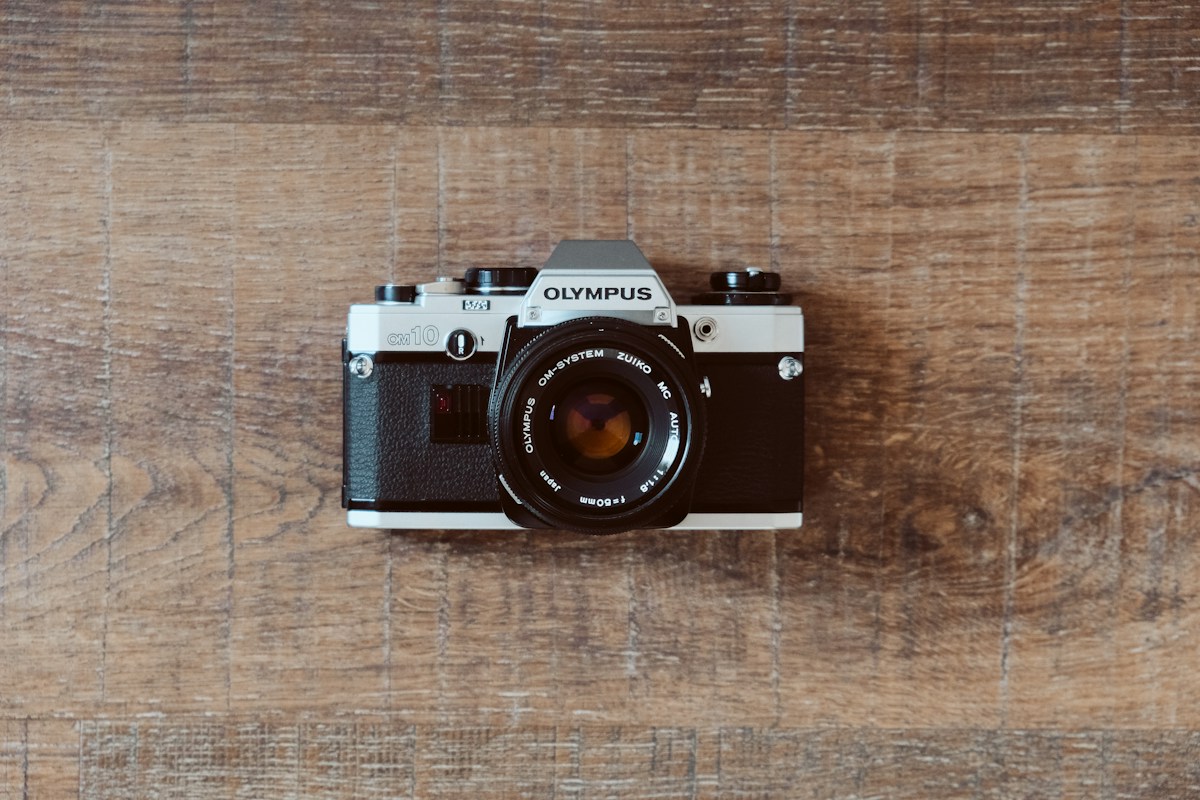
To hold a classic mechanical rangefinder or SLR from the 1950s or 1960s is to commune with an era of peerless horological manufacturing. Cameras like the Leica M3, Nikon F, Canon FTb, or Olympus OM-1 were crafted entirely from cold-rolled brass, optical glass, hardened steel gears, and vulcanite leatherette.
The mechanical feedback loops of these instruments provide deep somatic satisfaction. When your thumb sweeps the film advance lever, you feel the buttery, micro-machined meshing of precision planetary gears cocking the shutter springs and advancing the celluloid sprockets. There is zero electronic delay; every mechanical action is instantaneous, direct, and tactile.
Every camera system possesses its own unique acoustic shutter signature. An early Leica M possesses a gentle, dry, Swiss-watch click. A Nikon F releases with a robust, authoritative metallic ker-chack that communicates unyielding industrial durability. A Hasselblad 500C medium-format SLR announces itself with a thunderous, room-shaking mechanical symphony of auxiliary rear flaps, mirror release, and lens leaf-shutter operation. These tactile and auditory signatures ground the photographer in the physical reality of manual craftsmanship, transforming photography from an unthinking digital click into an embodied creative ritual.
11. Focusing Physics: Effective Base Length (EBL) and Wide-Aperture Calibration
A critical technical parameter governing rangefinder performance is Effective Base Length (EBL). The accuracy of coincident rangefinder focusing is mathematically determined by multiplying the physical base length (the distance between the two optical windows) by the optical magnification of the viewfinder ocular:
EBL = Physical Base Length Ã- Viewfinder Magnification
Consider the legendary 1954 Leica M3. It possesses a physical base length of 68.5mm and an enormous viewfinder magnification of 0.91x (almost life-size 1:1 viewing). Multiplying these figures yields an extraordinary EBL of 62.33mm. This vast optical baseline allowed photographers to focus ultra-fast 50mm f/1.4 and 85mm f/1.5 lenses wide open at close range with microscopic focusing accuracy.
Modern rangefinders designed with wider viewing windows (such as the Leica M6 0.72x or Voigtländer Bessa R 0.68x) trade magnification for wider framelines, allowing 28mm lenses to be viewed without external shoe-mounted viewfinders. However, their lower EBL (approx. 49mm and 25mm respectively) reduces focusing precision with telephoto or ultra-fast glass. Understanding EBL ensures that photographers do not attempt to shoot wide-open f/1.0 optics on compact, short-baseline rangefinder bodies.
12. Zone Focusing and Hyperfocal Mastery: Shooting from the Hip
One of the greatest tactical secrets of master street photographers-such as Garry Winogrand, William Klein, and Daido Moriyama-is that they rarely looked through the viewfinder when working in dense pedestrian crowds. Instead, they relied upon zone focusing and hyperfocal distance.
Classic rangefinder lenses feature an engraved, highly detailed depth of field scale directly on the lens barrel. Surrounding the central focus index mark are pairs of symmetrical lines corresponding to various f-stops (f/4, f/8, f/11, f/16). By stopping the lens down to f/8 or f/11 in daylight, a street photographer can align the infinity mark against the f/8 tick mark. Instantly, the opposite f/8 tick mark indicates that everything from 5 feet to infinity is rendered acceptably sharp.
With hyperfocal depth dialed in, the photographer eliminates focusing time completely. There is no autofocus hunting, no rangefinder patch alignment, and no latency. The photographer simply points the camera from chest or waist level, pre-visualizes the angle of coverage, and fires instantly. Because rangefinder cameras are compact and silent, this technique enables candid, dynamic street documentation of raw, unvarnished human life that would be instantly ruined if the camera were held conspicuously to the eye.
13. Historic Watershed: The 1954 Leica M3 vs. The 1959 Nikon F
The golden era of mechanical camera design is epitomized by the epic ideological clash between two titan platforms: the 1954 Leica M3 and the 1959 Nikon F. These two cameras charted the course of twentieth-century visual history.
When Ernst Leitz introduced the Leica M3 at Photokina 1954, it sent shockwaves through the camera industry. The M3 consolidated coincident rangefinder focusing and bright projected framelines into a single, breathtakingly brilliant 0.91x viewfinder. It featured an ultra-fast bayonet mount (the M mount), an integrated lever wind, and an automatic reset frame counter. The M3 was so mechanically perfect that competitor Nippon Kogaku (Nikon)-which had achieved worldwide acclaim with its screw-mount and S-series rangefinders-recognized that it could not surpass the M3 in rangefinder design.
Nikon made a bold, visionary strategic pivot: it took the rugged chassis, focal-plane shutter, and rangefinder genetics of its Nikon SP, inserted a mirror box and pentaprism, engineered an automatic diaphragm bayonet mount, and unveiled the Nikon F in 1959. The Nikon F became the undisputed king of photojournalism during the Vietnam War, proving that a single modular SLR body could shoot battlefield combat, macro medical specimens, sports stadiums, and NASA orbital missions. The era of rangefinder hegemony ended, but the rangefinder retreated into its pure, specialized niche as the ultimate instrument for street poetry.
14. Horological Maintenance: Calibration, Lubrication, and Rangefinder Alignment
Unlike modern electronic cameras that become disposable electronic waste when circuit boards corrode or sensors fail, mechanical rangefinders and SLRs are fully repairable, horological heirlooms engineered to operate for over a century with proper maintenance.
The primary mechanical maintenance requirement for rangefinders is optical rangefinder calibration. Over decades of street use, accidental bumps, vibrations, and thermal expansions can slightly knock the internal rangefinder mirror out of alignment. Calibration involves adjusting eccentric micro-screws located behind the camera mount or under the top plate, aligning the rangefinder patch on both the horizontal axis (infinity alignment) and the vertical axis (coincidence registration).
Furthermore, mechanical shutters require a periodic Clean, Lubricate, and Adjust (CLA) service every fifteen to twenty years. A skilled camera technician disassembles the body, strips old gummed-up whale oil or synthetic lubricants from gear escapements using ultrasonic solvent baths, applies high-precision synthetic watch oils to jewel bearings, and electronically calibrates shutter curtain tensions to ensure accurate exposure timings within +/- 5% tolerances.
15. The Tactile Psychology of Manual Shooting: Moving Past Autofocus Complacency
In our current era of 60-frames-per-second burst shooting, artificial intelligence subject-tracking autofocus, and in-body sensor stabilization, why are thousands of young contemporary photographers choosing to shoot fully manual mechanical film cameras?
The psychological answer lies in the rejection of algorithmic complacency. When a camera does everything automatically, the human photographer is relegated to a passive button-pusher. The camera’s autofocus algorithm decides what is important in the frame; its auto-exposure algorithm averages away dramatic shadows; its continuous drive fires 200 images of the same gesture, outsourcing artistic discernment to post-processing software.
Operating a fully manual rangefinder or mechanical SLR demands total, unmediated presence. The photographer must read the light with their own biological eyes (or an incident meter), manually set the aperture and shutter speed, manually rotate the focus ring, and wait patiently for the single, decisive gesture. This friction creates deep cognitive engagement. When you nail a frame on a manual rangefinder, the triumph belongs entirely to your human vision, skill, and intuition-not a software engineer’s code.
16. The Modern Rangefinder Renaissance in the Mirrorless Age
Today, in a digital photographic world dominated by mirrorless camera systems, the optical rangefinder occupies an elevated, almost mythical status. Leica continues to manufacture both traditional 35mm film rangefinders (the Leica M-A and M6 reissue) and digital full-frame rangefinders (the Leica M11 family) in Wetzlar, Germany, hand-assembled by master technicians.
Meanwhile, Japanese optical manufacturers such as Cosina (under the licensed Voigtländer brand) produce an extraordinary portfolio of modern M-mount manual prime lenses-such as the 35mm f/1.2 Nokton, 50mm f/1.0 Nokton, and 28mm f/1.5 Vintage Line. These lenses combine classic, compact brass mechanical housings with state-of-the-art anomalous partial dispersion optical glass.
Street photographers, fine-art documentarians, and editorial portraitists gravitate toward modern rangefinders because they offer a pure, distraction-free visual experience. By removing complex LCD menus, eye-tracking boxes, and electronic sensor lag, the rangefinder allows the artist to focus entirely on human emotion, composition, and light.
17. Medium Format Scale: The Texas Leica vs. Modular Studio SLRs
The philosophical divide between rangefinders and single lens reflex systems is not confined to the 35mm miniature format; it scales upward with dramatic intensity into 120 medium format photography. In medium format, the physical size of the camera body and the mass of its internal components expand exponentially, amplifying both the benefits and penalties of each mechanical architecture.
Consider the medium format SLR, epitomized by the modular Hasselblad 500C, Mamiya RB67, or Pentax 67. The reflex mirror required to cover a 6x6cm or 6x7cm negative is a massive, heavy sheet of optical glass. When that mirror swings upward during exposure, the kinetic force is substantial. Handholding a Pentax 67 below 1/125th of a second without tripod support invites noticeable mirror-induced micro-blur. Furthermore, the immense pentaprism adds kilograms of weight to the photographer’s neck, anchoring these cameras primarily to commercial studio stands and landscape tripods.
In stark contrast stands the medium format rangefinder-most famously the legendary Fujifilm GW690 series, affectionately nicknamed “The Texas Leica.” The GW690 produces a gargantuan 6x9cm negative (yielding image resolution comparable to modern 100-megapixel digital sensors) while utilizing a leaf shutter built directly inside its 90mm lens. Because it possesses zero swinging mirror, there is zero mirror shock. A photographer can comfortably handhold the GW690 at 1/30th of a second on city streets, capturing immense medium format tonality and negative latitude with the nimble, handheld speed of a street camera.
18. Bokeh Physics and Aperture Mechanics: Circular Iris Diaphragms vs. Angular Blur
The aesthetic rendering of out-of-focus background areas-known internationally by the Japanese term bokeh-is profoundly influenced by the mechanical design of the lens aperture mechanism. The relationship between lens architecture and aperture design reveals another fascinating distinction between rangefinder and SLR systems.
In modern and vintage SLR lenses, the aperture diaphragm must remain wide open during viewing to ensure the ground glass viewfinder is bright enough for focusing. When the shutter release is pressed, an internal mechanical lever or electromagnetic solenoid instantly slams the aperture blades down to the chosen shooting aperture (e.g., f/8) a fraction of a millisecond before the mirror flips. To minimize friction and guarantee lightning-fast actuation, SLR lens designers historically limited the diaphragm to five, six, or eight straight-edged aperture blades. Consequently, when stopped down, out-of-focus specular highlights take on harsh, polygonal geometric shapes: pentagons, hexagons, or octagons.
In classic rangefinder lenses, however, the photographer never views through the taking lens; the viewfinder brightness is completely unaffected by the lens aperture setting. Therefore, rangefinder lenses do not require complex, rapid-stop-down automatic mechanisms. Optical engineers could pack the lens barrel with ten, twelve, or even fifteen curved aperture blades (such as the legendary 15-blade iris of the 1950s Leitz 50mm Summarit or modern Voigtländer primes). These high-blade-count diaphragms maintain a virtually perfect circular opening at every f-stop, rendering out-of-focus background elements with creamy, velvety smoothness and zero angular distortion.
19. Comparative Diagnostic Matrix: Optical Rangefinders vs. Single Lens Reflex Systems
To systematically summarize the architectural, optical, and operational distinctions between rangefinder and single lens reflex platforms, we must contrast their mechanical performance across structural photographic dimensions. Understanding these core differences enables street photographers, documentary chroniclers, and optical collectors to choose the optimal mechanical companion for their unique visual rhythm.
The comparative diagnostic matrix below contrasts classical optical rangefinders with traditional single lens reflex systems across foundational functional criteria. By examining viewfinder mechanics, lens compatibility, shutter blackout, operational acoustic footprint, and field ergonomics, one gains an objective guide to how physical camera engineering dictates photographic workflow.
Notice that while SLRs provide absolute versatility, telephoto reach, and parallax-free macro precision, rangefinders excel in street discretion, peripheral spatial awareness, and vibration-free low-light handheld shooting. Master photographers often carry both systems: an agile rangefinder for street encounters and a robust SLR for telephoto landscapes and precision studio portraits.
| Operational Parameter | Optical Rangefinder System (e.g., Leica M) | Single Lens Reflex System (e.g., Nikon F) |
|---|---|---|
| Viewfinder Architecture | Direct optical window with floating framelines | Through-the-lens (TTL) ground glass via pentaprism |
| Shutter Blackout | Zero blackout; continuous, uninterrupted vision | Viewfinder blinds during mirror flip at exposure |
| Acoustic Footprint & Vibration | Whisper-quiet cloth curtain; zero mirror slap | Noticeable mirror slap clatter and kinetic shock |
| Wide-Angle Lens Optics | Compact, symmetrical non-retrofocus formulas | Bulky inverted telephoto (retrofocus) designs |
| Framing Accuracy (Parallax) | Parallax error at close range (minimum focus 0.7m) | 100% parallax-free framing at any distance or macro |
| Telephoto & Macro Versatility | Severely limited above 135mm; no native macro | Infinite versatility (extreme telephotos, bellows, zooms) |
Frequently Asked Questions About Rangefinders and SLR Cameras
What is the main advantage of a rangefinder over an SLR for street photography?
Rangefinders are compact, unobtrusive, and exceptionally quiet because they have no reflex mirror. Furthermore, they exhibit zero shutter blackout, allowing the photographer to see the exact moment of exposure while viewing subjects outside the frame margins.
Can I use telephoto lenses on a rangefinder camera?
While rangefinders support lenses up to 90mm and 135mm, telephoto shooting is challenging because the frameline in the viewfinder becomes very small. For lenses longer than 135mm, SLRs are vastly superior because the viewfinder automatically enlarges the image to fill the entire frame.
What does parallax error mean in rangefinder photography?
Parallax error occurs because the rangefinder viewfinder is located several centimeters above and to the left of the lens axis. While modern rangefinders have framelines that shift to compensate for this, framing close-up subjects (under 1 meter) can result in slight compositional offsets.
Why can rangefinders shoot at slower handheld shutter speeds than SLRs?
SLRs have a large mechanical mirror that flips up rapidly before exposure, causing kinetic vibration known as mirror slap. Rangefinders have no mirror, allowing photographers to shoot handheld at shutter speeds like 1/15s or 1/8s without camera shake.
How does a coincident split-image rangefinder work?
The rangefinder uses two windows separated by a baseline distance. Light from the secondary window reflects off a rotating mirror into a central beamsplitter. As you turn the lens focus ring, the secondary ghost image moves until it aligns perfectly over the main image, indicating exact focus.
Why are vintage rangefinder lenses generally smaller than vintage SLR lenses?
SLR cameras need a deep cavity between the lens and film to clear the swinging reflex mirror, requiring complex, bulky retrofocus designs for wide-angle lenses. Rangefinders allow lenses to sit mere millimeters from the film, enabling ultra-compact symmetrical designs.
What is Effective Base Length (EBL)?
Effective Base Length is the physical distance between the two rangefinder windows multiplied by the viewfinder magnification. A higher EBL allows more precise focusing, which is critical when shooting fast lenses (like 50mm f/1.4 or f/1.2) wide open.
Can mechanical film rangefinders be repaired today?
Yes. High-quality mechanical rangefinders like the Leica M series are crafted from brass and steel with no electronics. Skilled independent camera technicians worldwide perform routine Clean, Lubricate, and Adjust (CLA) services to keep them working flawlessly for decades.
18. Honoring the Mechanical Soul of Photography
In our headlong rush toward computational imaging, AI generative prompts, and smartphone algorithms, photography risks losing its essential connection to human craft and physical reality. An image generated without effort, without friction, and without presence is an image stripped of emotional gravity.
The enduring appeal of classical rangefinders and mechanical single lens reflex cameras lies in their demanding, rewarding honesty. These brass-and-glass instruments do not lie to us, do not coddle us, and do not make decisions on our behalf. When you walk through city streets with a mechanical rangefinder around your neck, you are engaged in an ancient, noble form of human attention: watching, anticipating, breathing, and capturing the fleeting beauty of our mortal world with your own hands and heart. In the mechanical precision of gears and prisms, the soul of photography remains vibrant, timeless, and profound.


1 Comment
Pingback: Medium Format Film Optics: Visual Physics and Depth Characteristics of Larger Negative Formats – Anemoia