

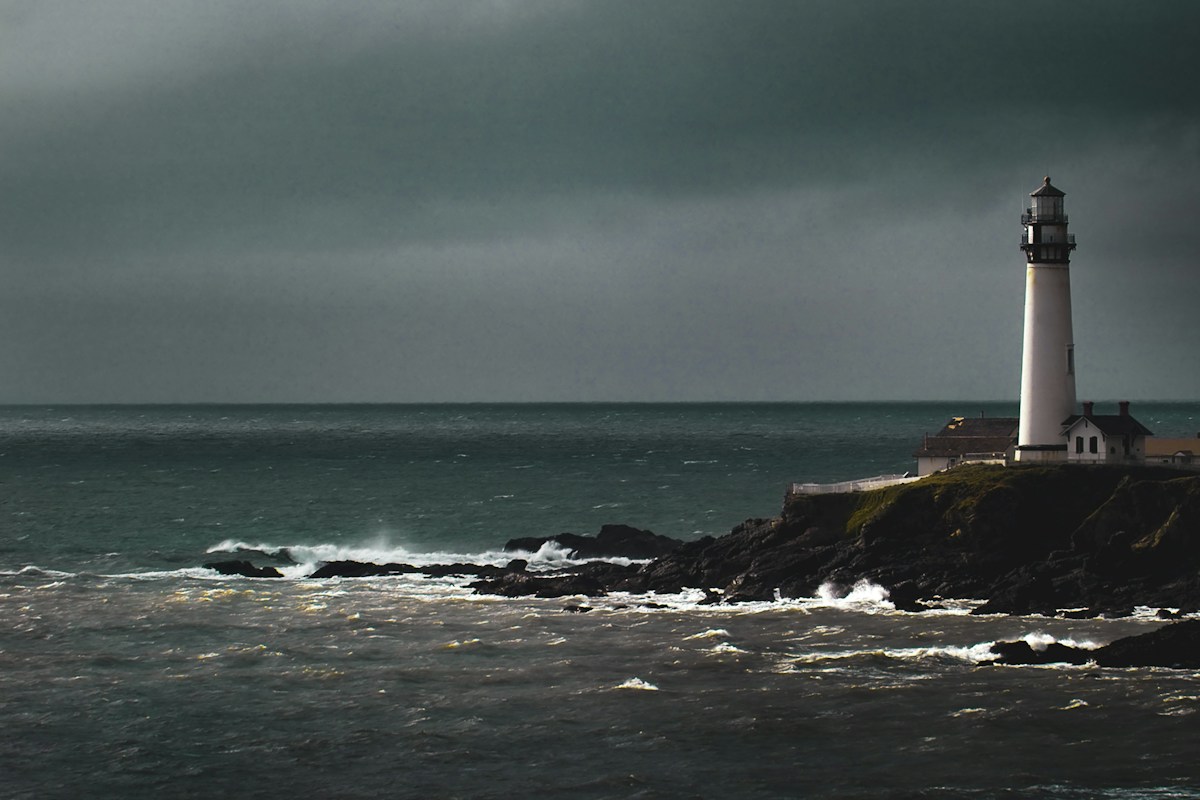
Stand atop a jagged, wave-swept granite reef twelve miles off the storm-lashed coast of Cornwall or the treacherous Scottish shoals of the North Sea during a ferocious winter gale, and you witness the absolute extremes of natural kinetic violence. Mountainous Atlantic swells, driven by hurricane-force winds, surge out of the abyssal deep and slam into isolated granite pillars with instantaneous impact pressures exceeding thirty tons per square meter. Breakers explode into white geysers of spray that vault two hundred feet into the air, completely engulfing lantern rooms and rattling multi-ton masonry blocks. Yet inside that vibrating column of stone, a brilliant beam of concentrated optical light rotates with silent, clockwork precision, sweeping across dark oceanic swells to warn mariners away from catastrophic watery graves.
For more than three centuries, the offshore rock lighthouse has represented the ultimate heroic duel between human civil engineering and the untamable fury of the sea. Long before diesel generators, satellite GPS navigation, radar transponders, or motorized crane barges, pioneer structural engineers ventured onto submerged tidal reefs that emerged above water for only a few fleeting hours during spring low tides. Working knee-deep in freezing surf with hand picks, gunpowder, and iron wedges, they carved foundations directly into living bedrock, invented interlocking dovetailed granite masonry, formulated waterproof hydraulic cements, and engineered stepped hyper-conical towers that transformed the destructive kinetic shock of ocean breakers into harmless upward trajectories.
In this authoritative civil engineering, architectural, and maritime treatise, we deconstruct the design and historical evolution of offshore rock lighthouses. We trace the harrowing trials of the Eddystone Reef from Henry Winstanley’s whimsical wooden pagoda to John Smeaton’s revolutionary oak-trunk granite tower, analyze the heroic Scottish engineering dynasty of Robert Stevenson at Bell Rock, examine the fluid mechanics of hydrodynamic wave impacts and bedrock scour, deconstruct Augustin-Jean Fresnel’s dioptric stepped-lens revolution, examine the psychological endurance of lonely nineteenth-century lighthouse keepers, and evaluate modern structural preservation efforts maintaining these stone sentinels against rising seas.
1. The Treacherous Shallows: Shipwrecks, Reefs, and the Age of Sail Peril
To understand the sheer urgency that drove the engineering of offshore lighthouses, one must first comprehend the lethal perils of coastal navigation during the seventeenth and eighteenth centuries: the Golden Age of Sail.
Sailing ships were entirely dependent on wind and tidal currents. Approaching a home coastline after months at sea across the Atlantic or Indian Oceans, navigators faced their most perilous trial: making landfall. Navigating by celestial dead reckoning with brass octants and lead-line soundings, a navigational error of even a single nautical mile in fog or gale conditions meant total annihilation. Jagged offshore rock ledges-submerged at high tide and barely visible beneath foaming breakers-acted as razor-sharp continental traps, slicing through wooden oak hulls in seconds.
Nowhere was this terror more acute than on the Western Approaches to the English Channel and the Irish Sea. Thousands of ships, carrying precious colonial cargoes of timber, spices, grain, and human lives, were pounded into splinters on uncharted offshore reefs. The human and economic toll was staggering; in 1707, an entire British Royal Navy squadron commanded by Admiral Sir Cloudesley Shovell struck the Western Rocks of the Isles of Scilly in dense fog, drowning nearly two thousand sailors in a single catastrophic night. Coastal commerce demanded structural beacons that could shine from the very teeth of the reefs themselves.
2. The Eddystone Lighthouse Saga: From Winstanley’s Folly to Smeaton’s Oak Tree
The undisputed ancestral crucible of offshore lighthouse engineering is the Eddystone Rocks, a notorious group of submerged gneiss reefs situated fourteen miles southwest of Plymouth, England. Swept by savage Atlantic swells and funneling tidal currents, the reef had claimed hundreds of vessels before anyone dared attempt the impossible task of erecting an artificial tower upon it.
The pioneer was an eccentric London merchant, inventor, and showman named Henry Winstanley. Between 1696 and 1698, Winstanley anchored an ornate, sixty-foot octagonal wooden tower to the rock using iron dowels. Painted with gold sunbursts, fitted with ornamental balconies, open verandas, and whimsical wind vanes, Winstanley’s tower resembled a baroque garden pagoda rather than a maritime fortress. Despite warnings that the ornate overhangs presented lethal wind resistance, Winstanley possessed supreme confidence, famously declaring: “I wish I may be in the lighthouse during the greatest storm that ever blew under heaven, to see what effect it will have upon the structure.”
On the night of November 26, 1703, Winstanley was staying in his lighthouse when the Great Storm of 1703-the most destructive hurricane in recorded British history-struck the southern coast. When morning dawned, the Eddystone reef was completely bare; Winstanley, his five keepers, and the ornate wooden tower had been swept into the sea without leaving a single trace. A second wooden tower, designed by John Rudyard with a smooth cone silhouette, survived for nearly fifty years until it was consumed by an unstoppable lantern fire in 1755, demonstrating that wood was fatally unsuited to withstand either oceanic water or domestic fire.
3. Smeaton’s Dovetailed Granite: Mechanical Interlocking and Hydraulic Lime Mastery
The turning point in civil engineering history arrived in 1756 with John Smeaton, the founder of the modern profession of civil engineering. Smeaton recognized that to resist the dynamic kinetic power of Atlantic waves, a tower could not rely on iron rods fastened into wood; it required massive dead weight, monolithic structural continuity, and total hydrodynamic streamlining.
Seeking architectural inspiration, Smeaton observed the natural geometry of a mature English oak tree. He noted how an oak rises from its roots with a broad, spreading base, curves inward with an elegant concave hyperbolic flair to minimize wind resistance, and rises with a sturdy, flexible vertical trunk. Smeaton resolved to build his tower from solid granite blocks imitating this organic profile. However, stacking loose stones on a reef was impossible; incoming waves would pluck individual blocks from the wall before mortar could cure.
To solve this crisis, Smeaton invented two revolutionary structural systems:
- Three-Dimensional Dovetailed Joinery: Every single granite block was carved with complex male and female dovetail tenons along its top, bottom, and side faces. When fitted together, each horizontal layer formed an indivisible, interlocking puzzle ring. Once a course was completed, no single stone could be removed or displaced without lifting the entire forty-ton layer simultaneously.
- Hydraulic Lime Mortar: Smeaton conducted pioneering chemical experiments with various limes, discovering that limestone containing a high proportion of clay minerals produced a mortar that would set rapidly underwater. Blending burned blue lias limestone from Aberthaw with Italian volcanic pozzolana, Smeaton formulated the world’s first modern hydraulic cement, creating joint seals that cured into impermeable stone beneath surging saltwater.
Completed in 1759, Smeaton’s Eddystone tower stood triumphantly for over 120 years, proving that human engineering could conquer open oceanic reefs.
4. The Stevenson Dynasty: Robert Stevenson, Bell Rock, and Scottish Coastal Engineering
While Smeaton conquered Eddystone, the challenge was elevated to even more terrifying proportions along the jagged, fog-bound coast of Scotland by the legendary Stevenson engineering family. For four generations, the Stevensons-beginning with Robert Stevenson and continuing through his sons Alan, David, and Thomas (the father of author Robert Louis Stevenson)-designed and constructed dozens of the most daring offshore lighthouses in the world under the Northern Lighthouse Board.
The supreme trial was the Bell Rock (Inchcape Reef), situated eleven miles off the coast of Angus in the North Sea. Unlike Eddystone, which remained partially exposed at high tide, Bell Rock was an entirely submerged sandstone reef that was drowned beneath twelve to sixteen feet of raging sea twice daily, emerging for a mere three to four hours during low water. Building an eighty-foot stone tower upon a reef that barely existed seemed like suicidal madness.
Between 1807 and 1810, Robert Stevenson mounted a military-style engineering campaign. To house his stonemasons safely above the crashing breakers, he erected a towering temporary wooden barracks on iron stilts anchored into the sandstone. Stonemasons labored furiously during low tide, standing in swirling surf to cut foundation steps with hand chisels, retreating up the barracks ladder as the tide roared in beneath them. Stevenson refined Smeaton’s dovetail system, designing an even broader hyperbolic base and incorporating internal joggled pins. Commissioned in 1811, the Bell Rock Lighthouse has never suffered a structural failure in over two centuries, standing today as the oldest surviving sea-washed rock lighthouse in the world.
5. The Physics of Wave Impact: Hydrodynamic Shock Waves, Upward Plumes, and Scour
The structural forces confronting an offshore rock lighthouse are among the most violent dynamic loads encountered in terrestrial civil architecture. Civil engineers divide wave loading into three distinct hydrodynamic phases:
- Quasi-Static Hydrostatic Pressure: The steady, lateral fluid force exerted by the continuous body of moving water as a wave crest rushes past the tower, calculated using classical fluid drag equations based on tower diameter and current velocity.
- Dynamic Peak Shock Impact: The catastrophic, instantaneous hammer-blow delivered when a plunging breaking wave slams directly against the vertical stone face. When an breaking wave traps a pocket of air between the water wall and the masonry, the sudden compression of that air pocket generates an acoustic shock wave with peak pressures exceeding 300 to 500 kilonewtons per square meter lasting for fractions of a second. This shock wave can shatter unreinforced stone or force saltwater through micro-fissures in mortar joints like a hydraulic wedge.
- Upward Plume and Free-Fall Shock: When a horizontal breaker hits a curved concave tower base, the geometry redirects the horizontal kinetic energy vertically, shooting thousands of tons of water upward in a vertical jet. When this plume stalls at its zenith and crashes back down onto the lantern gallery, it delivers an enormous vertical dead-weight impact load capable of crushing bronze roofs and iron railings.
In addition to surface impact, engineers must calculate hydrodynamic scour: the high-velocity underwater vortex created around the base of the tower that erodes the soft bedrock supporting the foundation, threatening to undercut the entire structure over decades.
6. Siting and Foundation Anchoring: Caissons, Rock-Cut Foundations, and Doweling
An offshore lighthouse is only as strong as its connection to the seabed. If the underlying rock fractures or slips along a geological fault line, the entire tower will topple regardless of how perfectly its masonry is dovetailed. Consequently, site selection and foundation preparation were the most critical stages of construction.
Before laying a single block, engineers spent months conducting subsea geological surveys. Divers equipped with early brass Siebe Gorman diving helmets descended onto the wave-swept reefs to examine rock strata, mapping joint planes, fault lines, and rock hardness. Once the site was chosen, stonemasons blasted and chiseled the uneven, sloping reef face into a series of stepped, horizontal rock benches. Every step was leveled to absolute horizontal precision so that the foundation stones sat flat against the earth, preventing lateral sliding.
To anchor the foundation courses against the sea, engineers bored deep vertical holes through the granite blocks into the living bedrock using heavy iron jumpers. Into these shafts they drove massive forged wrought-iron or bronze dowels up to three inches in diameter and six feet long. To lock the dowels permanently in place, workers poured molten sulfur or molten lead down the hole around the metal, which expanded upon cooling to form an indestructible, mechanical molecular anchor connecting the artificial tower to the continental crust.
7. Curved Conical Geometry: How Hyperbolic and Exponential Flairs Dissipate Wave Energy
The iconic, graceful silhouette of an offshore rock lighthouse-the broad flared skirt tapering smoothly upward into a slender cylindrical column-is not an aesthetic choice; it is an exercise in hydrodynamic fluid dynamics.
A simple vertical stone cylinder presents a flat, unyielding obstruction to incoming waves. When a storm breaker strikes a vertical wall, the kinetic energy has nowhere to go; it dissipates entirely as a shattering impact force against the masonry. Conversely, a broad, sloping cone redirects fluid flow. As an ocean wave encounters the flared hyperbolic base of the tower, the rising curve acts as an inclined ramp.
The wave’s kinetic energy is smoothly transformed: the horizontal momentum of the water is converted into vertical upward velocity. Rather than slamming against the tower with explosive force, the wave glides upward along the curved granite profile, shedding kinetic energy against gravity before curling harmlessly away into spray. Furthermore, the exponential upward taper minimizes the surface area exposed to high-elevation wind buffeting, ensuring that wind shears during hundred-mile-per-hour gales cannot induce destructive resonance frequencies or torsional twisting within the stone column.
8. From Wood Bonfires to Sperm Oil: Early Illumination and Reflector Systems
Building an indestructible stone tower was only half the engineering challenge; the structure was useless unless it projected a luminous signal visible to ships across miles of rain, spray, and fog. For the first two centuries of modern lighthouse construction, light sources were shockingly crude and inefficient.
Sixteenth-century beacons-such as the original Tower of Cordouan at the mouth of the Gironde estuary in France-burned open bonfires of oak logs or mineral sea-coal inside open iron fire-cages (chauffoirs). These fires consumed tons of fuel, produced choking clouds of black smoke that blackened glass windows, and threw a weak, flickering red glow that was barely visible beyond three or four nautical miles. Keepers spent entire nights frantically shoveling coal and stoking flames.
In the late eighteenth century, open fires were replaced by oil lamps burning vegetable colza oil or sperm whale oil (harvested from the head cavities of sperm whales, prized for burning with a clear, smoke-free flame). In 1782, Swiss physicist Aimé Argand invented the Argand lamp: a hollow cylindrical braided cotton wick surrounded by glass chimneys that supplied air directly to the center of the flame, multiplying luminous intensity tenfold. To direct this light toward the horizon, engineers mounted Argand lamps inside polished silvered parabolic copper reflectors: a system known as the catoptric system. However, parabolic reflectors scattered large amounts of light into the sky and sea, losing over eighty percent of the flame’s total radiant output.
9. Augustin-Jean Fresnel and the Dioptric Revolution: Stepped Prisms and Collimated Light
The monumental breakthrough that revolutionized maritime safety and optical physics arrived in 1822 through the brilliant French civil engineer and physicist Augustin-Jean Fresnel. Tasked by the French Lighthouse Commission with improving light efficiency, Fresnel realized that ordinary curved glass lenses were impractical for lighthouses: to concentrate light over great distances, a conventional glass lens would have to be colossal, weigh several tons, absorb most of the light inside its thick core, and crack from the intense heat of the lamp.
Fresnel’s stroke of genius was the invention of the stepped dioptric lens (the Fresnel lens):
- Concentric Annular Rings: Fresnel mathematically eliminated the thick center of a curved lens, slicing it into concentric circular rings of stepped glass prisms mounted inside an ornate brass framework. Each ring had a slightly different prism angle, calibrated so that all individual glass sections focused light to the exact same focal point.
- Catadioptric Prisms: Above and below the central refractive rings, Fresnel added triangular glass prisms that operated on total internal reflection. These catadioptric rings captured light rays shooting upward toward the clouds and downward toward the rocks, reflecting and refracting them into the horizontal plane.
The result was an optical miracle: rather than scattering light in all directions, the Fresnel lens captured over eighty-five percent of the lamp’s light and concentrated it into an intensely bright, razor-sharp horizontal sheet of parallel beams (collimated light) visible for over twenty-five nautical miles. Often referred to as “the invention that saved a million ships,” the Fresnel lens transformed lighthouses into optical laser cannons of the nineteenth century.
10. Clockwork Revolving Carousels: Mercury Baths and Mechanical Weight Drives
To prevent mariners from confusing one lighthouse with another along a crowded coastline, authorities assigned each sentinel a unique optical signature: its light characteristic. One lighthouse showed a steady white beam; another flashed twice every ten seconds; another flashed red and white alternately.
Producing these timed flashes required rotating the colossal, multi-ton Fresnel lens apparatus continuously through 360 degrees. In an era before electric motors, this monumental mechanical task was accomplished via heavy clockwork mechanisms powered by falling gravity weights. Inside the central hollow stone core of the tower, a cylindrical lead weight weighing several hundred pounds was suspended on a steel cable wrapped around a geared drum. Every four hours, the keeper cranked a heavy bronze handle to hoist the weight to the top of the tower. As the weight descended under gravity, it drove an escapement train regulated by a spinning centrifugal fly governor, turning the giant lens carousel with absolute temporal precision.
In early installations, the giant lens rotated on brass wheels rolling along iron rails, generating massive frictional drag that wore out parts quickly. In 1890, French engineer Bourdelles introduced a revolutionary friction-free design: the mercury float bath. The entire multi-ton assembly of glass lenses and bronze frames was mounted atop an annular cast-iron hollow drum floating inside a trough filled with liquid metallic mercury. Because mercury has a staggering specific gravity of 13.6, the multi-ton lens floated on the dense liquid metal with virtually zero friction; a keeper could spin a four-ton optical apparatus with the gentle touch of a single finger, allowing small clockwork motors to turn the light reliably for decades.
11. The Fog Signal Evolution: Cannons, Bells, Compressed-Air Sirens, and Diaphones
Even the blinding intensity of a hyper-radiant Fresnel lens was utterly helpless against one atmospheric adversary: dense coastal sea fog. In zero-visibility fogbanks, light rays are scattered and absorbed by microscopic water droplets within a few hundred feet of the tower. To warn blinded ships, lighthouses had to speak through the medium of sound.
The early history of fog signaling was crude, dangerous, and exhausting:
- Fog Bells and Signal Guns: Keepers tolled massive bronze church bells with manual hammers or fired cast-iron signal carronades packed with black powder every fifteen minutes throughout days of continuous fog. The sound was directional and easily smothered by howling storm winds.
- Steam and Compressed-Air Sirens: In the late nineteenth century, steam boilers and petroleum hot-air engines were installed in lighthouse basements to compress air into giant storage tanks. This compressed air was discharged through rotating slotted disks, producing ear-splitting sonic screams that could penetrate maritime fog for several miles.
- The Canadian Diaphone: Invented in 1903 by J.P. Northey, the diaphone foghorn became the definitive acoustic voice of the coast. Operating via a reciprocating slotted piston driven by compressed air, the diaphone produced a powerful, bone-rattling low-frequency blast ending in a sudden drop in pitch: the famous two-tone “grunt” (haw-ooo-ugh) that could penetrate five to ten miles of heavy Atlantic sea mist.
12. The Solitary Keepers: Isolation, Logbooks, Clockwork Winding, and Tragic Storms
Behind the magnificent stone architecture and complex optics was the unsung human element: the lightkeepers. On offshore rock stations, life was an austere monastic existence governed by unbending discipline, relentless cleanliness, and terrifying isolation.
Crews typically consisted of three men serving six-week tours of duty, followed by two weeks of shore leave (contingent upon relief boats being able to land through savage surf). Their daily routine was grueling: every morning at sunrise, the lamp was extinguished, the precious optical prisms were polished with chamois leathers, the wick was trimmed, and linen protective curtains were drawn around the glass to prevent the focused sun rays from magnifying through the lens and melting the bronze burner. Every night, keepers stood four-hour watches, rewinding the heavy clockwork weights, trimming burning wicks, and watching the horizon for ships in distress.
The psychological toll of living inside a vibrating stone cylinder surrounded by howling ocean gales was immense. Confined to circular rooms barely twelve feet in diameter, men lived in enforced silence, battling cabin fever, scurvy, and despair. Occasionally, the sea claimed them; the most chilling mystery occurred in December 1900 on the Flannan Isles off the Outer Hebrides, when relief crews arrived to find the lighthouse locked and cold, the clock stopped, a half-eaten meal on the table, and all three keepers vanished forever without a single trace.
13. Cast-Iron Screw-Pile Lighthouses: Conquering Shoals and Muddy Estuaries
While solid granite masonry was ideal for hard bedrock reefs, vast expanses of the world’s coastline-such as the shifting sandy barrier shoals of North Carolina, the Chesapeake Bay, and the mudflats of the Thames Estuary-possessed no solid bedrock upon which to erect a thousand-ton stone tower. Building masonry on soft sand resulted in rapid sinking, tilting, and catastrophic foundation scouring.
To illuminate these shifting shoals, blind Irish civil engineer Alexander Mitchell patented a revolutionary structural foundation in 1833: the screw-pile. Mitchell realized that while sand and silt could not support dead weight, a broad helical blade could screw deep into marine sediment and resist both downward settlement and upward tension.
Screw-pile lighthouses were constructed using slender, hollow wrought-iron piles fitted with large cast-iron auger screws at their tips. Workers turned the piles using giant wooden capstans powered by dozens of men walking in circles on a floating barge, driving the screws ten to twenty feet deep into the seabed. Atop this spider-like framework of braced iron stilts, builders erected a lightweight octagonal wooden cottage and lantern room. Open to the sea, storm waves passed freely through the slender iron legs with minimal resistance, successfully illuminating thousands of miles of hazardous estuarine shallows.
14. Fastnet Rock: The Teardrop of Ireland and Monster Atlantic Swells
Known as “the Teardrop of Ireland” because it was the last sight of Irish homeland seen by millions of emigrants sailing to North America, Fastnet Rock sits on an isolated, wave-lashed pinnacle four miles southwest of Cape Clear Island in the open Atlantic.
The first lighthouse on Fastnet, a cast-iron tower built in 1854, suffered terrifying structural vibrations during storms. During an 1881 hurricane, a rogue breaker exploded over the rock, shattering the glass lantern 148 feet above sea level and tearing away iron handrails. Fearing the tower would snap off at its base, the Commissioners of Irish Lights commissioned master engineer William Douglass to construct an indestructible replacement.
Erected between 1897 and 1904 from 2,074 interlocking Cornish granite blocks weighing over 4,300 tons, the modern Fastnet lighthouse is an engineering masterpiece. Every block was carved in Cornwall, fitted together in an onshore trial yard, numbered, and shipped to the rock on a dedicated steamship. During construction, the engineering team survived dozens of gales trapped inside the unfinished granite stub. Fastnet has withstood rogue waves exceeding one hundred feet in height, including the infamous 1979 Fastnet Yacht Race disaster, standing as an unyielding breakwater against the full weight of the Atlantic Ocean.
15. The Automation Era: Electric Generators, Photovoltaic Arrays, and Remote Monitoring
The twentieth century brought sweeping technological changes that transformed the traditional offshore lighthouse. The introduction of high-intensity electric incandescent lamps, xenon flash tubes, and automated diesel generators gradually eliminated the need for manual wick trimming and clockwork winding.
Between 1970 and 2000, national lighthouse authorities across the globe-such as Trinity House in England, the Northern Lighthouse Board in Scotland, and the United States Coast Guard-undertook systematic automation programs. Modernization engineers retrofitted historic towers with solid-state optical sensors, solar photovoltaic arrays, automated backup battery banks, and satellite telemetry links that monitor lamp function and power levels from centralized shore control centers.
In November 1998, the historic North Foreland Lighthouse in Kent became the final lighthouse in England to be fully automated, ending more than four centuries of resident lightkeepers. Today, modern maritime navigation relies predominantly on Global Navigation Satellite Systems (GNSS), Electronic Chart Display and Information Systems (ECDIS), and Automated Identification System (AIS) radio transponders. Yet despite these digital marvels, visual lighthouses remain legally mandated as redundant failsafe aids to navigation, impervious to satellite jamming, electrical grid failures, or cyber warfare.
16. Historic Preservation and Cultural Legacy of Coastal Sentinels
Today, offshore rock lighthouses are recognized worldwide as irreplaceable monuments of industrial archaeology, maritime heritage, and heroic civil engineering.
Preserving these isolated sentinels poses complex modern logistical challenges. Deprived of the daily maintenance and coal-stove warmth once provided by full-time resident keepers, unheated granite towers face chronic interior condensation, salt efflorescence, and corrosion of historic cast-iron window frames and bronze fittings. Heritage conservation bodies deploy specialized masonry preservation teams via helicopter to replace failing hydraulic mortar, apply breathable silicone water-repellents, and restore historic Fresnel lenses to pristine museum standards.
Culturally, the lighthouse remains one of the most potent symbols in the collective human psyche: an unshakeable moral emblem of hope, guidance, solitary vigilance, and resilience against chaos. Standing lone against gray ocean swells and screaming gales, these stone sentinels remind us of an era when courageous human engineers dared to plant foundations upon the ocean floor, conquering the untamed wilderness of the sea to safeguard the passage of their fellow human beings.
Comparative Engineering Analysis: Monumental Offshore Rock Lighthouses
To understand the technological triumphs and structural diversity of oceanic lighthouse construction, one must analyze the defining offshore rock stations built during the golden age of coastal engineering. Each structure was forced to overcome unique hydrodynamic forces, differing seabed geologies, and extreme geographical isolation.
The following comparative engineering matrix deconstructs six of the most celebrated offshore rock lighthouses in maritime history. It evaluates their construction eras, marine locations, structural materials, focal plane heights, and primary engineering innovations, illustrating how pioneer builders pushed the boundaries of material science and fluid dynamics to conquer the sea.
| Lighthouse Name | Location & Date | Structural Material | Focal Height | Light Range | Key Engineering Breakthrough |
|---|---|---|---|---|---|
| Eddystone III (Smeaton) | Cornwall, England (1759) | Interlocking Granite | 22 meters | 10 nm | Invented dovetailed masonry blocks and underwater hydraulic lime mortar. |
| Bell Rock | North Sea, Scotland (1811) | Granite and Sandstone | 28 meters | 18 nm | First tower built on a completely submerged tidal reef; by Robert Stevenson. |
| Cordouan | Gironde, France (1611) | Dressed White Ashlar | 68 meters | 22 nm | The “Patriarch of Lighthouses”; site of Fresnel’s first stepped lens test in 1823. |
| Minot’s Ledge | Massachusetts, USA (1860) | Quincy Granite Ashlar | 35 meters | 15 nm | Deeply doweled foundation designed to resist lethal Atlantic nor’easters. |
| Bishop Rock | Isles of Scilly, UK (1858) | Granite with Iron Armor | 49 meters | 20 nm | Guinness World Record as world’s smallest island with a building; helipad roof. |
| Fastnet Rock | County Cork, Ireland (1904) | Cornish Granite Blocks | 48 meters | 27 nm | Massive 4,300-ton interlocking dovetailed monolith resisting 100ft rogue waves. |
Frequently Asked Questions About Historic Lighthouses and Coastal Engineering
How did Victorian stonemasons build lighthouses on reefs submerged under the ocean?
Masons worked during spring low tides when the reef emerged for only three to four hours. Crews jumped onto the slippery weed-covered rocks with picks and hammers, cutting stepped benches into the stone. As the high tide roared back in, they evacuated to anchored support tenders or temporary wooden barracks on iron stilts. Once the foundation was cut, pre-carved granite blocks were lowered into place by treadwheel cranes, locked with iron dowels, and grouted with quick-setting hydraulic lime cement before the ocean returned.
Why do offshore lighthouses have an outward curving, flared shape at their base?
The concave hyperbolic flair-first pioneered by John Smeaton after observing how oak trees resist wind-acts as a hydrodynamic wave deflector. When a massive breaking sea slams against the base, the curved granite surface redirects the horizontal kinetic energy of the water upward into a vertical geyser. This converts destructive shock impact into a harmless spray, shielding the main stone column and preventing wave cavitation from plucking stones out of the wall.
How did a Fresnel lens make light visible over twenty miles away?
Ordinary glass lenses absorb light in their thick cores and scatter rays in all directions. Augustin-Jean Fresnel eliminated the thick glass core by arranging stepped concentric prism rings around a central bullseye. Combined with upper and lower reflecting prisms that utilize total internal reflection, the lens captures over eighty-five percent of the lamp flame’s light and focuses it into a concentrated, parallel horizontal sheet of beam rays that sweeps across the sea without wasting energy into the sky or water.
Why did revolving lighthouse lenses float in troughs of liquid mercury?
A complete first-order Fresnel lens assembly, including brass armature and prisms, weighs between three and six tons. Rolling such massive weight on steel bearings or wheels created immense frictional drag that quickly ground components down. In 1890, engineers discovered that by floating the lens carriage in a circular trough filled with liquid mercury (which is thirteen times denser than water), the multi-ton optical system floated effortlessly. Frictional resistance became so negligible that a keeper could rotate the multi-ton lens with a light push of a finger.
Are there any manual lighthouse keepers left operating in the world today?
In the vast majority of developed maritime nations-including the United Kingdom, the United States, Canada, France, and Australia-all offshore and coastal lighthouses have been fully automated with electric lamps, solar arrays, and computerized satellite telemetry. A rare exception is the historic Boston Light in Massachusetts, where the United States Congress legally mandated the presence of a ceremonial Coast Guard keeper to preserve centuries of American maritime tradition.
What is a “screw-pile” lighthouse and why was it invented?
Screw-pile lighthouses were invented in 1833 by blind Irish engineer Alexander Mitchell for locations with soft sand, mudflats, or coral shoals where heavy stone towers would sink and collapse. Long iron poles fitted with broad helical auger blades were screwed deep into seabed sand. Atop these spindly, open iron legs sat a wooden cottage and light. Because the open iron framework allowed waves to pass cleanly between the legs rather than slamming against a solid wall, screw-pile structures survived savage bay storms with ease.
How did lighthouse keepers survive weeks of isolation without going mad?
Survival depended on strict military discipline and relentless physical routine. Keepers were forbidden from remaining idle; their days were filled with polishing brasswork, scrubbing soot from lanterns, maintaining engine air-compressors, recording meteorological observations every few hours, and preparing meals. Stations housed three keepers at all times to prevent unilateral breakdowns and maintain continuous four-hour watch rotations. Many keepers passed off-watch hours by crafting ship models inside glass bottles, painting seascapes, or studying botany.
Why do modern ships still need lighthouses when they have GPS and radar?
While modern commercial vessels rely heavily on GPS, satellite navigation is vulnerable to radio frequency jamming, solar flares, spoofing, onboard power blackouts, and cyber disruptions. Lighthouses require zero satellite links or vessel electronics; they provide a physical, infallible visual benchmark that allows a navigator to confirm their exact position with a magnetic compass and an eye. For small fishing vessels, coastal sailboats, and emergency lifeboats, lighthouses remain the ultimate lifesaver.
Conclusion: The Enduring Majesty of the Oceanic Sentinels
Rising like defiant granite fingers from the churning foam of the open sea, offshore rock lighthouses are monumental achievements of human audacity, scientific brilliance, and moral commitment. They stand as enduring memorials to an era when master engineers like Smeaton, Stevenson, and Douglass confronted the most terrifying forces of nature with nothing more than hand-drawn blueprints, local stone, and sheer determination.
Though modern microchips, automated solar arrays, and satellite constellations have replaced the smell of whale oil, the clanking of clockwork weights, and the lonely vigil of resident keepers, the lighthouse has lost none of its power to move the human soul. By transforming the blind fury of the Atlantic into a sanctuary of light, these coastal sentinels remind us that civilization is defined by our willingness to build monuments not for war or conquest, but to guide the traveler safely home through the storm.
Scholarly Citations and Authoritative Maritime Archives
- Corporation of Trinity House: Historical Lighthouses, Engineering Evolution, and Light Characteristics Archive (trinityhouse.co.uk)
- Northern Lighthouse Board: The Stevenson Engineers and Scottish Rock Lighthouse Heritage (nlb.org.uk)
- United States Lighthouse Society: Fresnel Lens Optical Theory, Development, and Preservation History (uslhs.org)
- Encyclopaedia Britannica Academic: Lighthouse Civil Engineering, Wave Impact Dynamics, and Optics (britannica.com)
- National Maritime Historical Society: Sea History: The Battle for the Eddystone and Rock Engineering (seahistory.org)
- Internal Archive: Anemoia History & Places, Ancient Civilizations, and Monumental Architecture Vault

