

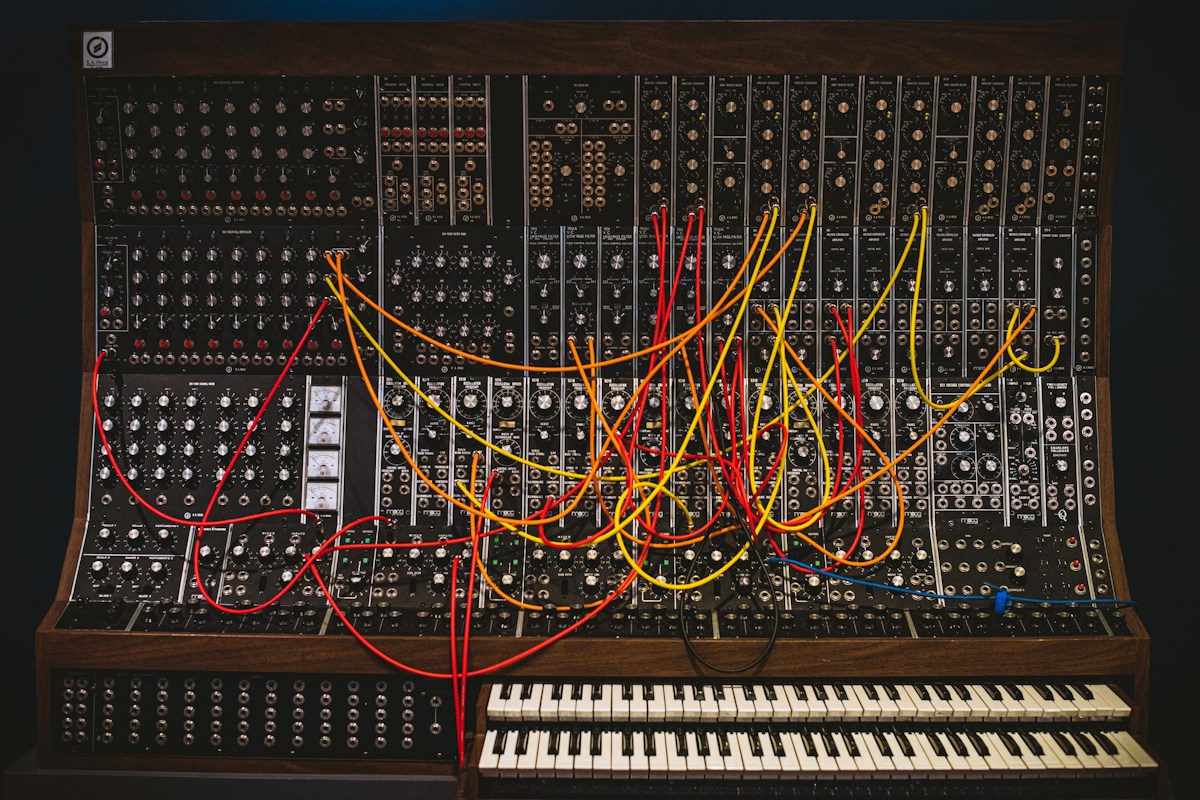
Step into a recording studio from the late 1960s, and you are confronted by a magnificent, imposing monolith of black anodized aluminum faceplates, polished walnut cabinetry, and a tangled jungle of woven nylon patch cables. In the center of this electronic tapestry, an array of voltage-controlled oscillators hums with microscopic electrical fluctuations, driven by discrete transistors and hand-soldered capacitors. When an artisan plugs a quarter-inch cable from an envelope generator into a resonant low-pass filter and depresses a key on the accompanying keyboard, the room shakes with a bass tone so deep, creamy, visceral, and harmonically rich that it rattles the listener’s ribcage. This is the unmistakable, physical voice of the Moog modular synthesizer.
Before the arrival of Robert Arthur Moog’s modular systems, electronic music was an agonizingly slow, academic discipline confined to university research laboratories and avant-garde broadcast studios. Composers spent days slicing physical magnetic audio tape, manually calculating frequency test tones from military signal generators, or programming room-sized vacuum-tube computers like the Columbia-Princeton RCA Mark II. Bob Moog fundamentally revolutionized music by introducing a single, elegant engineering paradigm: voltage control. By allowing one electrical voltage to modulate and direct another, Moog created an intuitive, playable, and infinitely expressive musical instrument.
In this definitive technical guide and historical masterclass, we explore the physics, circuit topologies, and sound design principles of the Moog modular synthesizer. We analyze the mathematics of voltage-controlled oscillators (VCOs), dissect the genius of Moog’s patented four-pole transistor ladder filter, contrast East Coast subtractive synthesis with Don Buchla’s West Coast wavefolding philosophy, and demonstrate why analog modular sound design continues to inspire a massive global revival in our digital era.
1. The Electrical Spark of Sound: Robert Moog and Voltage Control
The journey toward the modern synthesizer began not in an elite corporate research laboratory, but in a small basement workshop in Queens, New York, where young physics doctoral student Robert Moog built and sold custom vacuum-tube Theremins by mail order. Fascinated by electronic sound generation and deeply attuned to the frustrations of experimental musicians, Moog attended the 1964 Audio Engineering Society (AES) convention, where he presented a modest paper that would alter twentieth-century culture: Voltage-Controlled Electronic Music Modules.
Prior to Moog’s breakthrough, electronic sound sources were rigid and static. If a composer wanted to change the pitch of an oscillator or the cutoff frequency of a filter, they had to turn a physical potentiometer knob with their fingers or manually alter component values. Playing a rapid musical melody or dynamic vibrato was physically impossible.
Moog’s revolutionary insight was voltage control. In a voltage-controlled system, operational parameters-pitch, loudness, harmonic timbre, modulation speed-are governed directly by variable direct-current (DC) control voltages. By establishing a standardized relationship of one volt per octave (1V/Oct), Moog created a universal musical language: increasing the control voltage by exactly one volt doubled the electrical frequency of an oscillator, shifting the pitch up precisely one musical octave. Suddenly, an electronic circuit could be connected to an ordinary organ-style piano keyboard, turning abstract physics into an expressive musical instrument.
2. Electronic Music Before Moog: The Splicing Blocks of Musique Concrète
To appreciate the transformative impact of the Moog synthesizer, one must understand the grueling landscape of mid-twentieth-century electronic composition. In the 1940s and 1950s, experimental composers were divided into two main ideological camps:
Musique Concrète (Paris RTF Studio): Led by Pierre Schaeffer and Pierre Henry, this French avant-garde movement utilized recorded acoustic sounds-train whistles, spinning pot lids, human whispers-recorded onto physical disc or magnetic tape. Composers manipulated sounds mechanically by running tape recorders at variable speeds, reversing tape reels, and laboriously cutting magnetic tape with razor blades and splicing blocks. Creating a three-minute composition required weeks of meticulous physical collage.
Elektronische Musik (Cologne WDR Studio): Led by Karlheinz Stockhausen and Herbert Eimert, the German school rejected acoustic recordings in favor of pure synthetic sine-wave tones generated by laboratory test oscillators. Composers painstakingly built complex harmonic overtone structures by superimposing dozens of individual tape recordings onto a master reel.
Across the Atlantic, the Columbia-Princeton Electronic Music Center housed the monstrous RCA Mark II Sound Synthesizer-a room-sized behemoth powered by vacuum tubes and programmed via punched paper rolls. While historically groundbreaking, these systems were monumental, immovable, financially inaccessible, and completely incapable of real-time expressive live performance. Bob Moog’s modular systems dismantled these barriers, bringing immediate, tactile sound synthesis into commercial recording studios.
3. Voltage-Controlled Oscillators (VCO): Geometries of Pure Tone
At the origin of the Moog signal chain sits the Voltage-Controlled Oscillator (VCO)-the primary sound generator that converts direct-current electrical energy into raw, oscillating alternating-current waveforms. Unlike digital synthesizers that read static wave-tables stored in silicon memory, an analog VCO generates continuously variable geometric wave shapes through the charging and discharging of electrical capacitors.
The core of an analog VCO is an electronic relaxation oscillator or integrator circuit. The charging rate of the capacitor is controlled by an exponential current converter driven by the incoming 1V/Oct control voltage. The resulting core waveform is a raw sawtooth wave, which is then passed through analog waveshaper circuits to synthesize additional fundamental geometries:
- The Sawtooth Wave: Contains the fundamental frequency and ALL integer harmonic overtones (both even and odd: 1st, 2nd, 3rd, 4th, 5th…). It is bright, aggressive, buzzing, and harmonically rich-the foundational raw material for synthesizing brass, strings, and biting synth leads.
- The Square / Pulse Wave: Contains ONLY odd-numbered harmonic overtones (1st, 3rd, 5th, 7th…). It produces a hollow, woody, nasal acoustic timbre reminiscent of clarinets, oboes, and retro video game chiptunes. Moog VCOs feature Pulse Width Modulation (PWM), which dynamically alters the symmetry of the wave from 50% square to a thin 5% pulse, creating a rich, chorus-like acoustic shimmering.
- The Triangle Wave: Contains only odd harmonics, but their amplitude decays exponentially (1/n²). It sounds pure, fluty, and mellow, with subtle warmth.
- The Sine Wave: Contains only the fundamental frequency with zero harmonic overtones. It produces pure, clean acoustic energy, ideal for sub-bass rumble and clean test tones.
4. The Transistor Ladder Filter: Patent US3475623 and 24dB/Octave Magic
If the VCO is the vocal cords of the Moog synthesizer, the low-pass filter (VCF) is its soul. In 1966, Robert Moog filed patent US3475623 for what remains the most famous, copied, and celebrated electronic circuit in musical history: the Moog Transistor Ladder Filter.
The circuit architecture is an engineering masterpiece of minimalist elegance. Moog arranged four pairs of matched NPN silicon bipolar transistors in a vertical ladder configuration, connected across constant-current sources. Each transistor pair acts as an electrically variable resistor forming an active RC low-pass filter pole. The four poles combined create a steep, surgical attenuation slope of 24 decibels per octave (4-pole filter).
What gives the Moog ladder its legendary acoustic character is its non-linear behavior under audio overdrive. When audio signals from multiple VCOs are summed and fed into the filter, the input differential transistor pair is driven into gentle, symmetric tanh (hyperbolic tangent) saturation. As the input level rises, the circuit compresses the audio peaks softly, generating warm, musical, second- and third-order harmonic overtones. Furthermore, when the resonance (regeneration) control is turned up, a portion of the filter’s output is fed back into the input, causing the circuit to ring with a sharp, piercing, singing whistle at the cutoff frequency. Under extreme resonance, the ladder filter enters self-oscillation, transforming into a pure, crystalline sine-wave oscillator that tracks keyboard pitch with haunting beauty.
5. Voltage-Controlled Amplifiers (VCA) and the ADSR Envelope Generator
An unfiltered, sustained oscillator tone is an unmusical drone. To transform raw electrical oscillation into a musical note that breathes, attacks, and decays like an acoustic instrument, the synthesizer relies upon the Voltage-Controlled Amplifier (VCA) and the Envelope Generator.
The VCA is an electronic circuit whose gain (volume) is directly modulated by an incoming control voltage. To shape this volume dynamically over time, Bob Moog, collaborating with composer Herbert Deutsch, codified the four-stage ADSR Envelope Generator-a standardized temporal model that has been universally adopted across every electronic instrument, software synthesizer, and digital audio workstation in the world:
- Attack (A): The time it takes for the sound to rise from silence to its initial maximum peak volume when a key is pressed. (Fast attack for a percussive drum hit; slow attack for a swelling orchestral string pad).
- Decay (D): The time it takes for the signal to drop from the initial attack peak down to the steady sustain level.
- Sustain (S): The steady volume level at which the sound remains held for as long as the keyboard key continues to be depressed. (Unlike Attack, Decay, and Release, which are time measurements, Sustain is an amplitude/voltage level).
- Release (R): The time it takes for the sound to fade away into absolute silence once the keyboard key is released.
By routing dual ADSR envelope generators simultaneously-one modulating the VCF cutoff frequency to animate the brightness over time, and a second modulating the VCA to control the loudness-a synthesist can sculpt an infinite universe of organic, evolving acoustic textures.
6. Subtractive Synthesis: Sculpting Sound from Harmonic Granite
The operational philosophy championed by Bob Moog is known in acoustic theory as Subtractive Synthesis. The conceptual metaphor of subtractive synthesis is identical to classical marble sculpture: an artist begins with a massive, solid, dense block of raw stone (the harmonically rich sawtooth or square wave), and uses precision chisels and rasps (the resonant low-pass filter) to systematically carve away unwanted material until a beautiful form emerges.
In a standard subtractive Moog patch, two or three VCOs are tuned together to form a rich acoustic foundation. For example, Oscillator 1 might be set to a 32-foot sawtooth wave (deep bass octave), Oscillator 2 set to a 16-foot sawtooth tuned slightly sharp (+3 cents) to create a warm, animated chorusing beat frequency, and Oscillator 3 set to a square wave tuned a musical fifth above.
When this harmonically saturated signal passes into the Moog ladder filter, the filter acts as an acoustic sculptor. By lowering the cutoff frequency, the harsh, high-frequency harmonics are shaved away, leaving only the rich, warm, fundamental low tones. By modulating the cutoff with a fast envelope, the sound opens with an initial bright acoustic “bite” before settling into a warm, resonant body-mimicking the physical physics of a plucked acoustic upright bass or a struck grand piano string.
7. Modular Patching Topology: Control Voltage (CV), Gate, and Trigger Signals
Unlike modern consumer synthesizers where internal circuits are hardwired behind plastic shells, a Modular Synthesizer possesses zero fixed internal connections. A modular synthesizer is a collection of completely independent, specialized electronic instruments mounted inside a common chassis, sharing a regulated power supply.
To create a sound, the musician must physically construct the synthesizer’s internal circuit architecture using quarter-inch patch cables. In the Moog modular paradigm, electrical signals running through these patch cables belong to three distinct operational categories:
- Audio Signals: High-frequency alternating-current (AC) signals vibrating within the human audible range (20 Hz to 20,000 Hz), originating from VCOs or noise generators and traveling toward filters, amplifiers, and studio monitors.
- Control Voltage (CV) Signals: Direct-current (DC) voltages or low-frequency AC waveforms that transmit instructions to parameter inputs (such as pitch CV from a keyboard, or modulation CV from an LFO).
- Gate and Trigger Signals: Binary electrical impulses that communicate temporal timing. When a key is pressed, the keyboard outputs a continuous Gate voltage (typically +5V or +10V) that commands the ADSR envelope to remain in the Sustain stage for as long as the key is held. Simultaneously, a sharp microsecond S-Trigger (Switch Trigger) pulse is fired to tell the envelope generator to initiate its Attack stage immediately.
8. Wendy Carlos and Switched-On Bach: The 1968 Cultural Watershed
For the first four years of its commercial existence, the Moog modular synthesizer was regarded by the mainstream music industry as an expensive, esoteric sound-effects novelty for avant-garde film soundtracks (such as the sinister metallic sounds created for the 1968 film The Planet of the Apes) and psychedelic rock studio interludes (such as The Monkees and The Doors).
The watershed moment that transformed the synthesizer from an obscure laboratory curiosity into a respected classical musical instrument arrived in October 1968 with the release of Switched-On Bach, conceived, arranged, and performed by composer Wendy Carlos and producer Rachel Elkind.
Working on a custom Moog modular system in a cramped New York brownstone apartment, Carlos spent hundreds of grueling hours realizing Johann Sebastian Bach’s Brandenburg Concertos and two-part inventions entirely through multi-track electronic synthesis. Because the Moog was strictly monophonic (capable of playing only one single musical note at a time), Carlos recorded every single counterpoint voice, flute run, and harpsichord line individually onto an eight-track magnetic tape recorder, laboriously rewinding and overdubbing layer upon layer with surgical rhythmic accuracy.
The album was a monumental cultural phenomenon. Switched-On Bach topped the Billboard classical charts for over three years, won three Grammy Awards, became the first classical album in history to be certified Platinum (over one million copies sold), and convinced the global music community that electronic synthesis was an expressive, nuanced musical art form.
9. The Minimoog Model D: The Portable Monophonic Revolution
While the giant Moog modular systems (the Moog I, II, and III, and later System 55) conquered prestigious commercial studios, they were massive, delicate, and prohibitively expensive (costing upwards of ,000 in late-1960s dollars-equivalent to over ,000 today). They were impossible to transport to nightclub gigs or rock tours without a crew of specialized technicians.
In 1970, Bob Moog and a visionary team of young engineers-most notably Bill Hemsath, Jim Scott, and Chad Kelly-engineered the most influential commercial musical instrument of the modern era: the Minimoog Model D.
The engineering genius of the Minimoog was internal pre-wiring. The engineers selected the core essentials of a modular system-three VCOs, a noise generator, the 24dB ladder filter, dual ADSR contour generators, and a VCA-housed them in an iconic, hinged walnut cabinet with an integrated 44-key keyboard, and hardwired the signal path internally using front-panel rocker switches. No patch cables were required. Musicians could open the latch, plug into a stage amplifier, and unleash thunderous lead and bass sounds instantly. From the fat funk basslines of Stevie Wonder and Bernie Worrell (Parliament-Funkadelic) to the blistering progressive rock leads of Keith Emerson and Rick Wakeman, the Minimoog established the definitive acoustic vocabulary of contemporary popular music.
10. East Coast vs. West Coast Synthesis: Robert Moog vs. Don Buchla
During the mid-1960s, while Bob Moog was refining his keyboard-driven modular synthesizer on the East Coast in Trumansburg, New York, an entirely different electronic music philosophy was being forged three thousand miles away on the West Coast in Berkeley, California, by inventor Don Buchla.
The philosophical divergence between East Coast (Moog) and West Coast (Buchla) synthesis remains one of the most intellectually fascinating debates in acoustic design:
- East Coast (Moog Subtractive): Rooted in traditional Western musical structures. Features a traditional black-and-white piano keyboard, familiar 1V/Oct pitch intervals, harmonically rich oscillators (sawtooth/pulse), and resonant low-pass filters used to carve away frequencies. Moog designed instruments for musicians who wanted to play melodies, harmonies, basslines, and familiar instrumental timbres with electronic warmth.
- West Coast (Buchla Additive / Wavefolding): Rooted in avant-garde experimentalism and California counter-culture. Don Buchla adamantly refused to call his creations “synthesizers” or attach a traditional keyboard, arguing that a piano keyboard imposed seventeenth-century European musical prejudices onto a limitless electronic medium. Buchla designed touch-sensitive capacitive plates, random voltage sources (the Source of Uncertainty), and utilized Additive Synthesis and Wavefolders. Instead of filtering complex waves down, Buchla began with pure, simple sine waves and folded them back upon themselves using non-linear amplifiers, generating complex, unpredictable, metallic, and percussive organic textures.
11. Monophonic Limitations, Keyboard Prioritization, and Portamento
Early analog synthesizers like the Minimoog and modular systems were strictly monophonic: they could play only one note at a time. The physical limitation was rooted in analog circuitry: each musical voice required its own independent array of three VCOs, a VCF, a VCA, and two envelope generators. Building a truly polyphonic eight-voice analog synthesizer in 1970 would have required a machine the size of a bedroom, consuming thousands of watts of power.
Because the keyboard could only output a single pitch control voltage, engineers had to design keyboard priority logic. The Minimoog utilized Low-Note Priority: if a pianist pressed a three-note chord simultaneously, the internal circuit detected and played ONLY the lowest physical key depressed on the keyboard. This required keyboard players to master a clean, articulated, and deliberate playing technique, eliminating messy finger overlaps.
To enhance melodic expression, Moog introduced two foundational performance controls on the left cheek block of the Minimoog: the Pitch Bend Wheel and the Modulation Wheel. Furthermore, the keyboard incorporated an adjustable Portamento (Glide) circuit. Portamento introduces a calibrated lag into the control voltage path, causing the pitch to glide smoothly and continuously from one note to the next, mimicking the vocal glissando of an opera singer or the slide of a trombone.
12. Modulation Routing: Low-Frequency Oscillators and Ring Modulation
Sound synthesis achieves lifelike vitality through movement. A static electronic tone sounds artificial and dead to the human ear; real acoustic instruments fluctuate continuously in pitch, loudness, and harmonic spectrum.
To animate electronic sounds, modular synthesists deploy modulation sources:
- Low-Frequency Oscillators (LFO): Oscillators calibrated to vibrate beneath the human hearing threshold (typically 0.1 Hz to 20 Hz). Routing a slow 5 Hz sine-wave LFO to modulate VCO pitch creates expressive vibrato; routing an LFO to VCF cutoff creates rhythmic filter sweep or wah-wah; routing an LFO to VCA volume creates pulsating tremolo.
- Pink and White Noise Generators: Non-harmonic sound sources containing randomized frequency distributions. White noise contains equal energy per frequency, sounding like a rushing waterfall (used to synthesize snare drums, ocean surf, and wind). Pink noise contains equal energy per octave, providing a warmer, low-frequency rumble for volcanic explosions and thunder.
- The Ring Modulator: A specialized circuit that performs analog four-quadrant multiplication of two audio signals. The ring modulator completely cancels out the original fundamental frequencies, outputting only the sum and difference frequencies (sidebands), generating eerie, discordant, inharmonic metallic bells and the iconic, sinister robotic voice of the Daleks in BBC’s Doctor Who.
13. Analog Warmth vs. Digital Aliasing: The Physics of Voltage Drift
In modern audio engineering, what constitutes the elusive, beloved quality known as analog warmth? Why does an authentic vintage Moog synthesizer sound thick, alive, and organic, while an early digital software plugin can sound thin, flat, and sterile?
The acoustic magic of analog synthesizers is a direct consequence of physical, thermodynamic imperfection. Analog components-transistors, resistors, and capacitors-are sensitive to ambient room temperature and power-supply fluctuations. As a Moog warms up on stage, the internal junction temperatures of its silicon transistors shift by microscopic fractions of a degree. Consequently, the three oscillators never stay in mathematically 100% perfect, rigid phase alignment; they drift by 0.1 to 0.3 cents relative to one another.
This microscopic analog voltage drift causes the three sound waves to continuously slide past one another in physical time, producing rich, swirling phase cancellations and natural harmonic beat frequencies. The sound breathes like a live acoustic orchestra where three violinists play the identical note with slight, human micro-variations. Early digital synthesizers, by contrast, calculated wave pitches using rigid, locked mathematical formulas; every cycle was mathematically identical to the microsecond, producing an artificial, static sterility that the human brain quickly rejects as unnatural.
14. Krautrock, Berlin School, and Cosmic Space Music
While American musicians utilized the Moog synthesizer primarily within pop, funk, and rock structures, European electronic pioneers in the 1970s embraced the modular synthesizer as a vehicle for radical philosophical and cosmic exploration.
In Germany, the electronic counter-culture gave birth to Krautrock and the Berlin School, spearheaded by visionaries such as Tangerine Dream (Edgar Froese, Christopher Franke), Klaus Schulze, and Kraftwerk (Ralf Hütter, Florian Schneider). These artists abandoned traditional verse-chorus song forms, twelve-bar blues progressions, and traditional drum kits.
Instead, they utilized analog step sequencers (such as the Moog 960 Sequential Controller). An analog step sequencer uses a row of rotary knobs to output a repeating loop of eight or sixteen pre-set control voltages, clocking through the steps at a hypnotic tempo. By routing the sequencer to modulate VCO pitch and VCF cutoff simultaneously, German electronic artists created pulsating, hypnotic, multi-layered cosmic soundscapes that evolved gradually over forty-minute album sides. This pioneering modular sequencing established the architectural foundations of modern ambient music, Berlin techno, trance, and progressive electronic dance music.
15. The 1983 Digital Watershed: The MIDI Revolution and Analog Decline
By the conclusion of the 1970s, the golden era of analog modular synthesis was colliding with the unstoppable march of digital microprocessors. Musicians were growing frustrated with the inherent practical limitations of analog hardware: bulky cabinets that weighed hundreds of pounds, oscillators that drifted out of tune during live concerts under hot stage lights, the lack of polyphony, and above all, the total inability to save and recall sound patches. On a modular synthesizer, once you pulled out the patch cables, that unique sound was lost forever.
The turning point arrived in 1983 with two epochal technological milestones:
- The Invention of MIDI (Musical Instrument Digital Interface): Formulated by Dave Smith (Sequential Circuits) and Ikutaro Kakehashi (Roland), MIDI established a universal 5-pin digital communications protocol that allowed synthesizers, sequencers, and drum machines from different manufacturers to communicate digitally with absolute synchronization.
- The Yamaha DX7 Digital Synthesizer: Released in 1983, the DX7 utilized digital Frequency Modulation (FM) synthesis running on silicon chips. It offered full 16-voice polyphony, dozens of programmable preset memories, crystalline bell tones, and weighed a fraction of an analog synthesizer, costing only ,995.
Almost overnight, analog synthesizers were deemed obsolete relics. Moog Music collapsed into financial bankruptcy in 1986, and musicians literally threw vintage Minimoogs and modular systems into dumpsters or sold them for at pawnshops, eager to buy modern digital workstations.
16. The Eurorack Renaissance: Dieter Doepfer and the Modern Modular Boom
Just as occurred with vinyl records and silver gelatin darkroom photography, the premature declaration of the analog synthesizer’s death was shattered by a massive, grassroots cultural rebellion. By the mid-1990s, musicians were growing exhausted by the flat, sterile, menu-diving complexity of digital synthesizers. They longed for physical knobs, tactile patch cables, and the organic warmth of real analog electronics.
The catalyst for the contemporary modular renaissance arrived in 1995 when German engineer Dieter Doepfer unveiled the Doepfer A-100 system, introducing a compact, standardized modular architecture christened Eurorack. Doepfer standardized module height at 3U (approx. 5.25 inches), power distribution via ribbon cables (+/-12V DC), and replaced bulky quarter-inch phone jacks with compact 3.5mm minijacks.
The Eurorack standard unleashed an astonishing explosion of creative engineering. Today, hundreds of independent boutique manufacturers worldwide (such as Make Noise, Mutable Instruments, Intellijel, and Moog itself) produce thousands of specialized Eurorack modules, blending classic vintage analog circuits with cutting-edge digital DSP algorithms. Modern modular synthesists enjoy the best of all worlds: the limitless experimental routing of classic 1960s patch cords combined with space-age algorithmic processing, making modular synthesis the most vibrant, rapidly growing sector of contemporary musical instrument design.
17. Psychoacoustics of Resonant Filters: Why Analog Cutoffs Provoke Euphoria
The physical sensation experienced when a resonant analog low-pass filter sweeps through a harmonic frequency spectrum is one of the most universally powerful somatic responses in modern electronic music. In techno clubs, festival dance floors, and private listening sessions, a dramatic filter sweep triggers collective physical euphoria, goosebumps (frisson), and involuntary physical movement. Why?
The psychoacoustic explanation lies in how the human auditory cortex processes spectral flux and acoustic proximity. In nature, high-frequency sound waves carry low physical energy and are rapidly absorbed by air and atmospheric moisture. When a physical sound source moves closer to a human listener, its high-frequency overtones become dramatically louder; when it moves away, the highs fade, leaving only muffled low frequencies.
When an analog filter cutoff opens, flooding the ears with high-frequency harmonics, the brain’s spatial orientation circuits unconsciously interpret this spectral expansion as a massive, powerful physical object accelerating directly toward the listener at high velocity. The sharp resonant peak at the cutoff frequency stimulates the hair cells of the cochlea with localized electrical energy, triggering a rapid release of dopamine and adrenaline. The filter sweep is not merely an electronic adjustment; it is a primal neurobiological trigger of spatial excitement, power, and physical presence.
18. Sound Design Masterclass: Synthesizing Warm Analog Bass from Scratch
To ground these theoretical principles in practical musicianship, we outline the exact step-by-step patch architecture required to synthesize a classic, foundational Moog Analog Bass on any modular or subtractive synthesizer:
Step-by-Step Patch Construction:
- VCO Configuration: Set Oscillator 1 to a 32-foot (deep bass) Sawtooth wave. Set Oscillator 2 to a 16-foot Sawtooth wave. Detune Oscillator 2 slightly sharp (+2 to +3 cents) against Oscillator 1 to induce rich, organic chorusing beat frequencies. Set both oscillator volumes to 8 out of 10 in the mixer to drive the filter input into mild harmonic saturation.
- VCF Ladder Filter Settings: Turn the low-pass cutoff frequency down low to approximately 100 Hz, cutting off harsh buzz. Increase the Resonance (Regeneration) control to roughly 30% to 40% to add an expressive, vocal, rubbery bounce around the cutoff threshold.
- Filter Envelope Routing: Set the Filter ADSR Contour Generator to: Attack = 5ms (instant snap), Decay = 400ms, Sustain = 15%, Release = 200ms. Set the Filter Envelope Amount to approximately +60%. When a key is struck, the filter will instantly snap open to let through bright harmonics and then clamp down smoothly over 400 milliseconds, producing an iconic punchy “pluck-and-bloom” bass response.
- VCA Amplitude Envelope: Set the VCA ADSR to: Attack = 2ms, Decay = 600ms, Sustain = 70%, Release = 150ms. This ensures the volume tracks the punch of the filter while sustaining smoothly for held bass notes.
19. Comparative Diagnostic Matrix: East Coast (Moog) vs. West Coast (Buchla) Synthesis
To systematically summarize the philosophical, architectural, and operational distinctions between the two foundational paradigms of analog electronic music, we must contrast their core operating mechanisms across structural acoustic dimensions. Understanding these distinct design philosophies enables synthesists, sound designers, and electronic producers to navigate modular systems with intentional artistic command.
The comparative diagnostic matrix below contrasts East Coast (Moog) Subtractive Synthesis with West Coast (Buchla) Additive/Wavefolding Synthesis across foundational parameters. By evaluating primary waveforms, harmonic processing methodologies, physical human interfaces, and aesthetic results, one gains an authoritative roadmap to analog electronic sound design.
Notice that neither philosophy is superior; rather, they represent two brilliant, complementary views of the acoustic universe. While East Coast Moog synthesis excels in rich, warm melodic leads, powerful basslines, and accessible musical performance, West Coast Buchla synthesis unlocks an infinite frontier of unpredictable, percussive, organic, and cosmic sonic phenomena.
| Analytical Dimension | East Coast Synthesis (Robert Moog) | West Coast Synthesis (Don Buchla) |
|---|---|---|
| Core Synthesis Philosophy | Subtractive (Carving frequencies from rich waves) | Additive / Wavefolding (Generating complex harmonics) |
| Primary Raw Waveforms | Harmonically dense Sawtooth and Square/Pulse waves | Pure, simple Sine and Triangle fundamental waves |
| Primary Timbre Shaper | 24dB/octave Resonant Low-Pass Ladder Filter (VCF) | Wavefolder, Timbre Modulator, Low-Pass Gate (LPG) |
| Human Control Interface | Standard 12-tone tempered piano/organ keyboard | Capacitive touch plates, pressure pads, sequencers |
| Dominant Modulation Logic | Predictable 1V/Octave tracking and ADSR envelopes | Random voltages (Source of Uncertainty), cycling slews |
| Acoustic Character | Warm, fat, punchy, melodic, recognizable, singing | Percussive, organic, bongo-like, metallic, alien |
Frequently Asked Questions About Moog Synthesizers and Modular Sound Design
What does ‘voltage control’ mean in an analog synthesizer?
Voltage control means that operational parameters such as pitch, volume, and filter brightness are controlled directly by variable electrical voltages rather than manual knobs. For example, in the 1V/Oct standard, increasing control voltage by one volt shifts pitch up exactly one musical octave.
Why is the Moog ladder filter so famous and distinctive?
The Moog transistor ladder filter (Patent US3475623) uses four cascaded transistor pairs to achieve a steep 24dB/octave low-pass slope. When driven hard, the transistors enter gentle non-linear saturation, creating warm harmonic overtones and smooth resonant self-oscillation that sounds uniquely musical.
What is the difference between a modular synthesizer and a regular synthesizer?
A regular synthesizer (like a Minimoog or digital keyboard) has its internal circuits permanently hardwired. A modular synthesizer consists of independent electronic modules (oscillators, filters, envelopes) with no fixed internal connections, requiring physical patch cables to create sounds.
What does ADSR stand for in electronic music?
ADSR stands for Attack, Decay, Sustain, and Release. It is the four-stage envelope model developed by Bob Moog to describe how a sound’s volume or brightness evolves over time from the moment a key is pressed until after it is released.
What causes ‘analog warmth’ in vintage synthesizers?
Analog warmth is the result of subtle, organic physical phenomena: microscopic temperature-induced voltage drift that causes oscillators to detune slightly, analog saturation in transistor circuits, and the absence of high-frequency digital aliasing.
What is Eurorack?
Eurorack is a standardized format for modular synthesizers established in 1995 by Dieter Doepfer. It standardized module dimensions (3U height) and 3.5mm minijack connections, allowing musicians to combine modules from hundreds of different manufacturers in a single case.
What is the difference between East Coast and West Coast synthesis?
East Coast synthesis (Moog) uses keyboards and subtractive filtering of complex sawtooth waves to create warm, melodic musical tones. West Coast synthesis (Buchla) avoids traditional keyboards, using additive synthesis and wavefolding on pure sine waves to create experimental, percussive sounds.
Why was the Minimoog Model D so revolutionary?
The Minimoog Model D (1970) was the world’s first widely successful portable performance synthesizer. It packaged the essential modules of a giant modular system into an integrated, pre-wired walnut cabinet with a keyboard, making synthesizers accessible to touring rock and funk bands.
20. Honoring the Living Architecture of Voltage and Sound
In our modern era of infinite computer software plugins, where thousands of synthetic instruments can be opened with a click inside a digital audio workstation, music has achieved total convenience at the expense of tactile presence. Scrolling through pre-programmed digital presets on a computer screen often reduces sound design to passive consumer consumption.
The timeless magic of the Moog modular synthesizer lies in its demanding, rewarding physical reality. When you hold a patch cable in your hand, route a voltage through a warm copper circuit, and listen to the rich, living resonance of a transistor ladder filter, you are directly participating in the fundamental physics of electricity and sound. You are not mimicking music; you are breathing life into electrical currents, transforming raw voltage into human emotion. In the glowing dials and tangled cables of the analog synthesizer, the sacred soul of electronic music endures, vibrant, infinite, and eternally alive.

