

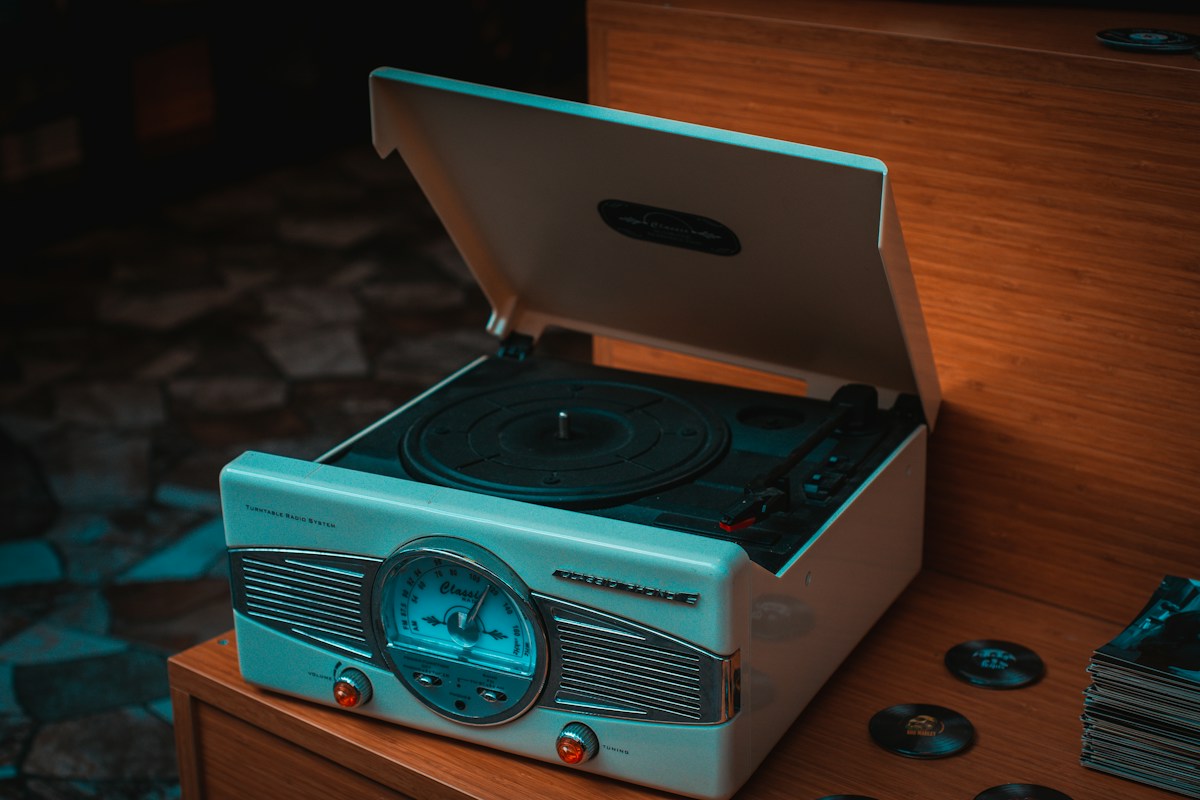
Wind the heavy cast-iron crank on the side of an oak Victor Victrola cabinet, feel the coiled spring motor tighten with immense mechanical torque, and gently lower a thick steel needle into the spinning black groove of a ten-inch shellac disc from 1927. Before the music begins, an unmistakable sound fills the room: a rhythmic, warm, physical surface hiss-the mechanical friction of steel traveling across crushed slate and insect resin at seventy-eight revolutions per minute. A fraction of a second later, through the expanding wooden acoustic horn, comes the raw, unfiltered voice of Bessie Smith or Charley Patton. It arrives without microphone preamplifiers, without digital converters, and without vacuum-tube processing-pure acoustic vibration captured by a diaphragm, etched into wax, and mechanically resurrected by a needle.
Before vinyl microgroove records conquered the modern world in 1948 and long before streaming algorithms collapsed music into weightless digital packets, humanity captured transient sound through an extraordinary era of mechanical and material innovation: the pre-vinyl age of phonograph cylinders and shellac 78s. For seven decades, between Thomas Edison’s 1877 laboratory breakthrough and the mid-twentieth century, recorded music was an intimate physical marriage of mechanical clockwork, acoustic horn physics, organic insect polymers, and heavy tracking forces.
In this comprehensive historical and engineering guide, we explore the origins, acoustic mechanics, and cultural revolutions of early sound reproduction. We trace the battle between Edison’s vertical-cut cylinders and Emile Berliner’s lateral-cut discs, analyze the organic chemistry of shellac harvested from Himalayan forests, explain the acoustic physics of exponential horn flares, and examine how the physical constraints of the three-minute 78 RPM record forged the modern architecture of the popular song.
1. The Acoustic Dawn: Thomas Edison and the Tinfoil Cylinder of 1877
On December 6, 1877, in his Menlo Park, New Jersey laboratory, thirty-year-old Thomas Alva Edison handed a crude mechanical sketch to his master machinist, John Kruesi, who assembled a device consisting of a grooved brass cylinder mounted on a threaded steel screw axle, turned by a hand crank. Edison wrapped a thin sheet of pliable tin foil around the cylinder, positioned a mica diaphragm attached to a sharp steel stylus, spoke into the mouthpiece, and recited a nursery rhyme: “Mary had a little lamb, its fleece was white as snow…”
When Edison reset the stylus to the starting groove and turned the crank again, the machine feebly reproduced his exact words. In his personal journals, Edison recorded his astonishment: “I was never so taken aback in all my life. Everybody was astonished. I was always afraid of things that worked the first time.” For the first time in the history of our species, the human voice-which had vanished into thin air since the dawn of evolutionary consciousness-had been captured as a permanent, physical indentation in solid matter, capable of speaking across time.
Edison christened his invention the Phonograph (from Greek roots meaning “sound writer”). While Edison initially envisioned the device primarily as a utilitarian dictation tool for business offices, the public immediately recognized its miraculous cultural destiny: the preservation of music, storytelling, and historical voices for future generations.
2. Hill-and-Dale Vertical Cut vs. Lateral Groove Modulation
The dawn of commercial sound reproduction was immediately paralyzed by a ferocious patent and engineering war between two incompatible methods of cutting acoustic sound into physical media: vertical modulation (hill-and-dale) and lateral modulation.
Thomas Edison championing the cylinder, and later Charles Tainter and Chichester Bell with the Graphophone, utilized the vertical cut (hill-and-dale). In this system, the recording stylus moves strictly up and down perpendicular to the surface. Quiet passages produce shallow indentations; loud passages cut deep, vertical trenches. The fundamental mechanical liability of the vertical cut was groove depth: loud low-frequency bass passages required cutting so deeply into the wax that the stylus tore the material, while extreme high frequencies lifted the playback stylus completely off the surface, resulting in severe skipping and distortion.
In 1887, German-American inventor Emile Berliner patented the Gramophone, introducing lateral modulation on a flat disc. In lateral recording, the groove remains at a constant, uniform depth below the surface. Sound vibrations drive the cutting stylus horizontally from left to right, wiggling the groove walls side-to-side. Lateral modulation was a mechanical triumph: the playback needle was firmly locked between two solid walls of the groove, preventing skips and providing tremendous mechanical leverage to drive the playback diaphragm without needing delicate balance weights.
3. The Chemistry of Wax: Carnauba, Stearic Acid, and Brown Wax Cylinders
Tinfoil was too fragile for commercial distribution; it tore after three plays and could not be mass-produced. The true commercial viability of the phonograph arrived in the late 1880s through the development of the metallic soap wax cylinder.
Despite the popular name “wax cylinder,” early records were not made from natural bee wax. They were complex chemical compounds formulated from lead stearate, aluminum stearate, carnauba wax, and ceresin. The formulation required precise chemical balancing: the material had to be soft enough at room temperature to allow a microscopic sapphire cutting tool to carve silky, whisper-quiet shavings without resistance, yet hard enough to withstand the severe downward drag of a weighted playback stylus without melting or deforming under friction.
Early Brown Wax Cylinders (1889-1901) suffered from a catastrophic economic limitation: they could not be pressed or molded. To make 500 copies of a song, a musical ensemble had to perform the song in a studio in front of a bank of ten phonograph horns simultaneously, repeat the performance fifty consecutive times, or duplicate cylinders mechanically using pantograph levers that degraded fidelity with every pass. This manufacturing bottleneck kept early cylinder prices high and limited global distribution.
4. Emile Berliner and the Flat Gramophone Disc: The Geometrical Triumph
Emile Berliner understood an elementary economic truth that Thomas Edison stubbornly resisted for decades: commercial success in consumer entertainment belongs not to the format that sounds slightly better in a laboratory, but to the format that can be mass-produced by the millions at penny-rate costs.
A cylinder was an engineering nightmare to mold: it had to be extracted from a three-dimensional hollow core, which required expanding split-molds that left seams on the playing surface. Berliner’s flat disc, by radical contrast, was a two-dimensional geometric plane. In Berliner’s system, a master recording was made on a zinc disc coated with a microscopic film of beeswax, etched in acid, and electroplated with copper to create a reverse metallic negative stamper (a “matrix”).
Using this metal matrix, thousands of identical flat records could be stamped out in hydraulic steam presses in thirty seconds, exactly like pressing waffles in an iron. Flat discs were durable, easy to store vertically in albums, took up a fraction of shelf space, and allowed high-quality paper labels to be pressed directly into the center of the disc. By 1910, Berliner’s flat disc Gramophone had decisively eclipsed the phonograph cylinder in international sales.
5. The Organic Polymer: Shellac Resin and Kerria Lacca Insects
When Emile Berliner searched for an ideal material to press his flat discs, he tested hard rubber (vulcanite) and celluloid, both of which warped easily and generated unlistenable surface hiss. In 1897, Berliner discovered the miracle polymer of the pre-modern world: shellac.
Shellac is not a synthetic plastic or petrochemical derivative; it is a natural, organic bio-resin secreted by tiny female lac bugs (Kerria lacca) that swarm in the millions along the branches of dhak and fig trees across the tropical forests of India and Thailand. The insects consume tree sap and secrete an amber protective resin encrusting the twigs (known as “sticklac”). Indigenous workers harvested the twigs, washed away impurities, crushed the resin, and melted it over charcoal fires into thin sheets of pure orange shellac.
However, a 78 RPM record was not made of pure shellac; pure shellac is flexible and expensive. A typical 78 RPM disc formula consisted of approximately 25% pure shellac resin mixed with 75% mineral fillers: finely powdered slate, limestone, barium sulfate, carbon black pigment, and microscopic cotton flock fibers to bind the mixture. The heavy mineral filler gave the record its ceramic-like weight and extreme rigidity, enabling the disc to withstand the crushing physical pressure of Victorian steel needles without gouging.
6. Acoustic Horn Recording: Singing into the Funnel
Before 1925, the electrical audio revolution had not yet arrived. There were no microphones, no vacuum-tube amplifiers, no electrical cables, and no electronic mixer consoles. The entire recording process was purely mechanical and acoustical.
In an acoustic recording studio, musicians gathered around one or more massive, tapered metal or papier-mâché recording horns suspended from the ceiling by ropes. The narrow end of the horn was connected directly to a cutting soundbox containing a thin diaphragm of mica or glass, attached to a sapphire cutting stylus resting on a rotating disc of soft warm wax.
Acoustic recording was an exercise in extreme physical exertion. Because the cutting stylus was propelled entirely by the kinetic physical energy of sound waves traveling down the horn, singers had to project their voices with operatic lung power directly into the horn’s throat. If an opera singer hit a loud high note, the recording engineer grabbed the singer’s coat collar and physically yanked them backward from the horn to prevent the needle from jumping out of the wax; during soft passages, the singer was shoved forward into the funnel. Orchestras were arranged in cramped, tiered wooden bleachers: violins were replaced by Stroh violins (wooden violins fitted with metal diaphragms and directional brass horns to direct sound into the funnel), and the tuba replaced the double bass because low acoustic bass frequencies could not drive the cutting diaphragm.
7. Spring-Motor Mechanics: Centrifugal Governors and Clockwork Torques
A phonograph or gramophone had to operate without electric wall current, as most homes in the late nineteenth and early twentieth centuries lacked domestic electrical wiring. The physical power driving the turntable platter was clockwork spring energy.
Inside the wooden cabinet sat a heavy mechanical motor powered by one, two, or four tightly coiled spiral steel mainsprings housed in brass drums. The user cranked the motor with a removable iron handle, storing immense kinetic torque. When the brake was released, the spring unwound through a gear train, driving the turntable spindle.
The mechanical genius ensuring that the record spun at a steady, unvarying pitch was the Watt centrifugal ball governor. As the motor spun, two or three weighted brass balls mounted on flexible leaf springs spun outward under centrifugal force. If the motor spun too fast, the outward expansion of the balls drew a felt friction pad against a spinning steel disc, applying immediate mechanical braking. By turning a pitch adjustment screw on the top plate, the user adjusted the governor’s braking threshold, calibrating speed. A well-maintained spring motor from 1915 remains so mechanically stable that it displays flutter and wow figures that rival consumer electronic belt-drive turntables.
8. Steel Needles and Tracking Force: The 100-Gram Gouging of Heavy Soundboxes
Modern audiophiles obsess over tracking forces measured in fractions of a gram (e.g., 1.5 to 2.0 grams on modern moving-magnet cartridges). In the 78 RPM era, playback tracking forces were measured in ounces and fractions of a pound.
An acoustic gramophone soundbox (such as the Victor Exhibition or No. 2 soundbox) was a heavy brass or pot-metal housing containing a round mica diaphragm. This soundbox was seated directly on top of the record groove, clamped to a sharp, disposable steel needle. The downward vertical tracking force was astronomical: typically between 80 and 150 grams!
Under this crushing pressure, the tiny point of the steel needle exerted thousands of pounds of pressure per square inch on the shellac groove. The mineral fillers (crushed slate) inside the shellac record were intentionally formulated to be slightly abrasive: during the first twenty seconds of play, the slate physically ground the sharp steel needle point into the exact contour of the groove. Consequently, steel needles were strictly single-use. If a user played a second record with an old needle, the flattened steel chisel edges gouged out the delicate groove walls, turning high-frequency audio into white dust. Dedicated users bought steel needles in decorative tins of 100 or 500, tossing the needle into a disposal well after every single three-minute song.
9. The 78 RPM Compromise: Why 78 Revolutions Per Minute Became Standard
In the earliest decades of disc recording, there was zero standardized playback speed. Different manufacturers cut records at whatever speed suited their mechanical motors: 72 RPM, 75 RPM, 80 RPM, or 82 RPM. An Edison Diamond Disc ran at 80 RPM; early Victor discs ran between 76 and 78 RPM. If a consumer bought a record from one label and played it on another machine without adjusting the governor, Caruso sounded like a chipmunk or a baritone.
The stabilization at 78.26 RPM was the result of electrical motor standardization in the 1920s. In the United States, alternating electrical current was standardized at 60 Hertz (Hz). When electric recording lathes were introduced, engineers powered them using synchronous AC electric motors spinning at 3,600 RPM. By connecting a standard 46-tooth worm gear to a single-thread spindle, the mathematical reduction yielded:
3600 RPM / 46 = 78.2608 RPM
In Europe, where electrical current was standardized at 50 Hertz, a 3,000 RPM motor geared through a 38-tooth reduction yielded 77.92 RPM. Over time, the industry converged on the universal shorthand “78 RPM,” establishing a global standard that governed international music releases until the mid-1950s.
10. The 1925 Electrical Recording Revolution: The Western Electric Orthophonic Era
In 1925, the acoustic era came to a sudden, screeching halt. Scientists at Bell Telephone Laboratories and Western Electric (most notably Joseph P. Maxfield and Henry C. Harrison) unveiled the Western Electric Electrical Recording System.
The electrical revolution eliminated the old acoustic horn completely. In its place came the condenser microphone, the vacuum-tube amplifier, and the electromagnetic cutting head. Instead of shouting into a funnel, a singer could stand three feet from a microphone and whisper intimately, giving birth to the art of “crooning” exemplified by Bing Crosby. The recorded frequency response, which had been crippled between 250 Hz and 2,500 Hz during the acoustic horn era, instantly expanded to 50 Hz to 6,000 Hz.
To play these magnificent new electrical recordings, the Victor Talking Machine Company introduced the Orthophonic Victrola (1925). Utilizing matched electrical-impedance analog modeling, Victor engineers designed a folded, six-foot exponential re-entrant horn concealed inside a magnificent wooden credenza. When the public heard electrical Orthophonic 78s, the realism was staggering: deep bass notes, ringing cymbals, and sibilant consonants that sounded as though living musicians were physically inside the room.
11. The Three-Minute Pop Song: How 10-Inch 78s Shaped Songwriting
Why is virtually every pop, rock, and soul single in modern history approximately three to three-and-a-half minutes in length? Why does the three-minute song structure-verse, chorus, verse, chorus, bridge, chorus-dominate global radio?
The answer is not artistic or psychological; it is an absolute physical constraint imposed by the ten-inch 78 RPM shellac record. At 78 revolutions per minute, with a coarse groove pitch of roughly 100 to 120 grooves per inch, a standard 10-inch shellac disc can physically hold only 3 minutes and 15 seconds of audio before the needle reaches the inner label margin. (A larger 12-inch disc, reserved for classical movements and operatic arias, held roughly 4 minutes and 30 seconds).
For half a century, songwriters, bandleaders, and arrangers were forced to compress their musical ideas into this strict three-minute container. An arranger had exactly 180 seconds to state the theme, showcase a concise eight-bar solo, hit the emotional chorus, and deliver a memorable finale before the groove ran out. This three-minute discipline forged the modern DNA of popular songwriting, surviving across 45 RPM vinyl singles, cassette tapes, compact discs, and Spotify streaming algorithms long after the physical shellac constraint vanished.
12. Victor Talking Machine Company and the Nipper “His Master’s Voice” Trademark
No account of early sound reproduction is complete without the world’s most famous commercial trademark: Nipper the dog listening to his master’s voice.
Painted in 1898 by English artist Francis Barraud, the original oil painting depicted his deceased brother’s terrier-mix dog, Nipper, staring quizzically into the brass horn of an Edison-Bell cylinder phonograph, listening to a recorded cylinder of his departed master’s voice. When Barraud attempted to sell the painting, Edison executives dismissed it, declaring that “dogs do not listen to phonographs.”
Barraud walked into the London offices of Emile Berliner’s Gramophone Company, where manager William Barry Owen offered to buy the painting on one condition: Barraud had to paint out the Edison cylinder machine and paint in a black Berliner disc Gramophone. Barraud agreed, and in 1900, Eldridge Johnson of the Victor Talking Machine Company purchased the American rights. The image of Nipper gazing faithfully into the brass horn beneath the slogan “His Master’s Voice” (HMV) became one of the most recognized global corporate symbols in human history, embodying the mystical, emotional power of recorded sound to conquer death and time.
13. Indestructible Cylinders: Amberols, Celluloid, and Blue Amberol Resilience
Although Emile Berliner’s flat disc dominated the mass commercial market, Thomas Edison stubbornly refused to concede defeat. In 1908, Edison countered with the Amberol Cylinder, which doubled the groove density from 100 to 200 threads per inch, expanding playing time from two minutes to four minutes.
In 1912, Edison unveiled the crowning technological summit of the cylinder format: the Blue Amberol Cylinder. Blue Amberols replaced fragile wax with a tough, brilliant blue outer skin of celluloid (nitrocellulose plastic) molded over a solid core of plaster of Paris. Blue Amberols were virtually indestructible: you could drop them on a concrete floor, step on them, or wash them under a faucet without causing damage.
Played with a permanent polished diamond stylus on an Edison Diamond Disc or Amberola phonograph, Blue Amberols delivered remarkably low surface noise and pristine audio fidelity far superior to contemporary noisy shellac discs. However, Edison’s refusal to abandon the cylinder format ultimately isolated his company, as consumers overwhelmingly preferred the ease, portability, and catalog depth of flat records.
14. Exponential Horn Physics: Acoustic Flares and Cutoff Frequencies
The iconic flaring brass or morning-glory horn of a vintage phonograph was not a decorative ornament; it was a high-precision acoustic transformer based on mathematical horn theory.
A vibrating soundbox diaphragm has a small physical surface area (roughly 2 inches in diameter) and high acoustic impedance. Ambient room air, by contrast, has low acoustic impedance. Connecting a tiny vibrating diaphragm directly to open room air results in terrible acoustic mismatch: 99% of the sound energy reflects back into the diaphragm, producing a faint, tinny, inaudible squeak.
The horn acts as an acoustic matching transformer. By gradually expanding the cross-sectional area of the sound column along an exponential mathematical curve:
S(x) = S₀ · exp(m · x)
Where S(x) represents the cross-sectional area at distance x, Sâ‚€ is the throat area, and m is the flare constant. The horn couples the high-pressure sound waves at the throat smoothly to the low-pressure air at the wide mouth, multiplying acoustic volume by hundreds of times with zero electrical amplification. The diameter of the horn mouth dictates the acoustic cutoff frequency: a small 10-inch horn cannot reproduce frequencies below 400 Hz, while a massive 30-inch horn allows deep musical fundamentals to blossom into the room.
15. Archival Preservation: The Cardinal Rules of Shellac Conservation
For modern collectors, sound archivists, and audio historians, preserving historic 78 RPM shellac records requires strict scientific discipline. Treating a shellac disc like a modern vinyl LP will result in instantaneous, catastrophic destruction of the recording:
The Cardinal Rule of Shellac: NEVER USE ALCOHOL! Modern vinyl record cleaning solutions frequently contain isopropyl or ethyl alcohol. While alcohol is completely safe on polyvinyl chloride (vinyl), alcohol is an aggressive chemical solvent for shellac. A single wipe with an alcohol-based cleaner will chemically melt and dissolve the shellac grooves, turning a valuable historical record into a sticky, unplayable smear of ruined paste.
Proper Shellac Conservation Protocols:
- Cleaning Chemistry: Wash shellac records using distilled water mixed with a tiny drop of laboratory-grade non-ionic detergent (such as Tergitol 15-S-9 or Triton X-100), rinsed thoroughly with distilled water and dried vertically on lint-free cotton towels.
- Preventing Crayon Mold: Shellac contains organic fatty acids that, when stored in humid conditions (above 55% RH), serve as food for microscopic molds and fungi, causing white spidery blooms that etch the groove walls. Store records at stable temperatures (18C to 20C) in acid-free paper sleeves.
- Vertical Storage Only: Shellac is exceptionally brittle and heavy. Never stack 78s horizontally in piles; the weight of ten records will crack or shatter the bottom discs. Always store discs vertically in heavy wood shelving with rigid vertical dividers every four to six inches.
16. Modern Archival Playback: Truncated Styli, Equalization Curves, and Optical Scanning
Playing a historic 78 RPM record on modern audiophile equipment requires specialized hardware. Attempting to play a 78 with a standard modern stereo cartridge will ruin both the record and your stylus: modern microgroove needles (0.7 mil radius) sink to the bottom of a wide 78 groove (which requires a 2.5 mil to 3.5 mil stylus), scraping along the gritty bottom trough and generating deafening noise.
Archivists utilize modern cartridges fitted with custom truncated elliptical diamond styli. The truncated tip rides comfortably along the smooth, unworn middle sidewalls of the groove, floating safely above the bottom dirt and below the surface damage caused by historical steel needles.
Furthermore, early 78s were cut before the 1954 standardization of the RIAA equalization curve. Different record companies used proprietary turnover and rolloff curves (e.g., American Columbia, Decca, Victor, European FFRR). Modern archival phono preamplifiers feature selectable analog turnover frequencies and treble rolloffs, allowing engineers to decode the exact tonal balance intended by the original recording engineer. In cutting-edge institutions like the Library of Congress, non-contact IRENE optical scanning systems use high-resolution 3D confocal microscopy to read broken, cracked, or fragile wax cylinders and shellac discs without a needle ever touching the physical groove.
17. The Cultural Resonance of 78s: Pre-War Blues, Hot Jazz, and the American Memory
The true glory of the 78 RPM era lies not in its mechanical gears or lacquer chemistry, but in the incomparable cultural treasure it preserved for human civilization. The 1920s and 1930s witnessed an explosive, unrepeatable golden age of vernacular music documented almost exclusively on 78 RPM shellac.
Field recordists from Victor, Okeh, Vocalion, and Paramount traveled across the American South with portable cutting lathes set up in hotel rooms and furniture store backrooms, recording genius musicians who had never set foot in a major city: Robert Johnson, Blind Willie Johnson, Son House, the Carter Family, Jimmie Rodgers, King Oliver, and Louis Armstrong.
Harry Smith’s legendary 1952 Anthology of American Folk Music-compiled entirely from commercial 78 RPM discs released between 1927 and 1932-sparked the global 1960s folk revival, directly inspiring Bob Dylan, Joan Baez, and the Grateful Dead. If these fragile shellac discs had not been pressed and collected, the foundational roots of modern blues, country, bluegrass, rock and roll, and jazz would have dissolved into forgotten oral myth.
18. The Collapse of Shellac: World War II Blockades and the Birth of Vinyl Microgrooves
The reign of the 78 RPM shellac record was finally brought to an end by global geopolitics and the chemistry of petroleum polymers during World War II.
In 1941, Japanese military expansion across Southeast Asia and naval blockades in the Bay of Bengal severed Allied shipping routes from India. Raw shellac became a critically rationed strategic military material, urgently needed for munitions waterproofing, electrical insulator coatings, and military aviation varnishes. Commercial record pressing plants were cut off from supplies, forcing record companies to institute nationwide scrap drives, asking citizens to turn in old, unwanted 78s to be melted down into re-pressed wartime discs.
Desperate for alternatives, chemical engineers turned to synthetic petroleum plastics, discovering polyvinyl chloride (PVC). Vinyl was flexible, lightweight, virtually unbreakable, and possessed a microscopic grain structure hundreds of times smoother than mineral-filled shellac. In 1948, Columbia Records engineer Peter Goldmark unveiled the 33 1/3 RPM Long Playing (LP) Microgroove record. Capable of holding twenty-three minutes of noise-free, high-fidelity music per side, the vinyl LP rendered the heavy, brittle, three-minute shellac 78 instantly obsolete. An epoch had concluded, but the physical voice of the acoustic dawn had been etched forever into human history.
19. Comparative Diagnostic Matrix: Cylinders vs. Shellac 78s vs. Vinyl Microgrooves
To systematically summarize the technical, material, and acoustic evolution across the golden age of physical sound recording, we must contrast each historic recording format across structural physical dimensions. Understanding these foundational parameters enables sound archivists, vinyl collectors, and audio historians to trace the technological journey from nineteenth-century tinfoil to mid-century high-fidelity vinyl.
The comparative diagnostic matrix below contrasts Wax/Celluloid Cylinders, Shellac 78 RPM Discs, and Modern Vinyl Microgroove (LP) Records across foundational physical criteria. By evaluating physical substrate, groove modulation, rotation speed, playing duration, frequency response, and tracking forces, one gains an authoritative roadmap to sound reproduction history.
Notice how tracking force plunged from 100 grams down to 1.5 grams as playback styli evolved from disposable steel spikes into precision-polished diamond tips. This radical reduction in mechanical wear transformed sound recording from an abrasive, destructive physical encounter into an enduring archival art form.
| Format Medium | Primary Material Composition | Groove Modulation Type | Standard Rotation Speed | Typical Playing Time | Standard Playback Tracking Force |
|---|---|---|---|---|---|
| Wax / Celluloid Cylinder | Metallic soap wax or celluloid over plaster core | Vertical (Hill-and-Dale) cut | 120 – 160 RPM | 2 to 4 minutes maximum | 20 – 40 grams (Sapphire/Diamond) |
| Shellac 78 RPM Disc | 25% insect shellac resin + 75% slate/filler | Lateral groove modulation | 78.26 RPM (Standard) | 3 minutes 15 seconds (10-inch) | 80 – 120 grams (Disposable steel) |
| Vinyl Microgroove (LP) | Pure Polyvinyl Chloride (PVC) plastic | Lateral (Mono) or 45/45 Stereo | 33 1/3 RPM | 22 to 25 minutes per side | 1.25 – 2.0 grams (Elliptical diamond) |
Frequently Asked Questions About Phonograph Cylinders and Shellac 78s
Are 78 RPM records made of vinyl?
No. Vintage 78 RPM records produced prior to the 1950s were made from a brittle, heavy composite of natural shellac resin (secreted by Asian lac insects) mixed with powdered slate, limestone, and carbon black. Only a few late-era 78s in the 1950s were pressed on vinyl.
Can I play a 78 RPM record on a modern vinyl turntable?
Only if your turntable supports 78 RPM speed AND you install a dedicated 78 RPM stylus (typically 3.0 mil radius). Playing a 78 with a standard modern microgroove needle (0.7 mil) will ruin the cartridge and produce awful sound, as the needle scrapes along the bottom grit of the wide groove.
Why should I never clean a shellac record with alcohol?
Alcohol is an aggressive chemical solvent for natural shellac. Wiping a shellac record with rubbing alcohol or standard vinyl cleaning fluids will instantly melt and dissolve the groove walls, turning the surface into a ruined, sticky paste.
Why did people change needles after every single song on antique phonographs?
Antique acoustic phonographs used heavy tracking forces of 80 to 120 grams. The abrasive mineral fillers in the shellac wore the point of the steel needle into a flat chisel shape after playing one three-minute record. Playing a second record with that needle would gouge the groove walls.
Why were early pop songs limited to three minutes?
A standard 10-inch shellac 78 RPM record could only physically hold roughly 3 minutes and 15 seconds of audio before running out of surface space. Songwriters and bands had to compose within this strict time limit, establishing the three-minute pop song format that persists today.
What is the difference between vertical cut and lateral cut records?
In vertical-cut records (Edison cylinders and Diamond Discs), the needle moves up and down like hills and valleys. In lateral-cut records (Victor and Columbia 78s), the groove stays at a constant depth and wiggles from side to side, which was much more durable and reliable.
How were records made before microphones were invented?
Before 1925, recording was completely mechanical. Musicians performed directly into large conical acoustic horns that concentrated sound waves onto a thin mica diaphragm, which physically vibrated a cutting needle carving directly into warm wax.
Who was Nipper the dog in the famous Victor trademark?
Nipper was a real mixed-terrier dog living in England, painted by artist Francis Barraud in 1898 listening to a cylinder phonograph of his deceased master’s voice. The painting was purchased by the Gramophone Company and Victor, becoming the iconic ‘His Master’s Voice’ trademark.
20. Resurrecting the Acoustic Soul of Human Memory
In our modern era of impermanent cloud storage, algorithmic playlists, and disposable audio streams, the heavy shellac 78 and the fragile wax cylinder stand as profound monuments to the enduring physical reality of human culture. When you hold an authentic shellac disc from 1925 in your hands, you are holding a physical vessel that captured the literal breath, sweat, and acoustic energy of artists who walked this earth a century ago.
These ancient pre-vinyl artifacts remind us that recorded music was once a courageous, miraculous endeavor: artists singing with all their physical might into brass funnels, cutting needles carving physical grooves into warm wax, and listeners gathering around polished wooden horns to hear the voices of the living and the dead. As that steel needle traces the spinning black groove and the surface hiss gives way to timeless song, the past returns to life, vibrant, tangible, and forever preserved in the sacred matter of our shared history.

